Music And Muse: How Pianists And Writers Share The Same Creative Energy
In relation to music, writers are divided into two groups – those who are comfortable working in silence, completely immersed in their fantasies, and those for whom a suitable soundtrack significantly helps to withdraw into themselves.
May 22, 202543.5K Shares726.1K Views
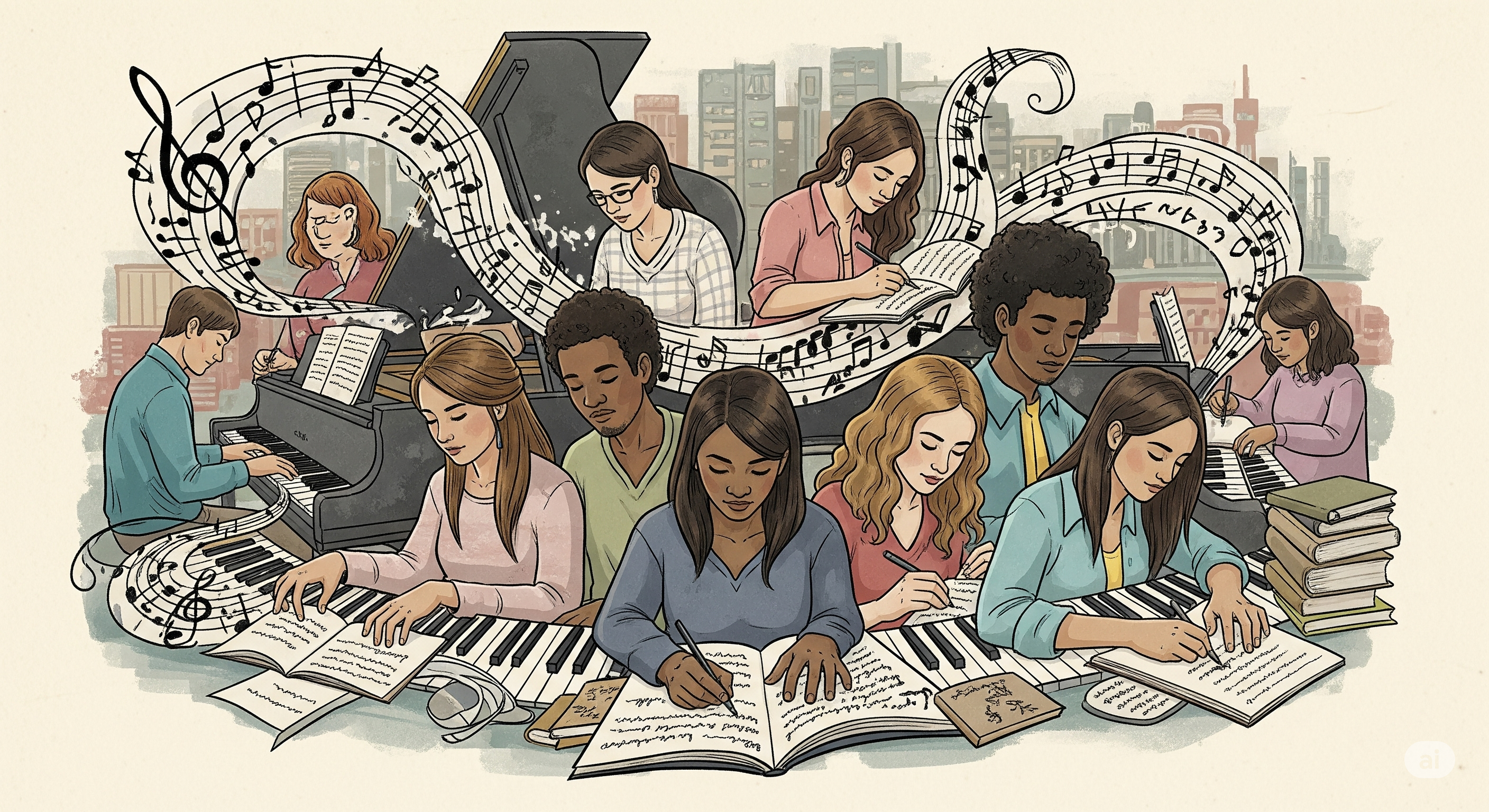
In relation to music, writers are divided into two groups – those who are comfortable working in silence, completely immersed in their fantasies, and those for whom a suitable soundtrack significantly helps to withdraw into themselves. Music periodically helps me, but in two cases – when I need to tune in to writing or when I need to set a rhythm for myself to do edits, and then delve into the text (no matter what is playing, I no longer hear it). In percentage terms, it's about 50/50, i.e., I write half of the text in silence, and in the other half of the work, music helps.
Using music correctly when writing texts comes with experience. For example, if you are a student and you need to write an essay, the wrong music will only distract you. And if you don’t know how to focus at all, then it’s better to use the professional writing servicesof experts. They can write you a paper on any topic.
Music and Writing
Music that you enjoy listening to and music that is comfortable for writing are different things. Moreover, music that evokes strong emotions in itself or is interesting for its composition will most likely be distracting. Other principles are used to select music for writing.
Out of curiosity, I googled to see how things are for others. People like different music, but a pattern immediately emerges. Music for writing lyrics is either movie/game soundtracks because they are background and atmospheric at the same time, or ambient/post-rock that allows you to dissolve into the music, or rhythmic electronics that give momentum, or classical instrumentals/imitations of classical music.
Japanese author Haruki Murakami almost always listens to music on vinyl. The writer has a huge collection of records – about 10,000 of them! In some articles, journalists even write that there are 40,000 of them. And every day, Murakami tries to listen to jazz for at least ten hours, but this is not the only genre that interests the writer. The author loves both Bach and The Beatles – in particular, he listened to their song "Norwegian Wood" on a player many times while sitting in a pub and working on the novel "Norwegian Wood." You can do like Haruki Murakami and start collecting vinyl for full immersion. But no one has cancelled CDs either! The Japanese writer says that he does not disdain them either. And he is right – after all, sometimes just looking at the box with the album cover, you can catch the muse.
Creative Writing Prompts with Music
I came across an article called Five Bands You Should Be Writing To, where the author suggests writing to Pink Floyd's Dark Side of the Moon, Mogwai, The Future Sound of London, Isis, and early Autechre albums. It's a very unusual set, but it's interesting how it reflects the writer's different needs:
- Rhythm to get into it
- Atmosphere to change the mood
- Music with a minimum of distraction to keep going.
The author uses Mogwai and Isis as examples of dramatic, over-the-top post-rock that pulls out all the guts. I find excess emotion distracting, but if things are stuck, it can push me forward with its frenzy. Isis is essentially a hybrid of metal and post-rock.
How to Write a Music Review
A music review is, first of all, the most important tool in the world of literature, music, and art in general. Therefore, it plays a key role in the development of authors, the improvement of their works, and informing a wide audience about new music.
A music review is the analysis of music albums or individual compositions. It naturally looks at the melody, lyrics, arrangement, and overall quality of the performance. Writing a review is a creative and analytical process that requires attention to detail and critical thinking. Therefore, here are a few steps that will help you write a quality music review:
- Getting to know the material. Before you start writing a review, carefully listen to the work you are reviewing. For example, listen to an album several times to get a full understanding of it.
- Make notes. While listening to music, take notes on important aspects that should be included in the review. First of all, pay attention to the melody, lyrics, arrangement, etc.
- Review structure. Start your review with a short introduction, where you will introduce the work you are reviewing and its author. Then move on to the main part, where you will analyze various aspects of the work in detail. Of course, finish the review with conclusions, where you will summarize your impressions and give recommendations.
- Objectivity and argumentation. Try, above all, to be objective in your assessment. Support your opinion with specific examples from the work. Of course, avoid unnecessary emotional statements, focusing on facts and arguments.
- Style and speech. First of all, write clearly and understandably, and avoid complex constructions and special terms if they are not necessary. Remember that the review should be interesting and understandable to the reader.
Of course, writers and pianistsuse different tools in their work. When a musician learns how to write a song, they use their means; when a writer wants to write a book, they use theirs. However, music can become a muse for both because it can evoke creativityand help in writing, whether it is writing a song or a text.
Latest Articles
Popular Articles