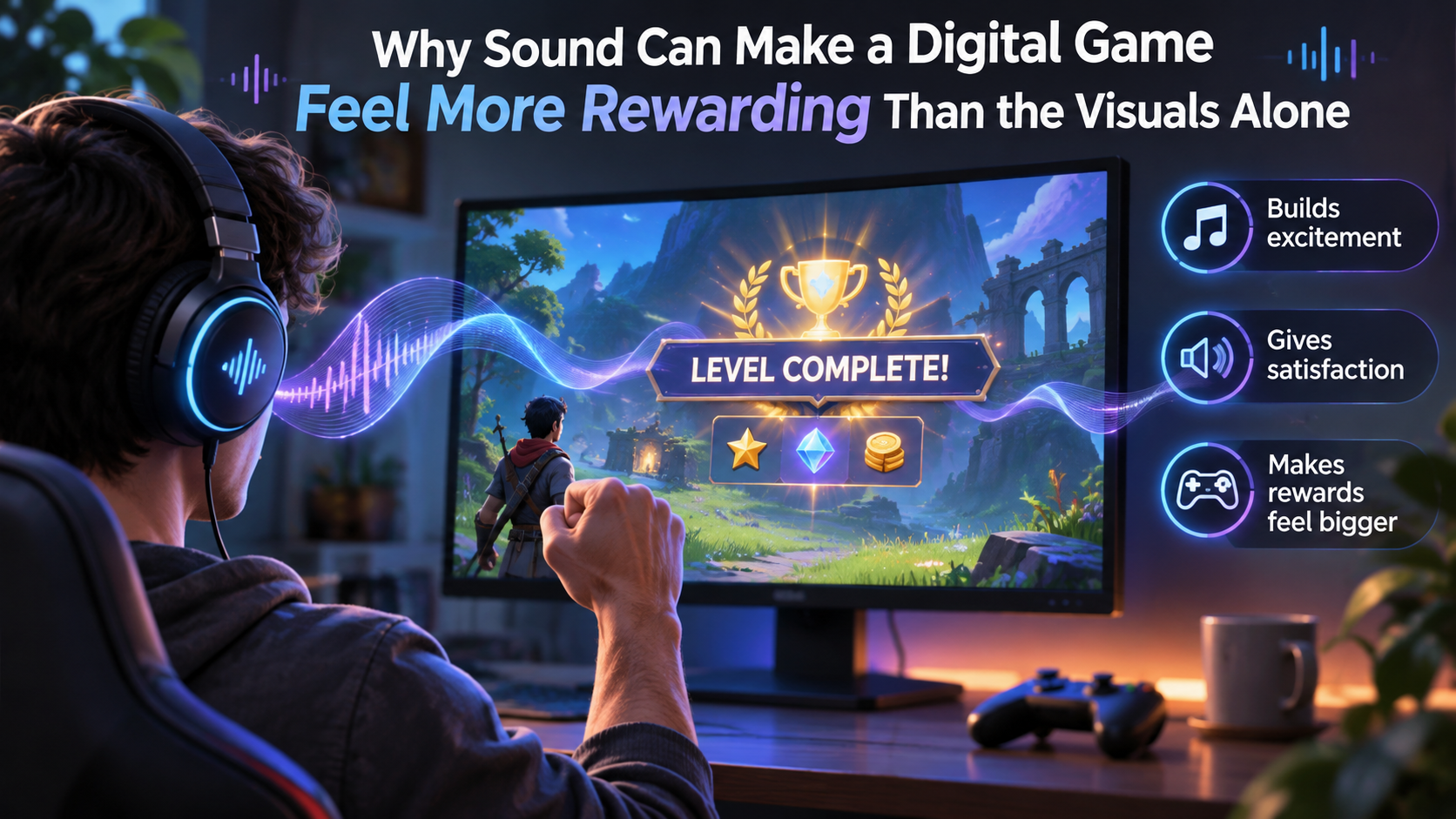
The graphics of a digital game are of course the first thing a player notices, and they need to be attractive in their own right, or else new users won’t stick around for long. However, good games take their time to engage all the senses, and the audio has the potential to do more of the heavy lifting in triggering the brain’s reward response than the visuals. Here’s why.
Speed Is Everything
We process the sounds we hear faster than the things we see. That’s a scientifically proven fact. So when a digital game uses sound cues to evoke an emotion, they’ll earn the desired response in less time than if visuals alone are doing the work.
The iGaming sphere provides endless examples of this. When a player at a Canada online casinohits a jackpot, the first hit of dopamine they get won’t be triggered by the flashy graphics celebrating their win, but by the sound effects and upbeat music that kicks in.
Audio Impacts Game Feel
We’ve had force feedback in games for decades, but most digital titles aren’t able to take advantage of this. So, sound stands in to increase the tactility and weight of the game experience without needing rumbles and vibrations.
For instance, a heavy sword swing accompanied by a deep, bass-heavy whoosh and a metallic crunch tricks the brain into feeling resistance and force. Without that audio, the exact same animation feels like waving a weightless cardboard cutout.
Even in games that aren’t action-oriented, it makes a difference. You’ll find SFX accompanying menu interactions and other UI elements just to give players a better cue that their input has been registered.
Immersion Is Improved
Digital games are generally limited to presenting players with visuals on a flat screen, meaning their view is limited to what’s in front of them, with all the limitations of FOV and depth of field that come with it. Conversely, sound can be deployed to create the sense of being in a fully realized world that surrounds the player, enabling a much more immersive experience. And if the player is wearing headphones, that’s all the better.
Memories Are Made
Classic games and their modern counterparts are united by one thing, and that’s the memory-making power of sound effects and music. Digital games that use their own little jingles to celebrate a victory make fond memories in players, just as retro titles did in the 80s and 90s.
Moreover, these audio-forged memories are more immediately evocative than any visual aspect of the game. Being able to recall in-game sound and share it years later easily surpasses the idea of describing how a particular graphical detail looks.
In short, the moment to moment aspects of a digital game’s design that are most rewarding can indeed stem from the sound choices to a greater degree than the visuals. And that rewarding feeling will last long after the play session has ended, living on in the memories of the people who played the game.