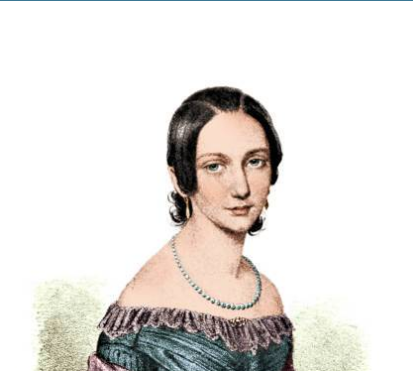
Clara Josephine Wieck was born on September 13, 1819, in Leipzig, Saxony (then part of the German Confederation). She grew up in a musical family: her father, Friedrich Wieck, was a prominent piano teacher and music merchant, and her mother Mariane (née Tromlitz) was a noted singer (soprano) and pianist.
When Clara was about five years old, her parents divorced, and she and her two younger brothers (Gustav and Alwin) remained in their father’s custody. Friedrich Wieck’s strict and ambitious approach shaped Clara’s early years. He chose the name “Clara” (meaning “bright” or “famous”) as a sign of his high hopes, and he personally managed her education from that point.
Clara’s schooling was conducted at home under private tutors rather than in a public school. Her father insisted on a broad curriculum: in addition to intense musical study, he ensured Clara learned languages (English and French) and even followed a regimen of physical exercise and daily walks.
Her musical training began almost as soon as she could walk. At age four she started piano lessons with her mother, and as her ability became apparent, her father took over her instruction. From about age five onward, Friedrich Wieckplanned a rigorous program of daily piano study and theory for Clara.
Under her father’s tutelage, Clara studied piano, music theory, and even composition as a child. Contemporary accounts note that as a child she took hour-long piano lessons each day and often practiced for two or more hours daily, reflecting the intensity of her training. This early, focused education in a highly musical household with constant encouragement from her parents laid the foundation for Clara’s subsequent development as a pianist and musician.
| Aspect | Details |
| Full Name | Clara Josephine Wieck |
| Date of Birth | September 13, 1819 |
| Place of Birth | Leipzig, Saxony |
| Family Background | Born into a musical family |
| Parents | Friedrich Wieck and Mariane Wieck |
| Parental Divorce | Around age five |
| Childhood Custody | Lived with her father |
| Lived with her father | Home education |
| Languages Studied | Languages Studied |
| Musical Training Start | Early childhood |
| Piano Instruction | Trained by her father |
| Practice Routine | Practice Routine |
Career Beginnings
Clara Wieck (later Clara Schumann) launched her public music career as a child prodigy. At age nine she made her concert debut in Leipzig’s Gewandhaus and quickly became an in-demand piano soloist across Germany.
By 1835 she was an established artist: that year she premiered her own Piano Concerto in A minor, performing it with the Leipzig Gewandhaus Orchestraunder the direction of composer Felix Mendelssohn. These early successes set the stage for a long career as a concert pianist and composer.
International Breakthrough
| Region / Period | Highlights |
| Paris (1839) | Gained international critical attention |
| Russia (1844) | Performed in St. Petersburg and Moscow |
| Britain (from 1856) | Became a regular and highly regarded concert artist |
| England Tours | Completed numerous tours with extensive concert schedules |
| Purpose of Touring | Promoted her own career and her husband’s music |
| Result | Established reputation as a leading European virtuoso |
Schumann’s renown soon spread beyond her native Saxony. In 1839 she toured Paris, giving public concerts there and attracting critical notice.
A few years later she traveled with her husband to Russia, appearing in St. Petersburg and Moscow in 1844 and introducing many Russian audiences to her husband’s music.
By the mid-1850s she was also a favorite in Britain. Her first English tour in 1856 included dozens of concerts in London (as well as performances in Manchester, Liverpool and Dublin), marking her debut on the British musical scene. These international tours confirmed her status as a leading European virtuoso.
Major Performances & Concert Highlights
Clara Schumann built her reputation on memorable recitals and chamber performances. As an adult she set new standards for concert pianists, often playing entire programs from memory.
Her recitals promoted contemporary music: she frequently programmed works by her husband Robert Schumannand by the younger Johannes Brahmsalongside established repertoire by Bach, Mozart and others.
A major highlight of her career was the extensive duo partnership with violinist Joseph Joachim. Over many years they gave more than 230 concerts together in Germany and England, becoming especially celebrated for their performances of Beethoven’s violin sonatas.
In the years after Robert Schumann’s death she returned to the concert stage with renewed vigor, often touring with Joachim and maintaining a high performance schedule. Her final public recital took place in March 1891 in Frankfurt, concluding a public career that had lasted over six decades.
Recordings & Discography
Although Clara Schumann lived before recording technology existed, her own compositions have since been widely recorded and published. Her compositional output includes several major works.
Notably, she completed a Piano Concerto in A minor, Op. 7 (premiered 1835), and later wrote a Piano Trio in G minor, Op. 17 (1846).
She also composed lieder (songs) and character pieces for piano. Among her last compositions were two sets of Romances, solo piano pieces (Op. 21) and violin piano duets (Op. 22), both written in 1853.
In recent decades these works have been issued on modern recording labels. For example, the Gewandhaus Orchestra’s 2019 anniversary performance of her Piano Concerto (conducted by Andris Nelsons) was released on CD.
Many pianists and chamber ensembles have also recorded her solo piano musicand songs, often as part of complete editions devoted to her work.
Awards & Professional Recognition
| Year | Recognition |
| 1838 | Appointed court pianist in Vienna |
| 1838 | Elected to Vienna’s Gesellschaft der Musikfreunde |
| 1887 | Awarded Honorary Membership by the Royal Philharmonic Society |
| Historical Significance | One of the most formally recognized pianists of the 19th century |
Schumann received several honors acknowledging her musical achievements. Early in her career she was recognized by the Austrian imperial court: in 1838 she was made a court pianists and was elected to Vienna’s prestigious Gesellschaft der Musikfreunde (the Friends of Music society).
Decades later, her lifetime of artistry was honored in England. In 1887 the Royal Philharmonic Society in London awarded her an Honorary Membership in recognition of her services to music.
(She was only the second pianist to receive this honor, following Mendelssohn.) These formal recognitions reflected her status as one of the foremost musicians of her time.
Collaborations With Orchestras & Conductors
Throughout her career Schumann worked with the leading orchestras and conductors of 19th-century Europe. She regularly appeared as soloist with the Leipzig Gewandhaus Orchestra for instance, Mendelssohn conducted her Piano Concerto debut there in 1835.
She also performed under the batons of noted conductors. In 1851 she gave a concert in Cologne conducted by her husband Robert Schumann, and she appeared at major German festivals (such as the Niederrhein Festival in Düsseldorf) that featured orchestral accompaniment.
In England, the Royal Philharmonic Society sponsored her concert seasons in London, placing her as featured soloist with local orchestral forces.
In chamber music settings she collaborated closely with leading instrumentalists: her long-time duo with Joseph Joachim blended violin and piano, and she often shared the stage with artists like Clara Novello(soprano) and Pauline Viardot(mezzo-soprano). These partnerships ensured that her performances ranged from grand orchestral showpieces to intimate chamber works.
Recent Career Activity
Clara Schumann’s last public appearances came in the late 1880s and early 1890s. She gave her final recital in 1891 and then largely retired from the concert stage.
She spent her remaining years teaching at Frankfurt’s Dr. Hoch Conservatory and preserving her husband’s legacy. She passed away in 1896, bringing her six-decade-long career to a close.
Since then, her legacy has been celebrated by musicians and historians. In recent years, ensembles and soloists have revived her compositions for example, marking her 200th birth anniversary in 2019 with performances and recordings of her music.
This continued interest in Schumann’s work reflects the lasting impact of her artistry on the classical music world.
Clara Schumann Performance Highlights
- Child prodigy debut:Clara Schumann gave her first public performance at age nine in 1828 at Leipzig’s Gewandhaus. She toured with her father across Germany and Paris as a child virtuoso. An extended tour in Austria earned her the honorary title “K.k. Kammervirtuosin” (court chamber virtuoso) in Vienna by 1837.
- Major tours with Robert Schumann:Between 1840 and 1854 she appeared in at least 139 concerts with husband Robert Schumann. Those joint tours brought her to major music centers including Northern Germany, Russia in 1844, Vienna in 1846, and the Netherlands in 1853, and helped introduce Robert’s music to international audiences.
- Solo touring career:After Robert’s death in 1856 Clara Schumann resumed intense solo touring. She made nineteen concert tours of England between 1863 and 1873 to support her family, and continued to perform widely across Europe including Germany, Scandinavia, and France, often filling major concert halls.
- Repertoire and recital style:Her programs emphasized mature Romantic works. She largely abandoned youthful showpieces in favor of full sonatas and cycles by Mozart, Beethoven, Chopin, Mendelssohn, Brahms, Bach, and Schumann. Clara pioneered the modern piano recital and was among the first soloists to dispense with orchestral or ensemble accompaniment and played most programs from memory.
- Key collaborations:Clara Schumann performed with leading orchestras and artists. In 1883 she played Beethoven’s Choral Fantasy and Robert Schumann’s Piano Concerto with the newly founded Berlin Philharmonic Orchestra. Even in her late 60s and 70s she drew packed houses and at age 70 a Berlin recital of Chopin’s F minor concerto was acclaimed for its power, fire, and freshness. She also frequently performed alongside violinist Joseph Joachim and at major festivals, further cementing her reputation.
- Career longevity and influence:Over a six decade concert career from 1828 to 1888 Clara Schumann gave more than 1,300 public performances across Europe. She dominated the nineteenth century piano stage longer than any other artist, and her advocacy of Romantic repertoire helped establish many works as concert standards.
- Final recital:Clara Schumann’s last public concert took place on 12 March 1891 in Frankfurt, five years before her death. This performance closed out a landmark career marked by virtuosity and musical insight.
Clara Schumann’s Piano Style And Interpretation
Technical Approach And Piano Control
Clara Schumann’s pianism combined strong virtuosity with disciplined control. Her technique was both assured and flexible: she mastered scales and arpeggios with even precision and a variety of articulations. Her training emphasized a relaxed wrist and even finger action, developing a “fine touch” that made the tone as beautiful as possible.
She rigorously practiced passages in all articulations and dynamics (staccato, legato, piano, forte, crescendos, etc.) at varying tempi. Reviewers noted this balance of dexterity and control – one London critic described her Beethoven playing as “masterly and intellectual” – reflecting a performer who blended formidable technique with careful execution.
Tone, Touch, And Sound Color
Observers often praised the elegance and singing quality of Schumann’s tone. Her touch on the keyboard was refined and responsive, produced by a loose, well-coordinated wrist motion. She achieved a warm, transparent sound without relying on heavy hand pressure or exaggerated pedal effects.
In fact, she was known to use the sustain pedal sparingly and judiciously, ensuring that her lines remained clear and the overall sonority never became muddy. This careful pedaling and the focus on a “beautiful” tone resulted in a sound palette that could be both shimmering and richly expressive, yet always clean and well-defined.
Rhythm, Phrasing, And Structural Clarity
Clara Schumann’s phrasing was noted for its clarity and cohesiveness. Critics remarked that under her hands, every musical phrase “stood out sharp and clear”. She maintained solid rhythmic steadiness, often practicing with strict counting to instill precise timing.
This attention to pulse and structure allowed her to shape lines organically without undue hesitations or artificial flexibility. As a result, listeners found her interpretations coherent and architecturally sound: long passages unfolded with logical continuity, and inner voices were brought out without obscuring the principal melody.
In short, her rhythmic approach served the music’s form, highlighting clear cadences and transitions so that the structure of each work was apparent even in complex pieces.
Interpretative Approach To Repertoire
Schumann’s interpretative ethos centered on fidelity to the composer’s intentions. She was a noted proponent of “Werktreue” (faithfulness to the work), subduing personal excess in order to realize each composer’s vision.
In practice this meant she often adopted stylistic traits associated with a composer: one 1856 review noted that her performance of Mendelssohn’s variations was played “in the manner of the great composer himself”. Her repertoire covered Baroque to Romantic works (Bach, Scarlatti, Mozart, Beethoven, Schubert, Mendelssohn, Chopin, Brahms, and Robert Schumann among others), and she treated each style with appropriate sensitivity.
For example, she approached Bach and Classical-era sonatas with clean articulation and clear counterpoint, while her Romantic pieces were imbued with poise and depth. Even when premiering contemporary works by her husband or by Brahms, her interpretations remained measured and sincere, intended more to serve the music than to showcase her own personality.
Balance Between Precision And Expression
Across her playing, Schumann achieved a balance of technical precision and emotional expression. Contemporary accounts highlight that she combined heartfelt lyricism with intellectual poise.
Her sound could be powerful and full-bodied, yet never heavy-handed: one critic lauded the “extraordinary power and facility” of her playing, noting that her interpretations kept each phrase distinct and expressive. At the same time, listeners often commented on the sincerity of her musical communication and the purity of her melodic lines.
In performance she avoided mechanical rigidity by subtle use of dynamics and slight inflections, but these never distorted the underlying tempo or form. Overall, she was commended for bringing warmth and nuance to pieces without sacrificing clarity or control – a combination that became a hallmark of her style.
Critical Observations And Musical Identity
Modern scholars and critics alike emphasize Clara Schumann’s reputation for interpretative integrity. She embodied the 19th-century ideal of faithful rendering of the score, often being viewed as a model of performer reverence for the composer.
Her playing was celebrated for its disciplined honesty: as one commentator later summarized, audiences remembered the “clarity” and “sincerity” of her approach. This meant her performances were neither indulgently sentimental nor purely academic; instead they reflected a mature personal voice grounded in respect for the music.
In critical retrospect, Clara Schumann’s musical identity rests on this fusion of precision and passion. She is remembered as a pianist whose every interpretation was deliberate and deliberate, revealing the essential character of the piece while still conveying genuine emotion. Through these qualities – crystalline technique, expressive tone, and unwavering text fidelity – Clara Schumann left a legacy as one of Romanticism’s defining pianists, an exemplar of thoughtful, composer-centered artistry.
Clara Schumann Net Worth
At the time of her death in 1896, Clara Schumann’s net worth is estimated to have been between $100,000 and $1 million. However, this figure comes from an unverified online source and no major financial publication confirms a specific number. Schumann earned her living as a celebrated Romantic era pianist and composer.
Over a six-decade career she toured widely, giving piano recitals, and beginning in 1878 taught at the Dr. Hoch conservatory in Frankfurt, providing income from concert appearances, teaching, and publishing music. She supported herself through these musical activities rather than through business ventures or investments.
FAQs
1. Who Was Clara Schumann?
Clara Schumann was a 19th-century German pianist, composer, and teacher, widely regarded as one of the greatest pianists of the Romantic era. She had a public concert career spanning more than sixty years across Europe.
2. What Is Clara Schumann Best Known For?
Clara Schumann is best known for her influential concert career, her interpretations of works by Beethoven, Robert Schumann, and Brahms, and for helping establish the modern piano recital. She also composed piano works, chamber music, and songs.
3. Was Clara Schumann A Child Prodigy?
Yes, Clara Schumann was a recognized child prodigy who began performing publicly at age nine. Her early career was carefully managed by her father, Friedrich Wieck, a prominent piano teacher.
4. Did Clara Schumann Compose Music?
Clara Schumann composed a range of works, including a Piano Concerto, piano pieces, chamber music, and songs. Although her output was limited by family and touring responsibilities, her compositions are now regularly performed and recorded.
5. How Did Clara Schumann Influence Classical Music?
Clara Schumann influenced classical music by promoting serious concert programming, performing from memory, and advocating for Romantic composers. Her performance standards shaped piano interpretation well beyond the 19th century.