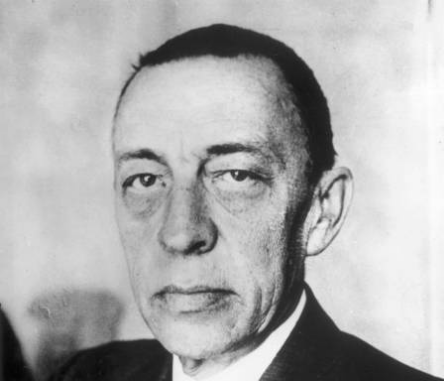
Sergei Vasilyevich Rachmaninoff was born on March 20 (Old Style) [April 1, New Style] 1873 at the Oneg estate near Semyonovo in northwestern Russia. He belonged to an aristocratic family of the Russian gentry. His father, Vasily Arkadievich, was a retired army officer, and his mother, Lyubov Petrovna, was the daughter of a general.
The family estate (held by his maternal grandparents) lay on the shore of Lake Ilmen in the Novgorod district. Music was part of Rachmaninoff’s early life, but the household fortunes declined: his father lost the family’s wealth through risky investments and ultimately left the family.
These hardships forced Rachmaninoff’s mother to move with her children into more modest living quarters, first in St. Petersburg and later in Moscow, during his youth.
From childhood Rachmaninoff studied piano. He began lessons at home – first with his mother and then with the pianist Anna Ornatskaya. Noting his ability, his older cousin, the pianist Aleksandr Siloti, arranged for the boy to study with the strict teacher Nikolay Zverevin Moscow.
In 1883, at about ten years old, Rachmaninoff was enrolled at the Saint Petersburg Conservatory. (His early teachers there included Ornatskaya and Gustav Kross.) After a family tragedy (the death of a sister) and related difficulties, he was transferred in 1885 to the Moscow Conservatory.
In Moscow he studied piano under Zverev and also received a full course of general musical education. Rachmaninoff completed his conservatory studies in 1892, graduating at age 19.
Throughout his childhood and schooling, Rachmaninoff grew up in a world steeped in music. His family’s Russian Orthodox faith and his grandmother’s influence exposed him to church services and chant, and his studies with teachers like Ornatskaya and Zverev gave him a rigorous foundation in piano and theory.
| Aspect | Details |
| Birth | Born on March 20 (Old Style) / April 1 (New Style), 1873, at the Oneg estate near Semyonovo in northwestern Russia. |
| Family Background | Born into an aristocratic Russian gentry family; his father was a retired army officer and his mother was the daughter of a general. |
| Childhood Environment | Grew up in a household where music and Russian Orthodox traditions were part of daily life. |
| Family Hardship | His father lost the family’s wealth through failed investments and later left the family. |
| Early Piano Training | Began piano lessons at home with his mother and later with pianist Anna Ornatskaya. |
| Advanced Instruction | His cousin Aleksandr Siloti arranged for him to study with Moscow teacher Nikolay Zverev. |
| Formal Education | Enrolled at the Saint Petersburg Conservatory in 1883 and transferred to the Moscow Conservatory in 1885. |
| Graduation | Completed his studies in 1892, graduating at the age of 19 with top academic recognition. |
Career Beginnings
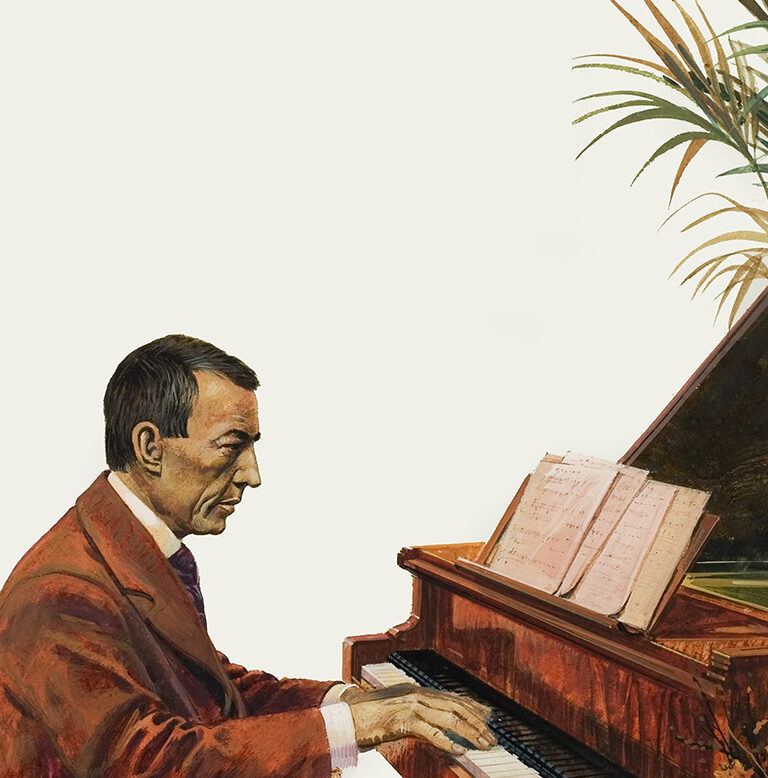
Sergei Rachmaninoff’s career took off in the 1890s with early achievements as both composer and pianist. In 1892 he won the Moscow Conservatory’s top prize by composing the one-act opera Aleko, and that same year his Piano Prelude in C-sharp minor became an instant popular success.
These early triumphs (including the opera examination win) earned him a gold medal at graduation. He balanced composing and performing from the start: in the mid-1890s he worked as a pianist and church organist in Russia and gave concerts throughout the country.
By the late 1890s he had established a reputation at home as a virtuoso performer of his own piano works, setting the stage for a dual career as concert pianist and composer.
International Breakthrough
Rachmaninoff’s international profile grew rapidly around the turn of the century. By 1899 he was already recognized beyond Russia he conducted a London concert of his own orchestral works while also performing as pianist. In 1901 he completed his Second Piano Concerto (Op. 18), which became one of his signature works.
Over the next decade he toured extensively, performing his piano concertos in Europe and expanding his reputation. His first trip to America in 1909 was a turning point: he appeared with Leopold Stokowski and the Philadelphia Orchestra, conducting his Second Symphony and playing solo piano works, and earned rave reviews.
In subsequent years he returned to international touring regularly. These engagements including concert appearances in major European capitals and annual tours of the U.S. cemented Rachmaninoff’s status as a world-class artist. At the same time, he continued to compose major works (like the Prelude in B-flat minor, his Third Piano Concerto in 1909, and his choral symphony The Bellsin 1913) that further boosted his fame abroad.
Major Performances & Concert Highlights
| Aspect | Details |
| Early International Exposure | Conducted a concert of his own works in London in 1899. |
| American Debut | First toured the United States in 1909, performing with the Philadelphia Orchestra. |
| Rachmaninoff Festival | In 1939, the Philadelphia Orchestra held a three-city festival celebrating his career. |
| Final Orchestral Premiere | Symphonic Dances premiered in January 1941 with Eugene Ormandy. |
| Final Performances | His last public concert was in May 1942; final recital took place in February 1943. |
Throughout his career Rachmaninoff gave numerous high-profile concerts. Notable highlights include premieres of his own works and commemorative festivals. In the late 1930s, for example, the Philadelphia Orchestra organized a three-city “Rachmaninoff Festival” (1939) to celebrate the 30th anniversary of his American debut.
The 66-year-old composer appeared in multiple concerts at New York’s Carnegie Hall and Philadelphia’s Academy of Music, performing as piano soloist in his concertos and conducting the final program of his Third Symphonyand the choral symphony The Bells. Contemporary accounts hailed the festival as “one of the outstanding musical events of all time,” and Rachmaninoff himself remarked in private correspondence that the festival “seems to be, for some reason, a ‘totaling of the sum’” of his career.
In January 1941 he led the premiere of his last orchestral piece, Symphonic Dances, with the Philadelphia Orchestra under Eugene Ormandy. He made his final public concert appearance in May 1942 (playing the Second Piano Concerto), and gave his last recital in February 1943 in Knoxville, Tennessee.
Besides these milestone events, Rachmaninoff was a constant recitalist and concerto soloist. He introduced new works in performance whenever possible, often premiering his own compositions as soloist (with orchestra) or as conductor.
His tours typically featured all his major piano concertos and solo pieces. In Russia he held prominent posts (for instance, serving as conductor at the Imperial Opera, Moscow, in the 1900s) and led his own works in concert halls.
Internationally he appeared regularly with the Chicago Symphony and in London, Berlin, and other capitals, always showcasing his lush, virtuosic style. Over four decades his performances drew critical acclaim and filled concert halls, making him a household name in classical music.
Recordings & Discography
| Aspect | Details |
| Recording Career Start | Signed with the Victor Talking Machine Company in 1920. |
| Piano Concertos | Recorded all four piano concertos and the Rhapsody on a Theme of Paganini. |
| Conducting Recordings | Conducted recordings of Isle of the Dead, Vocalise, and Third Symphony. |
| Legacy | His recordings have been reissued and are considered benchmarks of Romantic pianism. |
Rachmaninoff was also an early recording artist. In 1920 he signed with the Victor Talking Machine Company (later RCA Victor) and began an extensive studio career. During the 1920s and 1930s he recorded for the acoustic (and later electrical) recording media, laying down piano rolls and disc recordings that preserve his playing.
Notably, he recorded all four of his piano concertos and the Rhapsody on a Theme of Paganini(1934) as pianist with conductor Leopold Stokowski and the Philadelphia Orchestra. He also recorded a wide range of solo piano repertoire, including his own preludes, études, and transcriptions, as well as works by Chopin, Liszt and others.
In addition, Rachmaninoff often conducted recording sessions. With the Philadelphia Orchestra he made influential recordings of orchestral pieces: for example, his own Isle of the Deadand Vocalise(both in 1930) and his Third Symphony(1939).
Many of these historic sessions have been reissued in modern times on CD and digital platforms. Today his complete recorded legacy is celebrated as a benchmark of Romantic-era pianism: collections of “Rachmaninoff’s Complete Recordings” are widely available, allowing listeners to hear his interpretations firsthand.
Awards & Professional Recognition
During his life and posthumously, Rachmaninoff received abundant professional acclaim. He was honored by music societies and audiences around the world, even if formal prizes in that era were fewer. Critics and contemporaries often noted his exceptional success.
Composer and critic Virgil Thomson famously wrote that Rachmaninoff “received world-wide acceptance and acclaim” in his own lifetime as a composer, conductor, and pianist. By the late 1930s, Rachmaninoff had become, arguably, the most successful living composer of his generation in terms of public popularity and concert frequency.
He was celebrated by peers; for instance, the Philadelphia Orchestra’s Eugene Ormandy praised Rachmaninoff as “one of the greatest musicians in the history of music making.” (Ormandy even sent condolences to Rachmaninoff’s family in 1943, calling the composer an “honest friend” of the orchestra.)
Rachmaninoff’s music has continued to earn recognition: many of his compositions (like the Second Piano Concerto and Rhapsody on a Theme of Paganini) have entered the canonical repertoire and even received later honors such as inductions into various halls of fame.
His enduring popularity with audiences has ensured that decades of retrospectives, complete cycle recordings, and international awards in his name keep his legacy alive.
Collaborations With Orchestras & Conductors
Rachmaninoff forged significant collaborations with orchestras and conductors throughout his career. In Russia, he served as conductor of the Imperial Opera (Bolshoi) in Moscow (1904–1906) and later had associations with the Saint Petersburg and Kiev orchestras.
After emigrating, he developed an especially close partnership with the Philadelphia Orchestra. With Leopold Stokowski, Philadelphia’s conductor in the 1920s, Rachmaninoff premiered several major works: Stokowski led the premieres of Rachmaninoff’s Fourth Piano Concerto and the Three Russian Songs(both in 1927) and later introduced the Rhapsody on a Theme of Paganini(1934) and Third Symphony(1936).
When Eugene Ormandysucceeded Stokowski, the partnership continued: Ormandy premiered Symphonic Dances(1941) and was integral to the 1939 Rachmaninoff Festival. Rachmaninoff frequently cited the Philadelphia players’ excellence, writing that recording with that orchestra was “as thrilling an experience as any artist could desire” and calling them “the finest orchestral combination in the world.”
He also worked with other leading American ensembles; he performed and recorded two concerts with the Chicago Symphony Orchestra (1941) and declined formal directorships in Boston and Cincinnati to focus on performing.
In Europe, Rachmaninoff appeared with the London Symphony and Royal Philharmonic orchestras, and was conducting assistant at times for orchestras led by his mentors (acting briefly under Alexander Glazunovin St. Petersburg).
As a pianist and conductor, he maintained friendships with many famous conductors his concerts on tour often included conductors who specialized in Russian repertoire but his primary collaborative legacy rests with the Philadelphia Orchestra under Stokowski and Ormandy, which premiered and recorded a large portion of his late oeuvre.
Recent Career Activity
Though Rachmaninoff passed away in 1943, his musical career remains active through performances, recordings, and commemorations. In recent years institutions worldwide have celebrated his legacy.
Notably, the 150th anniversary of his birth (2023) inspired numerous tributes: concert halls featured festivals of his music, and new recordings were released. In January 2023 pianist Yuja Wangperformed all four of Rachmaninoff’s piano concertos and the Paganini Rhapsodyin marathon concert series at Carnegie Hall and with the Los Angeles Philharmonic, under the baton of Gustavo Dudamel.
The Philadelphia Orchestra also presented Rachmaninoff cycles that season, with Yannick Nézet-Séguinconducting and Wang as soloist, covering all his concertos and the Rhapsody. Churches and festivals organized special events too a Saint Thomas Church concert in New York in September 2023 marked the anniversary by presenting the complete Études-Tableauxin one program.
Scholarly and media projects have further renewed interest in his work: the Sergei Rachmaninoff Foundation has digitized materials from his Swiss estate (Villa Senar) and even released an augmented reality app so the public can virtually visit his studio. A documentary film about Rachmaninoff’s life (called Rachmaninoff Reborn) premiered on PBS in 2025, underscoring the composer’s enduring appeal.
Sergei Rachmaninoff – Performance Highlights
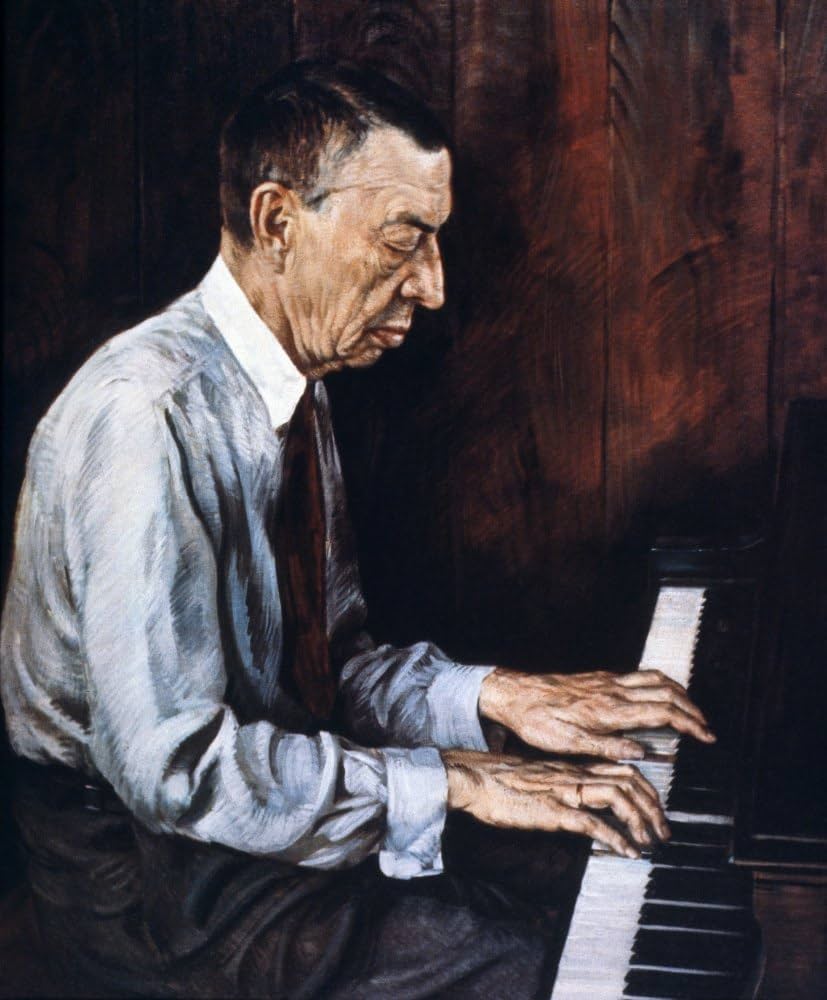
- Early career:Served as conductor at Moscow’s Bolshoi Theatre (1904–1906)before launching his first major U.S. concert tour in 1909.
- Extensive touring:After relocating to New York in 1918, he concentrated on public performances – touring frequently across North America and Europe. In total he gave about 1,643 concerts(including over 1,020 in the U.S./Canada).
- Carnegie Hall staple:Maintained a 33-year association with Carnegie Hall (1909–1942), giving 44 solo piano recitals and 49 concerto performances there. These appearances were major events, often to sold-out audiences.
- Major premieres:As soloist he debuted key works – he premiered his Piano Concerto No. 3on Nov 28, 1909 in New York (with Walter Damroschconducting), and later performed it under Gustav Mahler (Jan 1910).
- Final concerts:In his last performances (Feb 11–12, 1943) he joined the Chicago Symphony to play Beethoven’s First Piano Concerto and his own Rhapsody on a Theme of Paganini. His final public recital took place Feb 17, 1943 in Knoxville, Tennessee.
Sergei Rachmaninoff’s Piano Playing Style And Interpretation
Technical Approach And Piano Control
Rachmaninoff’s pianism combined extraordinary physical capacity with refined technique. He possessed enormous hands and explosive arm weight, yet his movements were famously economical and controlled. Witnesses describe him remaining almost motionless at the keyboard while executing enormous leaps and rapid runs.
He employed a full-arm technique – often playing melodies from the forearm or upper arm – which allowed him to sustain both pianissimo and fortissimo sounds with uniform control. At the same time his fingerwork was agile and articulate. As one colleague noted, his fingers were “like quicksilver, with such rapidity, expressiveness and incisiveness,” punctuated by “small accents, little electric shocks” of dynamics.
This combination of arm weight and finger dexterity gave him seamless control of touch across registers. His execution could be blisteringly fast yet perfectly clean – he “played very fast, terribly fast at times,” yet never at the expense of clarity. In sum, Rachmaninoff’s technique fused power and precision: he could thunder massive chordal passages or navigate intricate filigree with equal authority, because each gesture emerged from a calm, anchored technique rather than brute force.
Tone, Touch, And Sound Color
Rachmaninoff cultivated a vast and luminous tonal palette. His singing legato and warm “voce” quality earned admiration from colleagues and critics. Even in his loudest passages, the tone retained a rounded, forward projection rather than a forced thud. For example, one analyst notes that his sound “sometimes has an edge but is never forced, always rounded,” producing a powerful yet musically blended fortissimo.
He was praised for maintaining a perpetual “pearl-like luminescence” in the piano’s voice: his softest pianissimos still resonated with depth, and his climaxes shimmered rather than shouting. In performance he often treated the piano like an orchestra: beneath the main theme he implied multiple inner voices by subtle dynamic shading, giving the accompaniment a rich, orchestrallike sonority.
These hidden layers of sound were carefully balanced – Rachmaninoff ensured the principal melody always sang out, with the “listener’s ear” directed to the top line even while inner voices remain alive. Critics emphasize that he achieved a remarkably broad coloristic range through small changes in touch: Josef Hofmann said Rachmaninoff had “fingers of steel and a heart of gold,” reflecting both his robust attack and the warm, golden glow of his tone.
In sum, his touch could be ultralucid or rock-solid as needed, and he was able to blend colors so that complex textures emerged in vivid yet natural relief.
Rhythm, Phrasing, And Structural Clarity
Rachmaninoff’s rhythmic approach balanced expressive freedom with architectural logic. He never sacrificed the overall form for momentary gesture. Analysts of his recordings (both as pianist and conductor) note his playing combined “complete expressive freedom and utterly compelling structural clarity and momentum”.
In practice this meant his rubato – though often quite daring – always served the music’s large-scale design. He would subtly stretch or compress phrases, creating the sense of speech-like ebb and flow, yet maintain a clear pulse. As one commentator observes, Rachmaninoff’s use of “Tempo rubato” was a disciplined tool: it allowed the music to “breathe with lyrical life” without losing its line, pulse, or narrative thread.
He treated each phrase as an organic whole: long notes would unfold in a single breath of line, and climactic points were reached with natural inevitability. Inside this flexibility, the architecture remained evident. Rachmaninoff had an “absolute command of architecture” in performance – even when his tempos were fluid, the work’s form and key motifs stayed coherent.
He also managed multiple simultaneous lines without confusion, keeping the principal tune prominent. In other words, he wove inner counterpoints into the fabric of the music, but never at the expense of the main melody. This careful balance ensured that no matter how freely he phrased an individual passage, the overall structure and climactic shape of the piece were always maintained.
Interpretative Approach To Repertoire
Rachmaninoff’s interpretative choices reflect his Romantic temperament and pianistic strengths. He was highly selective in repertoire. He favored composers whose music lay “naturally under the fingers,” such as Chopin, Liszt, Grieg, Beethoven and Schumann.
He famously avoided Mozart and Brahms in his programs, finding them either pianistically unidiomatic or temperamentally distant; one chronicler notes he “all but ignored” Mozart and played “almost no Brahms”. Instead, his concert programs were anchored in virtuosic Romantic works and his own compositions.
Within that frame, though, he could apply a broad interpretive palette. He performed early Classical works (e.g. Mozart variations, a Beethoven sonata) with musical authority, and even “took liberties in Chopin and Schumann that I would not dare take”. In other words, whenever he encountered standard repertoire, he filtered it through his own style: Istomin reports that Rachmaninoff played Mozart and Beethoven “as though it were Rachmaninoff,” giving each work a romanticized sweep.
He also had a limited but genuine interest in contemporary music: he played select late-Romantic and Impressionist pieces. For example, he included Debussy and Ravel in recitals (calling them “novelties”) and even devoted some concerts to the music of his younger colleague Alexander Scriabin.
Notably, he could learn difficult new works very quickly – he once mastered Scriabin’s challenging Fantasy in a matter of days for a fundraising concert. However, he generally refrained from avant-garde repertoire, reflecting his personal taste and strengths. Overall, Rachmaninoff approached any piece – whether his own or another’s – with a Romantic sensibility and a deep respect for the text.
His goal was always to project the work’s emotional core and formal unity, even if that meant shaping the phrases in his own characteristic way.
Balance Between Precision And Expression
Rachmaninoff’s artistry is often praised for the perfect equilibrium between technical precision and heartfelt expression. His virtuosity never felt gratuitous or showy; rather, every note had purpose. Critics of his recordings note that there is “not a trace of indulgence” – his performances are impeccably clear, with every detail under tight control.
At the same time, they brim with passion and nuance. One reviewer contrasts his style with cruder performances: Rachmaninoff handled ferocious chordal sections with “sleight-of-hand deftness and tantalising restraint,” whereas less subtle pianistsmight simply batter the passage into submission. Likewise, even when attacking a final climax, he usually maintained clarity and bloom rather than blur.
His dynamic shadings were nuanced – he punctuated phrases with “small accents” that energized the line without distorting it. In short, nothing in his playing seemed arbitrary: his lightning runs, thunderous chords and lush arpeggios were always precisely articulated and carefully voiced.
But technical exactitude was never an end in itself for Rachmaninoff – it served expressive depth. The rich, dramatic character of the music always remained paramount. As one contemporary noted, Rachmaninoff projected an “overpowering eloquence” born from his beautiful tone and the “depth of feeling he projected,” so that even the fastest virtuosic displays felt deeply passionate.
Critical Observations And Musical Identity
Commentators have consistently observed that Rachmaninoff’s style epitomized the highest Romantic ideals combined with professional discipline. Pianist Eugene Istomin called him “undoubtedly the greatest pianist I have ever heard,” praising the unique blend of raw power and lyric finesse in his sound.
Others remarked on the humility of his stage demeanor: Istomin vividly recalls Rachmaninoff at the keyboard “absolutely impassive, like Jascha Heifetz,” with all “fire and passion” emerging from the music itself rather than any physical display. This high-minded integrity comes through in every performance: he never resorted to empty mannerisms or emotional excess.
His tone was famed for its beauty and sincerity – Rubinstein even idealized Rachmaninoff’s “golden” sound – yet tone production was a means to serve phrasing and form, not an end. In many ways, Rachmaninoff’s musical identity is inseparable from his style: by refining and projecting the late-Romantic tradition at its zenith, he becomes nearly synonymous with it.
His playing conveyed a vast, genuine emotional world in strict alignment with the score. As modern critics note, even when Rachmaninoff was at his most free-spirited in tempo or color, the result was always “maximum clarity and impact” rather than vagueness.
Listeners remember him as a consummate artist who married technical authority to soulful poetry: powerful yet warm, precise yet poetically pliant. This enduring perception reflects the factual legacy of his technique and interpretation as witnessed by those who heard him and studied his records.
Sergei Rachmaninoff Net Worth
At the time of death, Rachmaninoff’s net worth was estimated between $0.7 million and $1.0 million. He built his wealth through a successful concert career, touring internationally as a pianist and commanding high fees for performances.
In the 1920s–30s he was among the highest-paid piano soloists. He also composed popular works and earned royalties whenever his music including his famed piano concertos and Rhapsody on a Theme of Paganiniwas performed.
After fleeing Russia in 1917 (which cost him much inherited wealth), his extensive touring and composition royalties still left him a sizable estate by 1943.
FAQs
1. Who Was Sergei Rachmaninoff?
Sergei Rachmaninoff was a Russian-born composer, pianist, and conductor, widely regarded as one of the last great figures of the Romantic era. He is best known for his piano concertos, symphonies, and solo piano works.
2. What Are Sergei Rachmaninoff’s Most Famous Compositions?
His most famous works include Piano Concerto No. 2, Piano Concerto No. 3, Rhapsody on a Theme of Paganini, and the Prelude in C-sharp minor. These pieces remain staples of the international concert repertoire.
3. Why Is Sergei Rachmaninoff Considered An Important Composer?
Sergei Rachmaninoff is important for preserving and advancing late Romantic musical traditions during a time of rapid stylistic change. His music is valued for its emotional depth, technical brilliance, and distinctive melodic style.
4. Was Sergei Rachmaninoff Also A Professional Pianist?
Yes, Sergei Rachmaninoff was one of the leading concert pianists of his time. He performed extensively across Europe and North America and was especially known for his interpretations of his own works.
5. How Did Sergei Rachmaninoff Earn His Income?
Sergei Rachmaninoff earned income primarily through concert performances, conducting engagements, and recording contracts. He also received royalties from performances and publications of his compositions.
6. When Did Sergei Rachmaninoff Die, And What Was The Cause Of His Death?
Sergei Rachmaninoff died on March 28, 1943, in Beverly Hills, California, shortly before his 70th birthday. The cause of death was metastatic melanoma, a form of skin cancer.