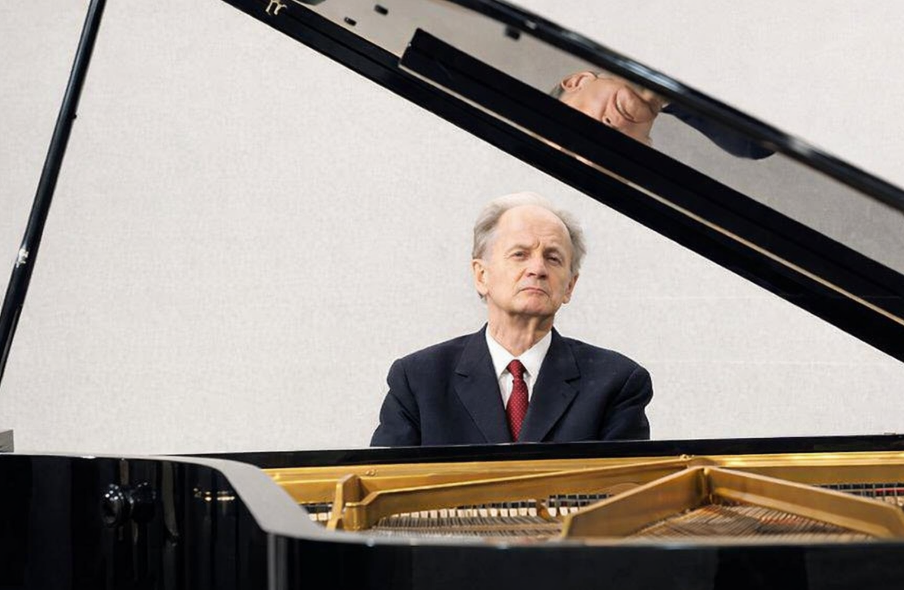
Wilhelm Walter Friedrich Kempff was born on 25 November 1895 in Jüterbog, a town in Brandenburg, Germany. His family relocated to nearby Potsdam when he was young, after his father (also named Wilhelm Kempff) took a position as a church organist there.
The Kempff family had deep roots in church music: both his father and his grandfather served as Lutheran church organists and cantors, and the household was noted for its musical tradition.
From the beginning, Kempff was immersed in music at home. He received his first lessons from his father around age five and began formal piano instruction at six years old with local teacher Ida Schmidt-Schlesicke.
His precocious talent earned him a scholarship to continue his studies in Berlin by the time he was nine. At that young age he enrolled at Berlin’s Hochschule für Musik (Berlin Academy of Music) to study piano and composition.
There, he studied composition and piano under prominent teachers; Heinrich Barth (a former pupil of Hans von Bülow) was one of his piano instructors.
Kempff’s education combined both advanced musical training and general schooling. As a teenager he attended the Viktoriagymnasium (a secondary grammar school) in Potsdam to complete his general education.
Around age 18 he returned to Berlin to finish his music studies at the Hochschule, while also taking courses at the university in related academic subjects such as music history and philosophy.
By the end of his student years, Kempff had built a strong foundation in both musical and academic studies, underpinned by the church-music heritage of his family.
| Aspect | Verified Details |
| Birth Date | 25 November 1895 |
| Birthplace | Jüterbog, Brandenburg, Germany |
| Family Background | Long tradition of church music |
| Father | Lutheran church organist |
| Grandfather | Organist and cantor |
| Childhood Home | Childhood Home |
| First Music Training | Learned music from his father |
| Piano Studies Begin | Started piano at age six |
| Early Piano Teacher | Ida Schmidt-Schlesicke |
| Piano Instructor | Heinrich Barth |
| Death Date | 23 May 1991 |
| Age at Death | 95 years |

wilhelm kempff plays beethoven's Moonlight sonata complete song.wmv
Career Beginnings
Kempff’s professional career began with rapid early successes. In 1916 he toured with the Berlin Cathedral Choir as an accompanist on organ and piano, and a year later he gave his first major solo recital in Berlin, a program including Beethoven’s “Hammerklavier” Sonata and Brahms’s Paganini Variations.
In 1918 he made his debut with the Berlin Philharmonic under conductor Arthur Nikisch, firmly establishing him as a concert pianist. Over the next few years he continued touring in Germany and Scandinavia and in 1924 became director of the Stuttgart Academy of Music.
After a five-year tenure in Stuttgart, he returned to Potsdam in 1929 to open his own piano school.
International Breakthrough
By the 1930s Kempff had built an international reputation, especially through his Beethoven interpretations. He toured extensively, performing across Europe, Scandinavia, the Far East and the Americas.
In 1934 he flew to Buenos Aires on the Graf Zeppelin for a South American tour, and from 1936 onward he regularly gave recital tours in Japan. After World War II he also began concert tours to North America, making him a globally recognized artist.
His breakthrough abroad was marked by successful performances in Europe, Asia and the Americas during this period.
Major Performances & Concert Highlights
Kempff’s recitals were often ambitious in scope, combining late Beethoven sonatas with works by Schubert, Liszt or Brahms. He frequently programmed entire cycles of Beethoven’s 32 piano sonatas in concert, ultimately performing complete Beethoven cycles over fifty times in his career.
One notable highlight was his London recital debut at Wigmore Hall in 1951, where at age 56 he played Beethoven’s Sonata Op. 111, Schubert’s Sonata D. 960 and Liszt’s Deux Légendes.
In 1964 he made his long-awaited United States debut at Carnegie Hall, an event noted at the time for his celebrated Beethoven interpretations. Another career highlight was his tour of South America in 1934, arriving in Buenos Aires as a celebrity via the Graf Zeppelin.
Kempff continued to perform publicly well into old age; according to reports his final concert appearance took place in Paris in 1981.
Recordings & Discography
| Aspect | Verified Details |
| Recording Label | Long-term exclusive artist for Deutsche Grammophon |
| Recording Career | Spanned more than six decades |
| Beethoven Sonatas | Recorded the complete cycle three times |
| Beethoven Concertos | Recorded all five piano concertos twice |
| Other Repertoire | Recorded major works by Schubert, Brahms, Schumann, and Bach |
| Special Projects | Produced piano transcriptions of Bach organ works |
| Landmark Release | 1960s stereo Beethoven sonata set widely acclaimed |
Kempff maintained a lifelong recording partnership with Deutsche Grammophon, beginning in 1920. Over a six-decade recording career he issued complete cycles of the Beethoven piano sonatas (recorded three times) and twice recorded all five Beethoven piano concertos.
His recordings include definitive versions of many core Romantic works: the bulk of Schubert’s piano sonatas and major Schumann and Brahms piano works can be found in his DG catalog.
He also produced albums of transcriptions, notably his own piano arrangements of Bach organ music. The mid-1960s DG stereo set of the complete Beethoven sonatas, in particular, is often cited as a landmark recording.
Awards & Professional Recognition
Kempff’s artistry was recognized by several honors. Early in his career he won two prestigious Mendelssohn Prizes in Berlin, one for piano performance and one for composition.
As a composer he gained acclaim as well; in 1932 he was elected to the Prussian Academy of Arts.
Throughout his life he was celebrated as a leading interpreter of Beethoven and Schubert, and his recordings and teaching continued to influence generations of pianists.
Collaborations With Orchestras & Conductors
Kempff frequently appeared as soloist with leading orchestras under renowned conductors. He maintained a decades-long association with the Berlin Philharmonic, debuting with that orchestra under Arthur Nikischin 1918 and later recording concertos with them.
Notably, his Beethoven piano concerto cycles were recorded with the Berlin Philharmonic under conductor Ferdinand Leitner. He worked with many other major conductors of his time ( the composer-conductor Wilhelm Furtwänglerpremiered Kempff’s Second Symphony in 1924).
In chamber music settings he collaborated with prominent artists such as violinists Henryk Szeryngand Yehudi Menuhinand cellist Pierre Fournier; Menuhin admired Kempff’s playing as a “supreme integration of the spontaneous … and the rigorous”.
Recent Career Activity
Kempff remained musically active into his late years. He regularly gave master classes in interpretation, especially in Positano, Italy, well into the late 1970s.
He continued concertizing sporadically through the 1970s, and his final public recital took place in Paris in 1981.
Even after health issues curtailed his performing, Kempff continued to record and teach; his later recordings and the students he mentored helped extend his influence.

Beethoven's Tempest Sonata mvt. 3 -- Wilhelm Kempff
Wilhelm Kempff Performance Highlights
- Extensive touring:Kempff performed widely across Europe, Asia and the Americas, making notable debut recitals in London (1951) and New York (1964). Audiences in France in particular cherished his concerts.
- High-profile collaborations:He appeared regularly as soloist with top orchestras and chamber ensembles. Kempff recorded the complete cycle of Beethoven piano concertos with the Berlin Philharmonic, and he partnered in chamber music projects with eminent artists such as violinist Yehudi Menuhin and cellist Pierre Fournier.
- Longevity and final recital:Kempff continued concertizing into his 80s (for example, giving a New York performance with conductor Leonard Bernstein around age 80). His last public recital took place at Paris’s Salle Pleyel on March 18, 1981; after this final concert he retired from performing due to illness.
- Artistic impact:His piano performances were praised for their lyricism and spontaneity, qualities that made him a major concert draw. Critics note that his interpretations set a benchmark for a generation of pianists, underscoring his lasting influence on the classical repertoire.
Wilhelm Kempff: Piano Style And Interpretation
Technical Approach And Piano Control
Kempff’s technique was both robust and finely tuned, yet he rarely indulged in flashy display. Early in his career he possessed great virtuosity, but mature accounts note he often chose moderate tempos and prioritized musical clarity over sheer speed.
Critics observe that he excelled in controlling soft dynamics: Kempff cultivated an extraordinary command of mezzo-piano and pianissimo, using a variety of touches to shape delicate passages with subtle nuance. Though fully capable of power, he avoided forcing the piano into harsh sonorities.
In sum, Kempff’s control was characterized by precision; each passage is confidently shaped; but always in the service of the music’s flow, with the engineering of sound serving expressive ends rather than mere technique.
Tone, Touch, And Sound Color
Observers consistently emphasize Kempff’s warm, singing tone and nuanced coloring. His sound is often described as bright yet rounded, with a clear, luminous sonority.
Even at low volume he could produce a rich, poetic tone, and reviewers note that his touch could transition seamlessly between intimate softness and full-bodied resonance.
Kempff preferred a refined, neoclassical articulation: he gave each note clarity and independence, avoiding overly lush blending. As a result, his tone often has a radiant quality without any hint of forced brassiness.
He also paid great attention to pedaling and weight distribution on the keys, which, combined with his sensitive touch, yielded a broad palette of colors; from the most whisper-quiet pianissimo to a controlled, glowing fortissimo; all subtly graded and organically integrated.
Rhythm, Phrasing, And Structural Clarity
Kempff’s phrasing is noted for its clarity and natural flow. He rarely imposed exaggerated rubato or dramatic accents; rather, he shaped lines with a steady pulse and slight flexibility that underlines the music’s architecture.
Commentators describe his phrasing as airborne and agile; fast movements are spirited yet never rushed, while slower ones unfold calmly, neither dragging nor artificially elongating the music.
This reflects his avoidance of excess weightiness; he dispensed with ponderousness, letting the music breath and the structural logic speak clearly.
His articulations are crisp and even, making inner voices and counterpoints transparent. The result is that form and motifs remain evident: each phrase feels thoughtfully leveled and each section of a piece connects coherently, so listeners can easily follow the unfolding musical structure.
Interpretative Approach To Repertoire
Kempff’s interpretative philosophy was anchored in fidelity to the composer’s intent and the music’s inner logic. He was most celebrated for Beethoven and Schubert, but he applied the same principles to Bach, Mozart, Brahms, and others.
In Mozart and Bach, reviewers note his playing tends to be light and precise; for example, his Mozart sonatas are marked by transparent textures and graceful articulation that balance brilliance with restraint.
In Schubert and Brahms, Kempff emphasizes lyrical beauty and singing phrasing, giving spacious tempo to songs and slow movements without over-dramatizing the sentiment.
Across all these works, he seldom indulges in personal flamboyance; instead, he consistently aims to uncover each piece’s poetic essence. His approach is sometimes called neo-classical: he highlights counterpoint and form, and he lets melodic lines sing, fostering a performance of elegance and nobility rather than virtuoso bravura.

Wilhelm Kempff plays Beethoven's Moonlight Sonata 3rd Movement on Piano
Balance Between Precision And Expression
A hallmark of Kempff’s artistry is the balance he struck between exacting precision and expressive warmth. Each of his performances is undergirded by clear, well-coordinated technique; even complicated passages are played with crystalline clarity and rhythmic stability.
At the same time, he never sacrifices musical expression for mere technical show. He uses his precision to enhance nuance, not to draw attention to itself.
Critics note that Kempff’s delivery is both meticulously neoclassical in diction and richly human in expression.
His dynamics and timing are finely calibrated so that every crescendo, pause or shift feels meaningful. The listening experience is that of a piece spoken with composure and depth: accuracy of rhythm and articulation serve the ebb and flow of the musical line, giving the performance a poised, almost conversational expressiveness.
Critical Observations And Musical Identity
Commentators often summarize Kempff’s musical identity with words like understated, noble, and serene. He is recognized as a pianist who consistently avoided excess and sought sincerity in interpretation.
Even after decades of performing the core repertoire, he brought a sense of fresh insight to familiar works.
Critics emphasize that Kempff’s playing is unmistakably bright and coherent: his distinct sound and method of phrasing make each phrase immediately recognizable.
Although fully capable of technical fireworks, especially in his youth, he chose to define himself by musical substance rather than spectacle.
Wilhelm Kempff’ Net Worth
At the time of his death in 1991, Wilhelm Kempff’s net worth was not reported by any reliable sources. Kempff earned his income through his career as a German classical pianist, music teacher and composer. He toured internationally in Europe, Asia and the Americas and recorded extensively over six decades, especially the sonatas of Beethoven and Schubert. He also held academic posts, for example, directing the Stuttgart Music Academy in the 1920s, and taught piano, which added to his income.
FAQs
1. Who Was Wilhelm Kempff?
Wilhelm Kempff was a German classical pianist and composer, born in 1895 and widely regarded as one of the leading pianists of the 20th century. He was especially renowned for his interpretations of Beethoven and Schubert.
2. Why Is Wilhelm Kempff Famous For Beethoven?
Wilhelm Kempff is famous for his poetic and structurally clear interpretations of Beethoven’s piano works. He recorded the complete Beethoven piano sonatas three times, making his performances influential worldwide.
3. Did Wilhelm Kempff Record With Major Orchestras?
Yes, Wilhelm Kempff recorded extensively with major orchestras, including the Berlin Philharmonic. His Beethoven piano concerto recordings with leading conductors remain widely respected.
4. Was Wilhelm Kempff Also A Composer And Teacher?
In addition to performing, Wilhelm Kempff composed orchestral and piano works and was elected to the Prussian Academy of Arts. He was also an influential teacher, giving master classes well into his later years.
5. When Did Wilhelm Kempff Die, And What Was The Cause Of His Death?
Wilhelm Kempff died on May 23, 1991, at the age of 95. No specific cause of death was publicly documented; reliable sources only note that he had been in declining health in his later years.