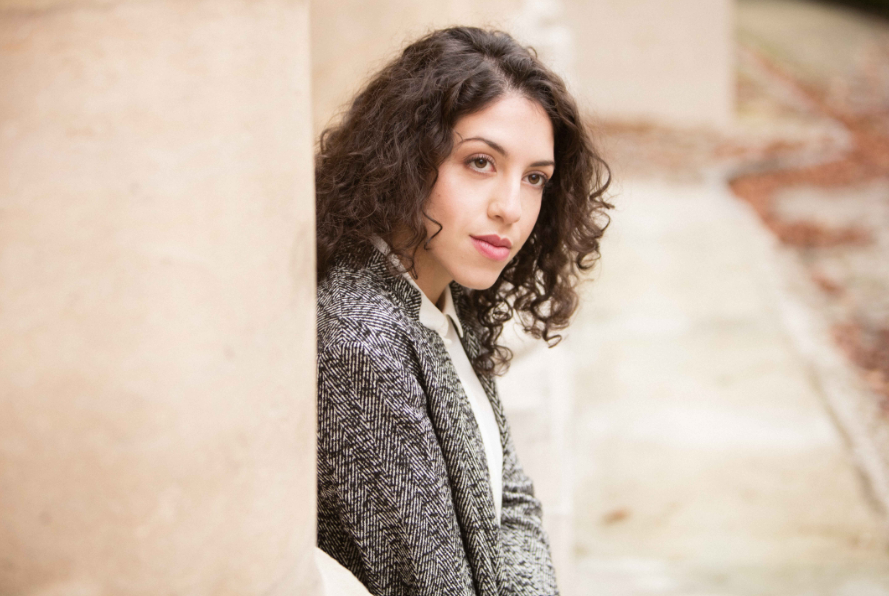
Beatrice Ranawas born on 22 January 1993 in Copertino, a town in the province of Lecce in southern Italy. She grew up in a very musical family: both of her parents were pianists(her mother taught solfège and her father worked with opera singers), so “the piano was always there” in her childhood home.
Rana notes that music was “in [her] blood” her father frequently played Bach at home after opera performances, and Rana says she ended up “practicing so much Bach” as a child. Her younger sister, Ludovica, also became a musician (a cellist), so the sisters grew up playing music together.
Rana began piano lessons very early around age four but her parents did not teach her directly. Instead, they enrolled her in group piano classes and she also attended normal schools throughout her childhood.
She later studied under the Italian pianist Benedetto Lupo. First Rana trained with Lupo at the Nino Rota Conservatory of Musicin Monopoli (where she also took composition lessons with Marco della Sciucca).
She continued under Lupo at Rome’s Accademia Nazionale di Santa Ceciliaand furthered her training abroad with Arie Vardi in Hannover, Germany. Alongside music, Rana completed secondary education at a science-oriented high school focusing on mathematics, chemistry and physics.
| Detail | Information |
| Full Name | Beatrice Rana |
| Date of Birth | 22 January 1993 |
| Place of Birth | Copertino, Lecce, Southern Italy |
| Family Background | Born into a musical family; both parents were pianists |
| Early Musical Environment | Grew up listening extensively to Bach at home |
| Sibling | Younger sister Ludovica Rana, a professional cellist |
| Start of Piano Lessons | Around age four |
| Early Education | Attended regular schools alongside music studies |
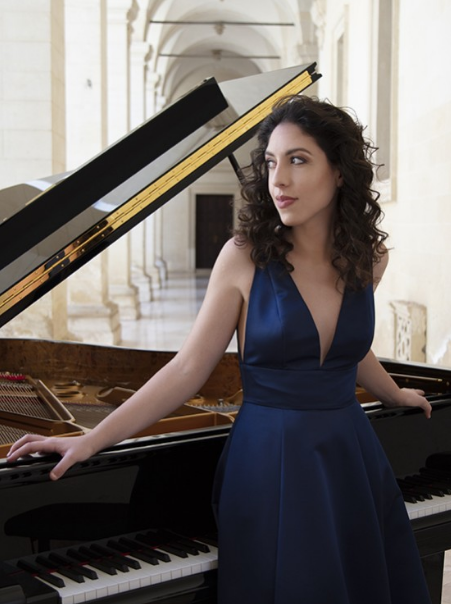
Career Beginnings
Rana’s first major international successes came in her late teens. In 2011, at age 18, she won the Grand Prize at the Concours musical international de Montréal, capturing first prize as well as all special prizes.
This victory launched her career abroad. Two years later, in 2013, Rana earned the Silver Medal and the Audience Prize at the Van Cliburn International Piano Competition. These back-to-back competition victories brought her to widespread attention and opened the door to high-profile engagements worldwide.
Major Performances & Concert Highlights
| Date & Location | Performance Details |
| June 2025 – Vatican Holy Year Gala, Rome | Performed Bach’s Goldberg Variations at the “Harmonies of Hope” Jubilee concert. |
| July 2025 – Wigmore Hall, London | Chamber recital featuring works by Robert and Clara Schumann. |
| August 2025 – BBC Proms, London | Soloist in Rachmaninoff’s Rhapsody on a Theme of Paganini. |
| August 2025 – Edinburgh International Festival | Performed Rachmaninoff’s Paganini Rhapsody with orchestra. |
| January 2026 – European Orchestra Tour | Appeared with the Bavarian State Orchestra in Europe. |
| March 2026 – Los Angeles Philharmonic | Soloist in Beethoven’s Piano Concerto No. 3. |
Following her competition wins, Rana became a sought-after soloist on major concert stages. She made her Carnegie Hall solo recital debut in New York in 2019, earning high praise from critics.
She is a regular guest at leading festivals and series for example, she has appeared at the BBC Proms and the Lucerne Festival. Rana’s touring includes European concert seasons and orchestra tours in 2023–24 she toured Europe with the Chamber Orchestra of Europe under conductor Antonio Pappano.
That season also saw her debut with the Berlin Philharmonic and a first appearance with the Cleveland Orchestra. She has performed with a wide array of great symphony orchestras, and her recitals have filled concert halls around the world, including London’s Barbican Centre and Royal Albert Hall, Boston’s Symphony Hall, Hollywood’s Walt Disney Concert Hall and Hollywood Bowl, and other major venues.
Recordings & Discography
Rana records exclusively for Warner Classics and has built a notable discography of piano repertoire. Her debut album (2015) featured Prokofiev’s Piano Concerto No. 2 and Tchaikovsky’s Piano Concerto No. 1 with conductor Antonio Pappanoand the Orchestra dell’Accademia Nazionale di Santa Cecilia.
Subsequent albums include landmark recordings of solo and concerto works. In 2017 she released Bach’s Goldberg Variations, a recording that earned critical acclaim and won major awards.
A 2019 album of Ravel’s and Stravinsky’s piano works followed. More recently, Rana has recorded the complete piano concertos of Clara and Robert Schumann(2023, with the Chamber Orchestra of Europe and Yannick Nézet-Séguin) and released a solo album pairing Chopin’s Second Piano Sonata (“Funeral March”) with Beethoven’s Hammerklavier Sonata(2024).
In early 2025 she produced a recording of J.S. Bach’s keyboard concertos, playing and directing them with the Amsterdam Sinfonietta. Her discography also includes solo piano albums of Chopin’s Études and Scherzi and Romantic works by Ravel and others.
Awards & Professional Recognition
Rana’s artistry has been recognized with numerous awards and honors. In addition to her competition prizes (Montréal 2011 and Cliburn 2013), she has won prestigious recording awards for her 2017 Goldberg Variations, she received Gramophone’s Young Artist of the Year and the Edison Klassiek Discovery of the Year.
BBC Music Magazine named her Newcomer of the Year in 2017. In 2018 she was named Female Artist of the Year at the Classic BRIT Awards, in recognition of her acclaimed recording of Bach’s Goldberg Variations.
Early in her career Rana was selected as a BBC New Generation Artist (2015–2017) and was awarded a prestigious Borletti-Buitoni Trust fellowship (2016). More recently, the New York Philharmonic honored her with its Ronnie and Lawrence Ackman Classical Piano Prize in 2022.
Collaborations With Orchestras & Conductors
Rana has performed with virtually all of the world’s leading orchestras and conductors. Her orchestral partners include the Berlin Philharmonic, Royal Concertgebouw Orchestra, London Symphony Orchestra, Orchestre de Paris, Accademia Nazionale di Santa Cecilia (Rome), La Scala Philharmonic, Chamber Orchestra of Europe, Academy of St Martin in the Fields, and major symphonies such as the Boston Symphony, Chicago Symphony, Cleveland Orchestra, Los Angeles Philharmonic, New York Philharmonic, Philadelphia Orchestra, San Francisco Symphony and the NHK Symphony, among others.
She has worked under conductors such as Zubin Mehta, Riccardo Chailly, Gianandrea Noseda, Fabio Luisi, Susanna Mälkki, Vladimir Jurowski, Manfred Honeck, Antonio Pappano, Paavo Järvi, Claudio Abbado, and Yannick Nézet-Séguin, to name just a few.
Recent Career Activity
In recent seasons Rana has continued a prolific schedule of performances and recordings. In 2024–25 she is serving as Artist-in-Residence at Radio France in Paris, giving a recital at the Radio France Auditorium and multiple concert appearances with its orchestras (Orchestre National de France and Orchestre Philharmonique de Radio France) under Music Directors Cristian Măcelaru and Mikko Franck.
She also returned to North American stages with recitals and concerto appearances in this period. Her latest recordings were released to critical acclaim the 2024 album of Beethoven’s Hammerklavier Sonata and Chopin’s Second Sonata, and the 2025 album of Bach’s Keyboard Concertos with Amsterdam Sinfonietta.
Looking ahead, Rana’s schedule continues to be active, with upcoming concert tours planned, including engagements in North America and Europe. Her career remains marked by both intensive touring and ongoing recording projects.
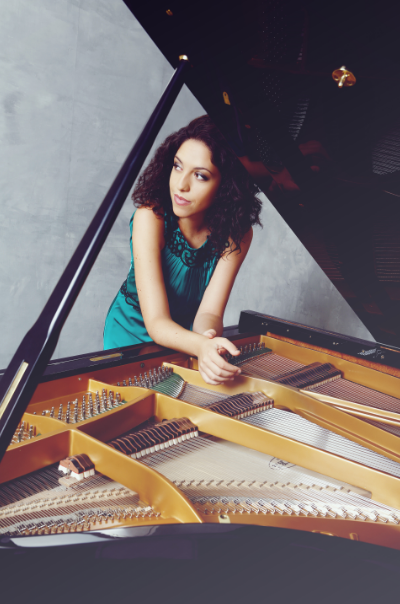
Beatrice Rana Performance (2025–2026)
- October–November 2025 North American recital tour:Beatrice Rana gave solo recitals across the U.S. and Canada, with key engagements at Carnegie Hall (New York), Severance Hall with the Cleveland Orchestra (Cleveland), Chicago’s Symphony Center, Celebrity Series of Boston, and Cliburn Concerts (Fort Worth). The tour featured debut recitals at Montréal’s Bourgie Hall and the Philadelphia Chamber Music Society.
- June 2025 Vatican Holy Year gala (Rome):Invited by the Italian government, Rana curated and performed at the “Harmonies of Hope” Jubilee concert in St. Peter’s Square (on June 21). She played Bach’s Goldberg Variationsat this prestigious event for the newly installed Pope (Leo XIV), sharing the stage with noted pianists Gabriela Montero, Brad Mehldau, Nobuyuki Tsujii, and others.
- July 2025 Wigmore Hall (London):As part of her Classiche Forme festival series, Rana led a chamber recital at Wigmore Hall. The program included works by Robert Schumann (Piano Trio No. 2 in F, Op. 80 and Piano Quintet in E-flat, Op. 44) and Clara Schumann(Three Romances, Op. 22), demonstrating her versatility in chamber music.
- August 2025 BBC Proms (London):Rana was featured as a soloist with the BBC Symphony Orchestra (conductor Josep Pons) at the Royal Albert Hall. She performed Rachmaninoff’s Rhapsody on a Theme of Paganini, winning praise for an “assured and fresh” interpretation.
- August 2025 Edinburgh International Festival:Rana appeared with the London Philharmonic Orchestra under Edward Gardnerat Usher Hall, again performing Rachmaninoff’s Rhapsody on a Theme of Paganini. This high-profile festival engagement underscored her command of virtuosic Romantic repertoire.
- August 2025 Saratoga SPAC (NY):Rana returned to the Saratoga Performing Arts Centeras soloist with the Philadelphia Orchestra under Yannick Nézet-Séguin. She performed Rachmaninoff’s Rhapsody on a Theme of Paganinionce more, reinforcing her growing collaborations with major U.S. orchestras.
- January 2026 European orchestra tour:Rana toured with the Bavarian State Orchestraunder Vladimir Jurowskiin Munich and Luxembourg. The programs featured Ravel’s Piano Concerto in G and Rachmaninoff’s symphonic poem Isle of the Dead, highlighting her affinity for large-scale late-Romantic and early-20th-century works.
- March 2026 Los Angeles Philharmonic (Los Angeles):Rana performedas soloist in Beethoven’s Piano Concerto No. 3 with the LA Philharmonic under Paavo Järvi at Walt Disney Concert Hall, illustrating her continued presence with top-tier orchestras on the West Coast.
Mitsuko Uchida’s Piano Technique And Interpretative Style
Technical Approach And Piano Control
Beatrice Rana’s pianism is consistently described as highly secure and agile. Reviewers note her “fearless technique” and unusually crisp articulation, even in the most demanding passages.
Her fingerwork and arm motion are praised for remarkable fluidity; one critic observed that her arms move freely with no tension, unleashing dense flurries of notes (“blizzards of notes”) yet maintaining clarity throughout.
She reliably manages large intervals and rapid figurations without strain: her control is so precise that “she never loses digital control, even when passages whiz by faster than the ear can grasp”. In practice this means that complex textures are cleanly voiced and inner voices are kept distinct.
Even in powerful moments her playing remains under technical command, with big dynamic leaps and octaves delivered securely and evenly.
Tone, Touch, And Sound Color
Rana is widely admired for her expansive tonal palette and sensitive touch. Critics describe her sound as rich and nuanced; one review notes her “prodigious” tonal resources and a sonority that fills the hall “without the slightest banging,” even in fortissimo passages.
Her tone is often characterized as warm and singing; for example, reviews of her Baroque performances mention a gentle, expressive cantabile quality in slow movements.
She uses pedal and touch judiciously to produce a variety of colors: in orchestral transcriptions critics have marveled at her ability to evoke horn calls, celesta-like tinkles and lush string textures from the keyboard.
At the same time, her articulation remains clear; even delicate bell-like chords and cascading arpeggios retain definition. In short, Rana balances a broad, symphonic sonority with precise pianistic shading, making both the resounding and the whispering moments equally compelling.
Rhythm, Phrasing, And Structural Clarity
Reviewers consistently emphasize Rana’s strong rhythmic sense and lucid shaping of phrases. She is said to “build a line in ways that are both exactingly dynamic and robustly emotional”, meaning her phrases are carefully sculpted with attention to inner pulse.
Even at very fast tempi her phrasing remains clear and coherent; one commentator notes that in her Bach interpretations “nuances are not sacrificed for celerity” and the musical intentions stay “lucid”.
In practice this shows up as supple, arching phrases where each voice is balanced; another critic writes of her Chopin Etudes that they are rendered with “fleet, supple, and ravishingly phrased” lines.
She is willing to stretch or compress the tempo for expressive effect, but always with a sense of underlying structure; slight accelerations and decelerations in her Chopin performances, for example, were noted as lively yet never undermining the work’s overall pulse. In summary, Rana’s rhythmic approach is flexible but precise, giving momentum and continuity to each piece’s architecture.
Interpretative Approach To Repertoire
Rana adapts her style thoughtfully to each repertoire’s character. In Romantic and post-Romantic works she often emphasizes sweeping lyricism and drama; for instance, reviews of her Chopin note a free-spirited, affectionato approach that highlights inner voices and rubato coloring.
In contrast, her playing of Baroque and Classical works is usually lighter and more transparent; in Bach keyboard concertos she interacts with ensembles in an almost chamber-like manner, bringing out dance rhythms with buoyant energy while preserving contrapuntal clarity.
Critics praise her sensitivity to style and color in Impressionist and modern repertoire. In Ravel’s piano pieces she distinguishes each movement’s mood from the impish to the melancholic by careful attention to harmonic color and meticulous pedaling.
Similarly, her performances of Stravinsky transcriptions are noted for capturing orchestral timbres on the piano, smoothly transitioning between different instrumental characters and maintaining clarity in the dense textures.
Whether playing Baroque, Classical, Romantic or contemporary works, Rana’s interpretations are anchored in the style’s idiom but also suffused with her own narrative sense. She has explained in interviews that she studies each piece’s form (“architecture”) deeply so that her expressive choices always serve the music’s structure.
Balance Between Precision And Expression
Across reviews, Rana is singled out for combining technical precision with heartfelt expression. Her command of the keyboard is so complete that virtuosic fireworks never feel gratuitous; one critic observed that when she descends on a challenging piece “with powerful ease,” the result is both “bravely” rendered and poetic.
Observers frequently note that even in thunderous passages there is no harshness; her loudest chords have “no banging at all”, and her fortes remain focused and honest.
At the same time, her softer playing is equally controlled; reviewers mention that her legato lines “retain a smooth profile” at any dynamic level, and that she produces a warm, expressive tone even in very quiet textures.
In performance Rana rarely sacrifices nuance for power; as one album review puts it, her speed never blurs the details or intent the musical ideas stay “lucid” no matter how fast the tempo. In sum, her style reflects a constant negotiation between exacting accuracy and expressive depth, neither overshadowing the other.
Critical Observations And Musical Identity
Critics often portray Beatrice Rana as a musician of vivid contrasts and strong individuality. Words like virtuoso, refined, joyous, and unpretentious appear repeatedly in reviews.
She is described as having “affetuoso, free-spirited” impulses that coexist with a solid grasp of form and style. Her performances are said to feel both electric and warm; she can unleash fierce, energetic outbursts (a “demonic burst of energy” in Beethoven, as one review says) yet immediately turn around and create moments of quiet lyricism.
This adventurous duality has become her musical signature; Rana is noted for making even towering repertoire seem immediate and personal, blending youthful exuberance with mature insight.
Altogether, the critical consensus sketches a pianist who combines dazzling technique, a rich tonal palette and compelling imagination qualities that define her evolving musical identity.
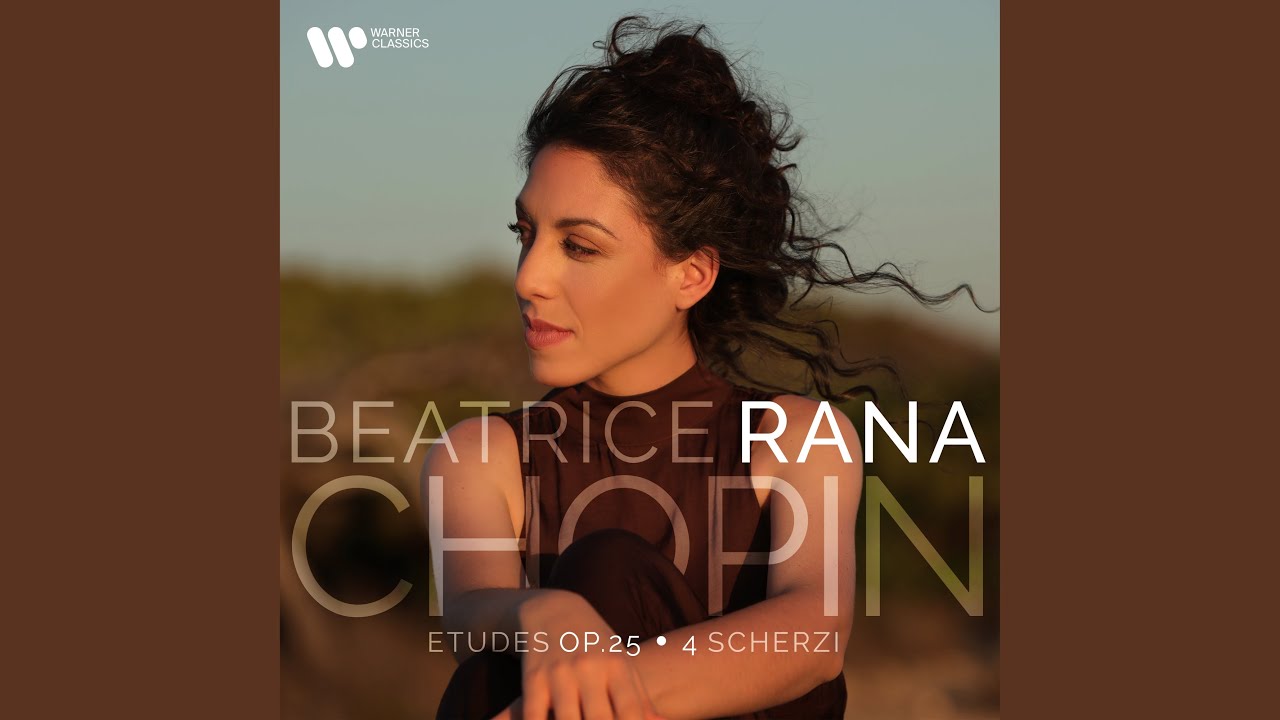
12 Études, Op. 25: No. 1 in A-Flat Major "Aeolian Harp"
Beatrice Rana Net Worth
As of 2026, reliable sources have not published an estimate of Beatrice Rana’s net worth. Rana is an Italian concert pianist who won major competitions (first prize, Montreal 2011; silver medal, Van Cliburn 2013). She records exclusively for Warner Classics and also performs internationally with top orchestras. Her income comes primarily from concert appearances, album sales, recording royalties and related professional activities. She frequently appears at major music festivals like the BBC Proms and Lucerne Festival and in prestigious venues worldwide.
FAQs
1. Who Is Beatrice Rana?
Beatrice Rana is an Italian classical pianist known for her exceptional technique and interpretative depth. She gained international recognition after winning first prize at the Concours musical international de Montréal in 2011 and the Silver Medal at the Van Cliburn International Piano Competition in 2013.
2. When And Where Was Beatrice Rana Born?
Beatrice Rana was born on 22 January 1993 in Copertino, a town in the province of Lecce, southern Italy. She grew up in a musical family, with both parents being pianists.
3. What Is Beatrice Rana Famous For?
Beatrice Rana is especially acclaimed for her performances of Bach, Chopin, Beethoven, and Romantic repertoire. Her recording of Bach’s Goldberg Variationsis widely regarded as one of the standout interpretations of her generation.
4. Which Record Label Does Beatrice Rana Record For?
Beatrice Rana is an exclusive recording artist with Warner Classics. Her discography includes solo piano works, concertos, and chamber music recordings that have received major international awards.
5. Has Beatrice Rana Won Any Major Awards?
Yes, Beatrice Rana has received several prestigious honors, including Gramophone Young Artist of the Year and Classic BRIT Female Artist of the Year. She has also been awarded the Borletti-Buitoni Trust Fellowship and the New York Philharmonic’s Ackman Classical Piano Prize.