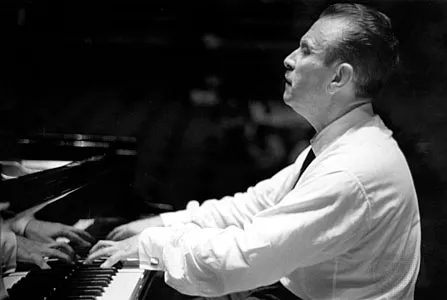
Claudio Arrauwas born on 6 February 1903 in Chillán, Chile. He was the youngest of three children in his family. His parents were Carlos Arrau Ojeda, an ophthalmologist (eye doctor), and Lucrecia León Bravo de Villalba, a piano teacher. His father died in a horseback riding accident when Claudio was about one year old, and his mother supported the family by giving piano lessons.
From a very early age, Arrau showed exceptional musical talent. He received his first piano instruction from his mother and was regarded as a child prodigy. According to biographers, by about age three he could read musical notation before he could read ordinary text. He gave his first public piano recital in Chillán at age five.
Arrau’s formal music education began in Santiago. He studied in Santiago for two years under the Italian teacher Bindo Paoli. In 1911, when he was about eight years old, the Chilean government awarded him a scholarship to continue his piano studies in Europe. He went to Berlin and studied at the Stern Conservatory, where he became a pupil of Martin Krause(a former student of Franz Liszt). These early educational experiences in Chile and Germany laid the foundation for his development as a pianist.
| Aspect | Verified Details |
| Full Name | Claudio Arrau León |
| Date of Birth | February 6, 1903 |
| Place of Birth | Chillán, Chile |
| Family Position | Youngest of three children |
| Mother | Lucrecia León Bravo de Villalba |
| Mother’s Profession | Piano teacher |
| Father | Carlos Arrau Ojeda |
| Early Training | Taught piano by his mother |
| Musical Ability | Read music before text |
| Early Studies | Studied in Santiago |
| Studied in Santiago | Bindo Paoli |
| European Scholarship | Awarded in 1911 |
| Awarded in 1911 | Martin Krause |
| Date of Death | June 9, 1991 |
| Age at Death | 88 years |
| Place of Death | Mürzzuschlag, Austria |

Arrau Bernstein Beethoven Piano Concerto No. 4
Career Beginnings
Claudio Arrau’s professional career began unusually early. He gave his first major recital in Berlin in 1914. While still a youth he won several top prizes, including the Rudolph Ibach competition in 1915 and the Franz LisztPrize in 1919 and 1920.
These awards led to extensive touring across Europe, South America and North America throughout the 1920s.
Arrau himself described his pianistic gifts as instinctive he once said piano playing “must be completely natural” and his early success set the stage for an enduring international career.
International Breakthrough
Arrau’s global reputation grew in the late 1920s and 1930s. In 1923 he made his American debut with the Boston Symphony Orchestra under conductor Pierre Monteux.
A key milestone came in 1927 when he won the Grand Prix at the International Piano Competition in Geneva. In the mid-1930s Arrau delivered a landmark series of Berlin recitals presenting the complete solo keyboard works of Bach, Mozart, Beethoven, Schubert and Weber.
These achievements firmly established Arrau as a leading interpreter of the core classical repertoire on the international stage.
Major Performances & Concert Highlights
Arrau became known for programming complete cycles and ambitious concert programs. In 1938 he performed all 32 Beethoven piano sonatas and all five Beethoven concertos in a single series in Mexico City.
Decades later, during Beethoven’s bicentennial year 1970, he played the five concertos in London and toured the Emperor Concerto across New York, London, Berlin and major festivals.
He also presented the entire set of Beethoven sonatas in major cities worldwide including New York, London, Berlin, Buenos Aires and Mexico City.
At the height of his performing powers roughly ages 40 to 60 Arrau averaged about 120 concerts per season, reflecting a vast repertoire that encompassed everything from Bach and Mozart to Chopin and Liszt.
His touring was truly global for example a 1958 to 1959 world tour took him through Europe, the Soviet Union, Japan, Australia and New Zealand, and he repeated a similar multi continent circuit in 1974 to 1975. In his later career Arrau’s recitals and concerts continued to draw huge interest.
His 80th birthday February 1983 was celebrated with a sold out Avery Fisher Hall recital at Lincoln Center and a televised orchestral concert with the Philadelphia Orchestra under Riccardo Muti.
That period brought major honors in recognition of his career achievements. In May 1984 Arrau returned to Santiago Chile his first visit in 17 years for a series of widely acclaimed concerts.
At age 85 in 1988 he performed Beethoven’s Emperor Concerto in London under Sir Colin Davisagain in a televised gala concert. These performances underscored Arrau’s enduring status as a maestro well into the final decades of his career.

Beethoven "Moonlight Sonata" (1 mvt.) by Claudio Arrau
Recordings & Discography
Arrau made an enormous number of recordings mostly for Philips Records covering the great Romantic and Classical piano literature.
He recorded landmark studio cycles such as the complete set of 32 Beethoven piano sonatas and all five Beethoven piano concertos.
His discography also includes two recordings each of the two Brahms piano concertos the complete piano concertos of Chopin and large compilations of solo works by Chopin Brahms Liszt Schumann Debussy and others.
In the 1970s he recorded Liszt’s 12 Transcendental Études and in the early 1980s he recorded Tchaikovsky’s Piano Concerto No 1 with the Boston Symphony Orchestra under Sir Colin Davis.
For his 80th birthday in 1983 Philips issued The Arrau Edition a 59 disc boxed set of his recordings. He later re recorded the Beethoven concertos a third time in the mid 1980s with the Dresden Staatskapelle under Colin Davis.
Arrau also brought scholarly rigor to his recordings preparing an Urtext performing edition of the Beethoven sonatas in the 1970s that reflected his close study of those works.
Awards & Professional Recognition
| Honor | Awarding Body |
| International Music Prize | UNESCO |
| Beethoven Medal | New York |
| Gold Medal | Royal Philharmonic Society (London) |
| National Honors | Mexico (Order of the Aztec Eagle) |
| French Honors | Légion d’Honneur, Ordre des Arts et des Lettres |
| Italian Honor | Accademia di Santa Cecilia |
| Honorary Doctorates | University of Chile, Oxford University, Universidad de Concepción |
Arrau’s artistry was recognized by numerous international honors. In 1983 he received UNESCO’s International Music Prize and the Beethoven Medal of New York.
The following year the Royal Philharmonic Society London awarded him its Gold Medal.
He was decorated by several governments for example Mexico awarded him the Order of the Aztec Eagle and France made him a Chevalier of the Ordre des Arts et des Lettres and a Commandeur of the Légion d’Honneur.
Italy’s Accademia di Santa Cecilia named him a Commandatore. Universities also honored his legacy he received honorary doctorates from the University of Chile Oxford University and the Universidad de Concepción.
These awards reflect Arrau’s broad esteem as an interpreter and cultural figure over many decades.
Collaborations With Orchestras & Conductors
Throughout his career Arrau was a regular soloist with the world’s leading orchestras. His 1923 US debut was with the Boston Symphony Orchestra under Pierre Monteux.
Over the years he performed with ensembles such as the Philadelphia Orchestra New York Philharmonic Chicago Symphony Cleveland Orchestra and London Philharmonic among others.
On record he often collaborated with conductor Sir Colin Davis for example in the complete Beethoven concertos with the Dresden Staatskapelle.
In 1988 he performed Beethoven’s Fourth Piano Concerto with the Philadelphia Orchestra under Riccardo Muti in a filmed concert.
Other renowned conductors he worked with included Sir George SzellWilhelm FurtwänglerBruno WalterRafael Frühbeck de BurgosNeville Marrinerand Daniel Barenboim.
These high profile partnerships both in concert and on recordings helped underscore Arrau’s stature in the classical music world.
Recent Career Activity
Arrau remained active into his late 80s. In the 1980s he continued to tour internationally making multiple trips to Asia and beyond.
In the 1981 to 1982 season he returned to Japan and toured Brazil as well as North America and Europe. He maintained a heavy recording schedule and gave recitals on special occasions notably in February 1983 Philips released a 59 CD retrospective on his 80th birthday.
In 1991 Arrau planned one last European tour. In late May he traveled to Austria and Germany where he was scheduled to inaugurate a recital series at the newly opened Brahms Museum in Mürzzuschlag and to play at a Schumann festival in Düsseldorf. Illness forced him to cancel both concerts.
Claudio Arrau died on June 9 1991 in Mürzzuschlag at the age of 88 ending a performing career that had spanned nearly eight decades.

Claudio Arrau Beethoven "Waldstein" (Full)
Claudio Arrau Performance Highlights
- Extensive international tours:Well into his 70s Claudio Arraumaintained a punishing concert schedule. In 1978 (age 75) he gave 96 concerts across Europe and the U.S. in a single year. That year he also made his debut recital at Washington D.C.’s Kennedy Center (program included Liszt, Brahms and Beethoven), underscoring his global presence.
- Prestigious venues & collaborations:Arraufrequently played major concert halls with top orchestras. In 1976 he performed Brahms’s Piano Concerto No. 1 at Carnegie Hall with the Israel Philharmonic under Zubin Mehta. That same year he gave Beethoven’s “Emperor” Concerto with the London Symphony Orchestra (conductor Klaus Tennstedt) at the Royal Festival Hall. These high-profile engagements (also including Avery Fisher Hall, Vienna’s Musikverein, etc.) reflect his stature among respected institutions and artists.
- Ambitious repertoire & expertise:Arrau was renowned for tackling the most demanding works. He performed complete keyboard cycles of Bach, Mozart, Beethoven and Chopin, and late-career programs often featured monumental pieces (e.g. large Beethoven sonatas, Liszt’s B-minor Sonata, major piano concertos). Critics noted his “fabulous virtuoso” technique and interpretive depth even in old age.
- Late-career plans (comeback):In June 1991 Arrau arranged a high-profile return to the stage. He was scheduled to inaugurate the newly renovated Johannes Brahms Museum in Mürzzuschlag (Austria) with a recital and to close the Düsseldorf Schumann Festival. These would have been his first public concerts in two years, highlighting his intent to resume performing until the very end of his life.
Claudio Arrau’s Piano Playing Style And Interpretation
Technical Approach And Piano Control
Claudio Arrau’s technique was grounded in the Liszt tradition but shaped by a uniquely relaxed, whole-arm approach. He followed his teacher Martin Krause’s emphasis on arm weight keeping the wrist and joints free of stiffness so that the pianist’s body moved as a unified whole. This allowed musical impulses to flow naturally from arm to keys.
The result was an ability to produce a very even, controlled touch even in the most demanding passages. Arrau’s fingers had great strength and agility, yet he rarely indulged in flashy pyrotechnics. Even in ultra-virtuosic pieces such as Liszt’s Études or his early recording of Balakirev’s Islamey, he favored smooth, bold passagework over gratuitous showmanship.
Critics note that he approached technically difficult works effortlessly, handling octaves and rapid runs with apparent ease, but always in service of the music. His command of dynamics and legato pedaling was similarly masterful: he had a powerful finger strength and depth of tone, yet employed the damper pedal very sparingly, preserving clarity of voicing and inner lines.
In short, his technique was both secure and flexible, able to adapt instantly to the piano’s character, with every note articulated clearly without tension.
Tone, Touch, And Sound Color
Arrau’s tone was consistently described as warm, rich, and deeply expressive. He prized a singing, vocal quality in the melody lines, supported by a full-bodied, resonant bass and a broad palette of mid-range colors. His attack was generally smooth and rounded rather than sharp or percussive.
Over time his sound grew more richer, more assertive as he gained confidence. In Chopin and Liszt, listeners hear a velvety legato and a sumptuous pedal wash that never becomes muddy even large chords have a blended, piano-like breadth rather than a dry staccato.
One reviewer highlights the warmth of his Chopin Nocturne: the trill returns are handled with a velvety touch that is characteristic of Arrau’s coloring. In faster, lighter pieces like some Mozart and Schubert, Arrau could lighten his touch, but always within a relatively broad, singing framework.
Overall his touch favored depth and color over gaudy brilliance: even at soft dynamics his tone remained full and resonant, contributing to the profound emotional character of his interpretations.
Rhythm, Phrasing, And Structural Clarity
Rhythmically, Arrau often took a broad and unhurried approach. His tempos tended to be measured rather than frenetic, and he was willing to let phrases breathe fully. Importantly, this did not mean the music became static.
Rather, Arrau shaped very long musical arcs while carefully sustaining forward motion. He avoided sudden tempo jolts or affectations; even his generous use of rubato always felt organic and in service of the phrase. For instance, in Schumann’s Fantasy Arrau plays the broad opening so evenly that transitional sections flow without jolt.
Critics have noted that, although his pacing was broad especially in Schumann or some Beethoven, the performance never drags the internal momentum of the music is respected. Phrases are often connected in a seamless legato, giving a sense of coherence and architecture.
Reviewers frequently observe that Arrau’s interpretations bring out structural clarity: disparate sections are knitted into a unified narrative. His Schumann Carnaval, avoids emphasizing the abrupt contrasts; instead he weaves the movements together into a coherent arc.
Likewise, in large sonata forms Beethoven, Liszt he highlights formal symmetry setting up motifs slowly but ensuring they develop logically. Overall, Arrau’s phrasing balances expansiveness with precision: one hears a careful, transparent delineation of themes even as lines are stretched and shaped with free, natural rubato.

Video | Claudio Arrau plays Beethoven Eroica Variations - Live in Bonn
Interpretative Approach To Repertoire
Arrau’s interpretative philosophy was based on deep respect for the score combined with an intellectually engaged imagination. He famously insisted that a pianist must first play exactly what is written and then add his own understanding.
In practice, this meant his performances were always founded on textual fidelity and historical style, but enlivened by a personal, thoughtful insight. In the Classical and early Romantic repertoire Mozart, Beethoven, Arrau was known for treating the music with philosophical gravity.
He approached Beethoven sonatas as profound dramas about human struggle and transcendence. Technically he was impeccable philosophical depth plus incredible technical control in Beethoven, and he sought to convey both the virtuosic and the deeply human sides of the music.
In the Romantic repertoire Schubert, Chopin, Schumann, Liszt, Brahms, Arrau’s interpretations emphasized introspection and unity of expression over brilliance for its own sake. His Chopin was often called poignant and melancholic; critics note a wide dynamic range and careful ornamentation, but above all a sense of lyric flow and emotional weight.
His famous Nocturne in B major Op. 62, No. 1 is praised for its singing legato and underlying tension nothing is gratuitously florid, yet the result is deeply moving. In Schumann he sought a balance of poise and impulsiveness.
He did not exaggerate Schumann’s wild swings; instead, as one writer notes, Arrau knits the contrasting moods of Carnaval into a single narrative. Liszt’s works he treated as spiritual dramas akin to Beethoven’s late sonatas; his 1970 recording of the B minor Sonata is often cited as definitive because it combines flawless technique with personal poetry.
Even in modern works he played e.g. early 20th century Schoenberg, Arrau found continuity with Romanticism: his tone remained warm and he emphasized song-like phrasing over angular shock. In short, Arrau was consistent in looking for the composer’s deeper meaning and emotional honesty, regardless of style period, rather than favoring any one national school or virtuoso effect.
Balance Between Precision And Expression
A hallmark of Arrau’s artistry was his ability to maintain rigorous precision while giving full expression to the music’s emotional content. He avoided gratuitous virtuosity dazzling technique only as needed and was instead fastidious about musical detail.
For instance, a critic notes that his rendition of the Beethoven Eroica Variations is as exacting in voice-leading and phrasing as any classical purist’s, even while the overall effect is grand and titanic. In the Liszt B minor sonata, his bardic sweep never turns heavy-handed, thanks to meticulous control of every voice.
This kind of balance is evident throughout his playing: loud passages are powerful but never coarse, quiet passages are refined but never fragile. Arrau’s rubato and articulation were always tightly linked to the music’s structure, so that the expressive ebb and flow never obscures the musical line.
In practice, he might take a Rubato very slowly, but each pause and acceleration serves the phrase. Listeners often remark on the equilibrium in his playing: the listener hears both emotional weight and clear musical architecture simultaneously.
Such balance combining the weight of a mature Romantic approach with almost classical restraint is why many regard Arrau’s interpretations as both heartfelt and architecturally sound.
Critical Observations And Musical Identity
Critics and fellow musicians have consistently identified Arrau’s playing with certain core qualities: introspection, breadth, and seriousness. He earned a reputation as a philosophical artist rather than a showman.
One reviewer contrasted his Chopin to two famous sopranos, saying Arrau is like Maria Callas dramatic and intense whereas many other pianistsare like Joan Sutherland light and brilliant. In this vein, Arrau’s style is often described as soulful and searching.
He brought gravity and sustained warmth even to virtuosic repertoire, and he maintained a consistently broad vision across composers. Over the decades, commentators noted little fundamental change in his approach: an older Arrau played with the same grandeur, though perhaps with a richer, more assured sound.
Any criticism of Arrau’s style is usually that it can verge on the ponderous; his tempos could be so generous that some listeners found them stately. However, most appraisals still emphasize his strengths the depth of tone, the intellectual grasp of form, and the sincerity of expression.
Arrau’s musical identity is that of a great artist’s artist, one whose aim was always the music itself. In sum, Claudio Arrau’s style is remembered as a unique blend of monumental technique, rich color, and profound interpretative insight an approach that prioritized meaning and coherence above all.
Claudio Arrau Net Worth
At the time of his death in 1991, reliable sources had not published any estimate of Claudio Arrau’s net worth. Arrau earned his income through his long career as a concert pianist and recording artist. He toured internationally for decades and produced numerous acclaimed recordings of works by composers like Bach, Mozart, Beethoven, Chopin and Brahms. Arrau remained active as a performer until late in life. Widely regarded as one of the twentieth century’s greatest pianists, his earnings came primarily from performance fees and sales of his recordings (including royalties).
FAQs
1. Who Was Claudio Arrau?
Claudio Arrau was a Chilean classical pianist widely regarded as one of the greatest pianists of the 20th century. He was especially known for his interpretations of Beethoven, Liszt, Chopin, and Brahms.
2. When And Where Was Claudio Arrau Born?
Claudio Arrau was born on February 6, 1903, in Chillán, Chile. He showed exceptional musical talent from early childhood and gave his first public recital at age five.
3. Why Is Claudio Arrau Famous In Classical Music?
Claudio Arrau is famous for his deep, scholarly interpretations and complete performance cycles of major composers, particularly Beethoven. His combination of technical mastery and intellectual depth set him apart from many virtuoso pianists.
4. What Are Claudio Arrau’s Most Important Recordings?
Claudio Arrau recorded the complete Beethoven piano sonatas and concertos, along with major works by Chopin, Liszt, Schumann, and Brahms. Many of these recordings were made for Philips Records and remain influential today.
5. When Did Claudio Arrau Die?
Claudio Arrau died on June 9, 1991, in Mürzzuschlag, Austria, at the age of 88. His performing career lasted nearly eight decades, making him one of the longest-active concert pianists in history.