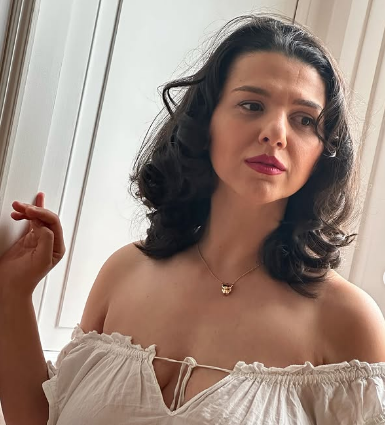
Khatia Buniatishviliwas born on 21 June 1987 in Batumi, a city on Georgia’s Black Sea coast. She grew up during a turbulent period in Georgia’s history born while the country was still part of the Soviet Union, she experienced her childhood amid the economic struggles that followed Georgia’s independence in 1991.
Her mother, an enthusiastic music lover, introduced Khatia and her elder sister Gvantsa to the piano at a very early age. Khatia began playing piano at age three and by age six she was performing publicly with the Tbilisi Chamber Orchestra. During these years the family often faced financial hardship, and her mother even sewed dresses from cloth scraps for Khatia and her sister to help make ends meet. (Her older sister Gvantsa also went on to become a pianist.)
Buniatishvili took formal music lessons in Tbilisi with the renowned pianist and teacher Tengiz Amirejibi. She also studied at the Tbilisi State Conservatoire. In her teens she met Austrian pianist Oleg Maisenberg at a local piano competition; he persuaded her to continue her musical studies at the University of Music and Performing Arts in Vienna.
Outside of music, Khatia was an avid reader from a young age. According to official accounts, she was already reading authors like Dostoevskyand Chekhovby the age of nine. She has also noted that Georgian folk music, a part of her country’s cultural heritage, was an early influence on her musical sensibility.
| Fact | Details |
| Full Name | Khatia Buniatishvili |
| Date of Birth | 21 June 1987 |
| Place of Birth | Batumi, Georgia |
| Nationality | Georgian |
| Profession | Concert pianist |
| Early Musical Start | Began piano at age three |
| First Orchestra Performance | Performed publicly at age six |
| Primary Teacher | Tengiz Amirejibi |
| Higher Education | Tbilisi State Conservatoire; later studies in Vienna |
| Recording Label | Sony Classical (exclusive contract since 2010) |
Career Beginnings
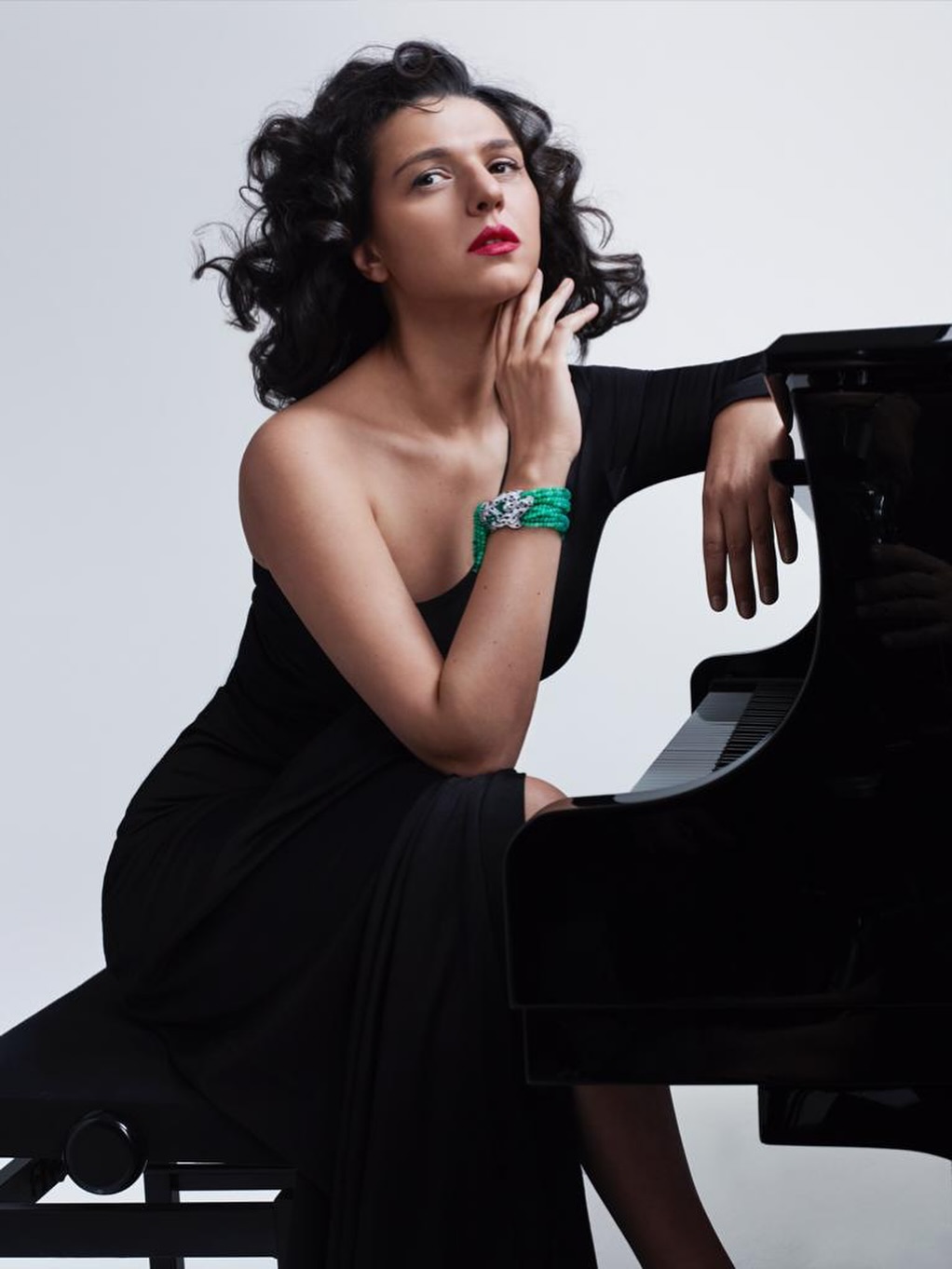
Khatia Buniatishvili showed extraordinary piano talent from a very young age. She made her debut with an orchestra at age six and soon gave international performances in Europe and the United States.
As a teenager she won several competition prizes, including a special prize at the International Horowitz Piano Competition in Kiev in 2003 and first prize in the Elisabeth Leonskaya Scholarship competition.
These early successes led to further professional engagements and increasing international exposure. This foundation of competition achievements and early performances established her entry into the professional concert circuit.
International Breakthrough
By the late 2000s, Buniatishvili’s career had gained significant international momentum. In 2008 she received third prize and special honors at the Arthur Rubinstein International Piano Competition, and the same year she made her United States debut at Carnegie Hall performing Chopin’s Piano Concerto No. 2.
In 2010 she signed an exclusive recording contract with Sony Classical, marking a major step in her international profile.
From 2009 to 2011 she was selected as a BBC Radio 3New Generation Artist, and during the 2011 to 2012 season she was named a Rising Star by the Vienna Musikvereinand Konzerthaus. These milestones contributed to her rapid recognition across Europe and beyond.
Major Performances & Concert Highlights
Buniatishvili has performed as a soloist and recitalist in many of the world’s leading concert halls. Her appearances include Carnegie Hall in New York, Walt Disney Concert Hall in Los Angeles, the Royal Festival Halland Wigmore Hallin London, the Concertgebouw in Amsterdam, the Musikverein and Konzerthaus in Vienna, the Philharmonie de Paris, the Théâtre des Champs Élysées, La Scala in Milan, and Suntory Hall in Tokyo.
She is also a regular guest at major international festivals such as the Salzburg Festival, Verbier Festival, Gstaad Menuhin Festival, La Roque d’Anthéron, and the BBC Proms. Her performances are frequently noted for their intensity, individuality, and strong audience engagement.
Recordings & Discography
Khatia Buniatishvili’s recording career is centered on her long standing collaboration with Sony Classical. Her debut album, released in 2011, was dedicated to solo piano works by Franz Liszt.
In 2012 she released a Chopin album featuring solo works alongside Chopin’s Piano Concerto No. 2 with the Orchestre de Paris conducted by Paavo Järvi.
In 2014 she released the album Motherland, which explored a personal and thematic program including works connected to her cultural background.
Her 2016 album Kaleidoscope included Mussorgsky’s Pictures at an Exhibition alongside other contrasting works.
That same year she recorded piano concertos by Liszt and Beethoven with the Israel Philharmonic Orchestra conducted by Zubin Mehta.
In 2017 she released recordings of Rachmaninoff’s Piano Concertos Nos. 2 and 3 with the Czech Philharmonic under Paavo Järvi.
Later releases include a solo Schubert album in 2019, the recital album Labyrinth in 2020, and a 2024 release featuring Mozart’s Piano Concertos Nos. 20 and 23 with the Academy of St Martin in the Fields.
Awards & Professional Recognition
| Recording | Details |
| Debut Album | Liszt solo works (2011, Sony Classical) |
| Chopin Album | Solo works and Piano Concerto No. 2 (2012) |
| Motherland | Thematic album reflecting cultural identity (2014) |
| Kaleidoscope | Mussorgsky and contrasting repertoire (2016) |
| Rachmaninoff Concertos | Concertos Nos. 2 & 3 (2017) |
| Mozart Concertos | Piano Concertos Nos. 20 & 23 (2024) |
Buniatishvili has received multiple awards and honors in recognition of her artistic achievements. Her early competition success includes a top prize at the Arthur RubinsteinInternational Piano Competition in 2008. She was awarded support from the Borletti Buitoni Trust and was selected as a BBC Radio 3 New Generation Artist from 2009 to 2011.
She has received Germany’s Echo Klassik Award, including Best Newcomer in 2012 and Best Instrumentalist in 2016. These distinctions reflect sustained recognition from international music institutions and critics.
Collaborations With Orchestras & Conductors
As a concerto soloist, Khatia Buniatishvili has appeared with many prominent orchestras worldwide.
These include the Orchestre de Paris, Vienna Symphony, Philharmonia Orchestra, Los Angeles Philharmonic, Israel Philharmonic Orchestra, St Petersburg Philharmonic, Czech Philharmonic, and San Francisco Symphony.
She has collaborated with conductors such as Paavo Järvi, Zubin Mehta, Gianandrea Noseda, Daniele Gatti, and Vladimir Jurowski.
In chamber music and duo performances, she has collaborated with artists including Gidon Kremerand Renaud Capuçon, expanding her artistic presence beyond the concerto repertoire.
Recent Career Activity
In the 2024 to 2025 season, Buniatishvili undertook an artist residency at the Barbican Centre in London. She presented multiple concerts including performances of Mozart’s Piano Concertos Nos. 20 and 23 with the Academy of St Martin in the Fields.
Her recording of these concertos was released in October 2024. In December 2024 she performed at the reopening concert of Notre Dame Cathedral in Paris.
In the summer of 2025 she appeared at the BBC Proms, performing Tchaikovsky’s Piano Concerto No. 1 with the Melbourne Symphony Orchestra conducted by Jaime Martín. These activities confirm her continued presence at the highest level of international concert performance.
Khatia Buniatishvili Performance (2025–2026)
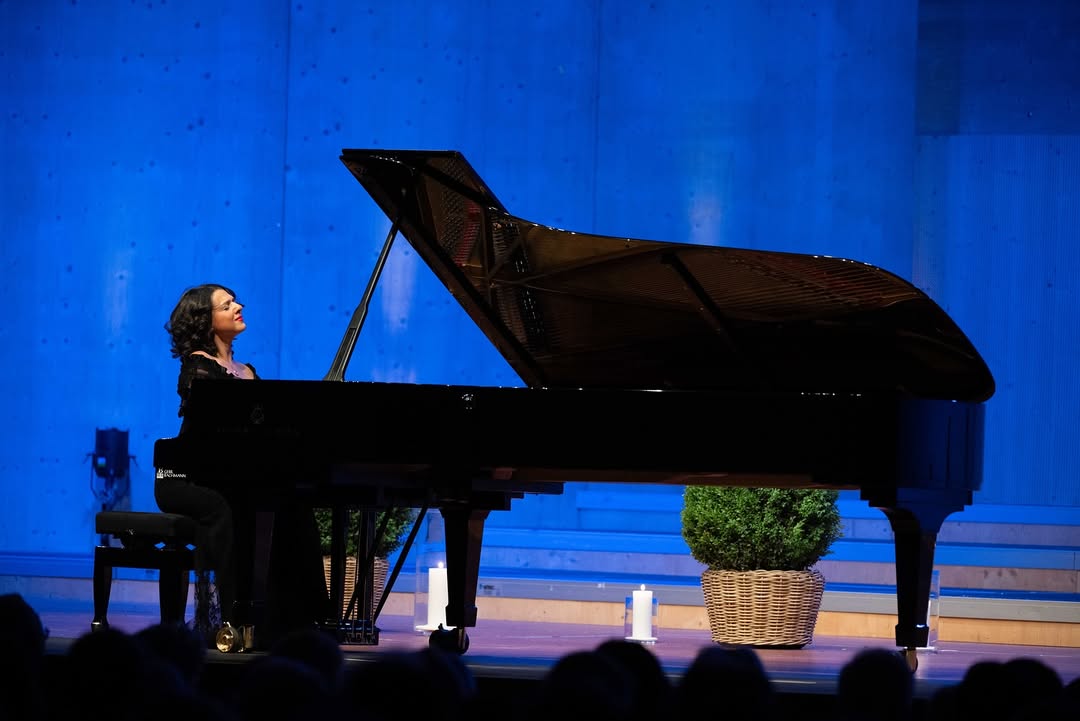
- Aug 2025 – BBC Proms (Royal Albert Hall, London):Soloist with the Melbourne Symphony Orchestra in Tchaikovsky’s Piano Concerto No.1. Critics praised her radiant virtuosity, noting “utterly incandescent” intensity, an “exquisite touch” and powerful execution.
- Dec 2025 – Berlin Philharmonie recital:Presented a demanding solo program in Philharmonie Berlin. Works included Chopin’s Sonata Op.35 (No.2), Bach/Alberti Prelude, Tchaikovsky’s Valse, Mozart Sonata K.545 and Liszt’s Mephisto Waltz No.1. This high-profile solo recital highlighted her technical brilliance and interpretive range on a major European stage.
- Mar 2026 – European recital tour:Concert tour through top venues including Vienna’s Konzerthaus, Munich Isarphilharmonie, Berlin Philharmonie, Copenhagen Konzerthuset, Frankfurt Alte Oper, Hamburg Elbphilharmonie and Paris Philharmonie. Each recital reinforced her international presence, showcasing her skill with demanding repertoire in premier halls.
- Apr–May 2026 – U.S. appearances:Featured at prestigious American venues. Solo recital at Kennedy Center in Washington, D.C., and a recital at Amelia Island Chamber Music Festival in Florida. At Amelia Island she performed Schubert’s B-flat Sonata (D.960) and virtuosic Liszt pieces including Mephisto Waltz No.1, Consolation No.3 and Hungarian Rhapsody No.6, underlining her versatility and expressive power.
- Apr 2026 – Carnegie Hall debut (Stern Auditorium):Gave a major New York solo recital. This landmark performance featured core classical repertoire including Beethoven, Schubert and Liszt and marked her return to Carnegie Hall in its main auditorium.
- Jul 2026 – Verbier Festival (Switzerland):Scheduled as a headliner with a solo recital on July 22, 2026. Appearance at this elite summer festival underscores her standing among today’s foremost concert pianists.
Technical Approach And Piano Control
Khatia Buniatishvili’s technical command of the piano is widely noted. She tackles demanding passages with apparent ease: rapid scales, arpeggios and octave leaps remain even and articulate at full speed. Her touch is controlled across a wide dynamic range – she can deliver thunderous fortissimos as easily as delicate pianissimos. Observers have described her octave runs and large leaps as thrilling and impressive, reflecting the security of her execution. At the same time, she often uses the sustaining pedal liberally, adding richness to her tone but occasionally smearing inner voicings and muddying contrapuntal details.
Tone, Touch, And Sound Color
Buniatishvili draws on a wide palette of tone colors. In lyrical slow passages, her touch often produces a warm, singing tone, for example, her Brahms intermezzi were praised for their tonal delicacy. Her legato playing allows chords to bloom in an impressionistic wash. In contrast, in faster or louder passages she can be markedly different: her octaves and chords become crisp and brilliant, often described as crystal clear and focused.
She also excels at delicate detail – reviewers described her ornamented passages as having a pearly, polished quality. Overall, she continuously varies her articulation and pedaling to shift between velvety warmth and sharp clarity, creating a highly personal sound world.
Rhythm, Phrasing, And Structural Clarity
Buniatishvili’s rhythmic approach is extremely flexible. She frequently uses wide rubato – drastically slowing or stretching one phrase, then rushing the next. Her phrasing includes sudden pauses, lingering on some notes and hurrying through others, which gives her playing a very personal, spontaneous feel. This freedom brings dramatic effect but can obscure the regular pulse and formal structure: critics often note that the underlying beat seems to disappear under her varied timing.
In fast, virtuosic pieces this can make the phrases feel episodic or destabilized. Conversely, in slower movements she generally maintains a steadier pace, allowing melodic lines to sing out coherently. Overall, her phrasing is expressive and unpredictable, sometimes highlighting inner details at the expense of strict structural continuity.
Interpretative Approach To Repertoire
Buniatishvili’s approach to repertoire is consistently her own. In Classical-era works (such as Mozart or early Beethoven) she often applies Romantic-era sensibilities. For example, in Mozart concertos she was noted for adding octave doublings and generous phrasing that lend even the slow movements an operatic fervor.
In Beethoven sonatas (like the Appassionata) she emphasizes dramatic contrast and fluid tempo, at times blurring the sonata’s formal architecture. She is most at home in late-Romantic and virtuosic repertoire: in Chopin, Liszt or Rachmaninoff she takes great liberties to heighten drama. Reviewers describe her Liszt readings (e.g. the Hungarian Rhapsodies) as intensely rhapsodic and impassioned, showcasing torrents of notes and dramatic peaks.
Even in Baroque or Classical transcriptions (such as Liszt’s arrangements of Bach or Handel) she often employs the same bold, expressive style. In modern works (Ravel, Stravinsky, etc.) she similarly prioritizes color and power: her performances of those pieces have been praised for their brilliance and intensity. In all cases, she projects a personal narrative onto the music, prioritizing emotional impact over strict stylistic convention.
Balance Between Precision And Expression
Buniatishvili’s playing exemplifies a balance tipped toward expression. Her fingers retain solid technical precision – the individual notes and fast passages are usually clear – but she bends the music’s timing and phrasing to her will. Many observers have noted that her dramatic tempo shifts and dynamic contrasts feel deliberate, as if choreographed for effect.
In practice, this means she sometimes sacrifices metrical exactness or formal symmetry in order to heighten emotion. For example, she may hold a chord longer or rush an ending to amplify tension. The result is a thrilling interplay of control and spontaneity: the musical details are executed securely, yet the performance takes on a bold, unpredictable character.
Critical Observations And Musical Identity
Observers agree that Buniatishvili has a distinctive musical personality. Her performances are frequently described as saturated with her own character and charisma. She brings a theatrical presence to the piano, making each recital feel like a dramatic event. Reviewers highlight that her style is so personal that it often sounds unmistakably like hers: for example, she might slow or intensify exactly where her signature instinct dictates, giving the music a unique emotional contour.
This strong personal imprint has become her hallmark. Ultimately, Buniatishvili’s artistry is defined by this vivid blend of virtuosity and expression: her playing often feels as much about the performer as the music itself, guiding listeners through a highly individual emotional journey.
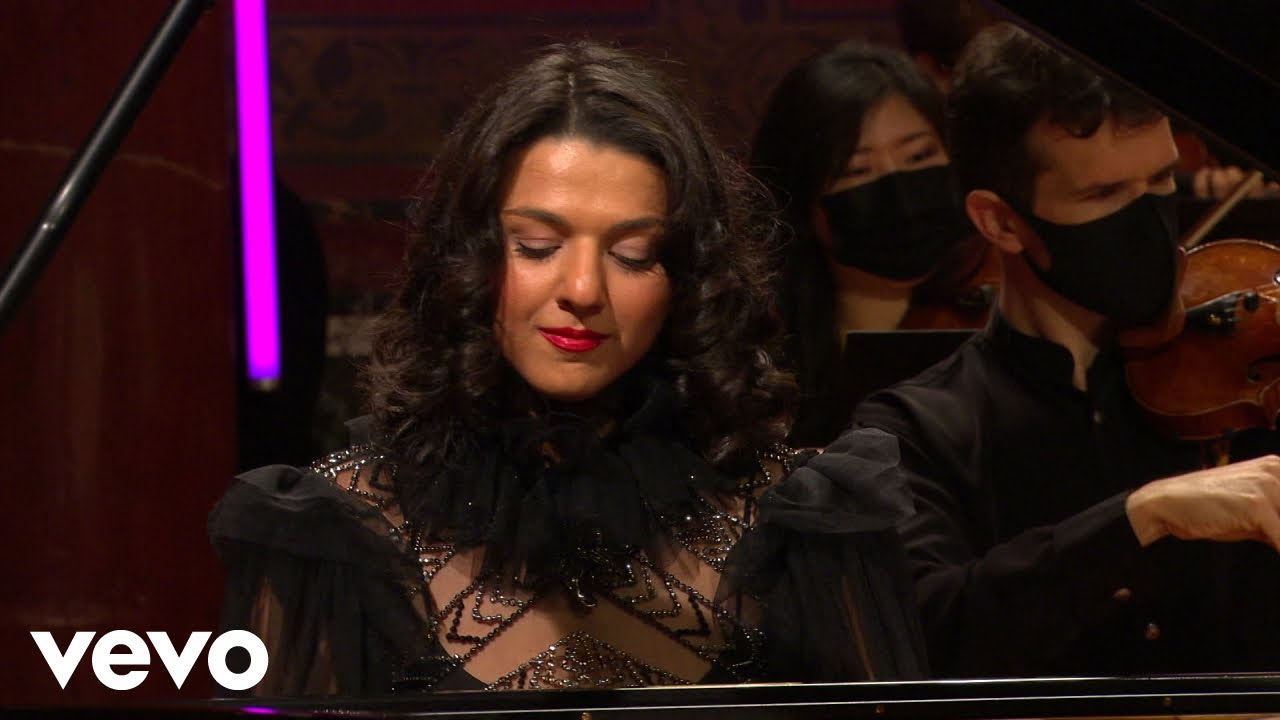
Tchaikovsky: Piano Concerto No. 1, Mov. 1
Khatia Buniatishvili Net Worth
As of 2026, Georgian-French concert pianist Khatia Buniatishvili’s net worth is estimated by entertainment sources to be between $100,000 and $1 million. She earns her income primarily as an international concert soloist and recording artist. She signed an exclusive contract with Sony Classical in 2010 and has released several albums on that label. Touring with major orchestras and live performances worldwide generate performance fees, and she supplements her income through teaching masterclasses and brand endorsements. These figures are not confirmed by major financial publications and should be considered approximate.
FAQs
Q1: Who Is Khatia Buniatishvili?
Khatia Buniatishvili is a Georgian-born concert pianist known for her highly expressive playing and international solo career. She performs regularly in major concert halls and festivals worldwide.
Q2: When Did Khatia Buniatishvili Begin Her Musical Career?
She began playing the piano at age three and performed publicly with an orchestra by age six. Her early performances and competition prizes established her professional path at a young age.
Q3: What Recording Label Is Khatia Buniatishvili Associated With?
She has been an exclusive recording artist with Sony Classical since 2010. Most of her major solo and concerto recordings have been released under this label.
Q4: What Repertoire Is Khatia Buniatishvili Best Known For?
She is particularly associated with Romantic and virtuosic repertoire, including works by Chopin, Liszt, Rachmaninoff, and Tchaikovsky. Her performances often emphasize emotional intensity and individuality.
Q5: Is Khatia Buniatishvili Still Actively Performing?
Yes, she remains highly active on the international concert stage. Recent seasons include major appearances at the BBC Proms, Carnegie Hall, European recital tours, and high-profile festival engagements.