Piano Music Theory Basics: How The Keyboard, Staff, And Chords Connect
If piano theory has ever felt like a stack of disconnected terms, the problem is usually not your talent. It is the order. Many learners are taught pieces of theory without being shown how those pieces connect on the keyboard.
Piano music theorymakes more sense when you learn pianoas a sequence of patterns. First you seethem on the keyboard and the page. Then you namethem. Then you buildthem. Then you usethem in actual music. That is the shift that turns theory from vocabulary into a working tool.
Key Takeaways
- Piano musictheoryexplains how notes, rhythm, scales, chords, and keys work on the keyboard.
- Beginners usually learn fastest in this order: keyboard layout, note names, rhythm, intervals, scales, chords, then chord progressions.
- You do not need to master all of music theory before you start playing songs.
- Theory becomes useful when you apply each idea at the keyboard, not just on paper.
- Advanced piano music theory grows out of the basics through harmony, modulation, extended chords, and deeper analysis.
What Piano Music Theory Actually Is
Piano musictheory is the system that explains how musical sound is organized for pianists. It covers pitch, rhythm, notation, scales, keys, chords, harmony, and the relationships between them.
That sounds broad, but the purpose is simple: theory helps you understand whymusic works. Instead of memorizing one song at a time, you start recognizing repeatable patterns. A major scale is not just one exercise. A triad is not just one chord shape. A progression is not just one sequence. Each one belongs to a larger system you can reuse across many songs.
That is why theory matters so much on piano. The keyboard makes musical structure unusually visible. You can see spacing, repeated note patterns, interval distances, chord shapes, and key relationships in a way that is harder to grasp on many other instruments.
The Order That Makes Piano Theory Click
A lot of frustration comes from learning the right ideas in the wrong sequence. Here is the version that usually works best, especially for beginners.
| Learn first | Why it matters now |
| Keyboard layout and note names | You need a map before anything else makes sense. |
| Rhythm and note values | Timing errors ruin even correct notes. |
| Whole steps, half steps, and intervals | These explain musical distance and structure. |
| Scales and keys | These organize notes into a usable system. |
| Chords and triads | These turn single notes into harmony. |
| Chord progressions | These explain how songs move and resolve. |
| Key signatures and transposition | These help you recognize patterns across pieces and keys. |
That sequence follows a practical logic:
- See it:keyboard layout, staff, clefs, note reading
- Name it:note names, intervals, scale degrees, chord qualities
- Build it:scales, triads, inversions, progressions
- Use it:songs, accompaniment, improvisation, transposition
Once you learn in that order, theory starts to feel connected instead of random.
Start With The Keyboard Map
Before scales, before Roman numerals, before the circle of fifths, you need to know the physical layout of the instrument.
The piano repeats the same seven letter names over and over: A, B, C, D, E, F, G. The black piano keysare grouped in twos and threes, and those patterns help you find everything quickly.
- The group of two black keyshelps you spot Cand D
- The group of three black keyshelps you spot Fand G
- This pattern repeats across the entire keyboard
That repeating design is one reason piano is such a powerful instrument for learning theory. The structure is built into the instrument itself.
Sharps, Flats, And Enharmonic Notes
A sharpraises a note by a half step. A flatlowers a note by a half step.
So:
- C-sharpmeans the key one half step above C
- D-flatmeans the key one half step below D
On piano, C-sharp and D-flat are the same physical key. That does not mean the names are interchangeable in every context. Spelling matters because theory is not only about sound. It is also about musical function and how notes behave inside a key.
Learn How The Grand Staff Connects To The Keyboard
Piano music is usually written on the grand staff, which combines two staves:
- Treble cleffor higher notes, usually played by the right hand
- Bass cleffor lower notes, usually played by the left hand
The most important landmark is middle C. It sits between the two staves and acts like a bridge between the hands. If you know where middle C is on the keyboard and on the page, note reading becomes much easier to organize.
If you want a more step-by-step walkthrough, here’s how to read piano notes.
Treble Clef And Bass Clef
The treble clef circles around the G above middle C, which is why it is also called the G clef. The bass clef marks the F below middle C, which is why it is also called the F clef.
At first, clefs can feel like two different languages. In practice, they are simply two reference systems for the same keyboard.
Ledger Lines, Rests, And Dotted Notes
This is one area many beginner articles skip too quickly, but it matters.
- Ledger linesare short lines added above or below the staff when notes go beyond the usual range
- Reststell you when not to play and for how long
- Dotted notesextend a note’s value by half of its original length
For example:
- A half note lasts two beats
- A dotted half note lasts three beats
- A quarter rest means one silent beat in 4/4 time
These are small notation details, but they make a big difference in reading confidence. If you can identify middle C, understand both clefs, and recognize basic rests and dotted values, sheet musicbecomes far less intimidating.
Rhythm Is The First Theory Skill You Feel In Your Hands
Many beginners focus on note names and ignore timing. That creates shaky playing very quickly. Rhythm is often the first theory skill that becomes physical.
Here is the simplest distinction:
- Beatis the steady pulse
- Rhythmis the pattern of longer and shorter sounds against that pulse
- Tempois the speed of the beat
- Meteris how beats are grouped
If those ideas stay blurred together, practice feels messy. Once they separate in your mind, counting becomes more reliable.
Time Signatures Without Confusion
A time signaturetells you how beats are organized in each bar.
In 4/4 time:
- The top 4 means there are four beats in the bar
- The bottom 4 means the quarter note gets one beat
You do not need to overcomplicate this at the start. What matters most is feeling the recurring pulse and learning how note values fit inside it.
A Tiny Rhythm Exercise
Try this in 4/4:
- Clap four quarter notes: 1 2 3 4
- Clap two half notes: 1-2, 3-4
- Play middle C four times as quarter notes
- Play middle C once as a whole note and count all four beats aloud
This simple drill teaches a major lesson: the same beat grid can hold very different rhythmic values. Once rhythm becomes stable, everything else in theory becomes easier to hear and place.
Intervals Are The Bridge Between Notes And Structure
An intervalis the distance between two notes. That may sound simple, but intervals are one of the most important ideas in piano music theory because they explain how notes relate to each other.
A half step is the smallest standard distance on the keyboard. A whole step is two half steps.
From there, intervals grow outward:
- minor 2nd
- major 2nd
- minor 3rd
- major 3rd
- perfect 4th
- perfect 5th
- and so on
At first, interval names can seem technical. On the keyboard, though, they are practical. Intervals tell you:
- how to build scales
- how to build chords
- why a chord sounds major or minor
- how tension and resolution are created
Once you understand intervals, scales and chords stop feeling like separate topics. They become two expressions of the same structure.
Scales, Keys, And Key Signatures Made Usable
A scaleis an ordered set of notes. A keygives those notes a home base, usually called the tonic. A key signaturetells you which sharps or flats belong consistently to that key.
That is the technical version. The practical version is this: a key tells you which notes and chords will feel most natural together.
How To Build A Major Scale
The major scale follows this pattern:
whole, whole, half, whole, whole, whole, half
Start on C and you get: C-D-E-F-G-A-B-C
That pattern matters more than the individual example. Once you know the formula, you can build a major scale from any starting note.
Natural Minor And Relative Minor
Minor keys bring a different emotional color and a different interval pattern. A useful beginner doorway is the idea of the relative minor.
- C major and A minor use the same notes
- They share the same key signature
- They feel different because the tonal center is different
That is a big moment in theory. It shows that music is not just about which notes appear. It is about which note feels like home.
What A Key Really Tells You
A key does not only list “allowed” notes. It creates a hierarchy.
Some notes feel settled. Some feel tense. Some feel like they want to move somewhere else.
The same is true for chords. In a key, chords have jobs. Some sound stable. Some prepare movement. Some pull strongly back to the tonic. That is where harmony begins to make sense.
When The Circle Of Fifths Actually Helps
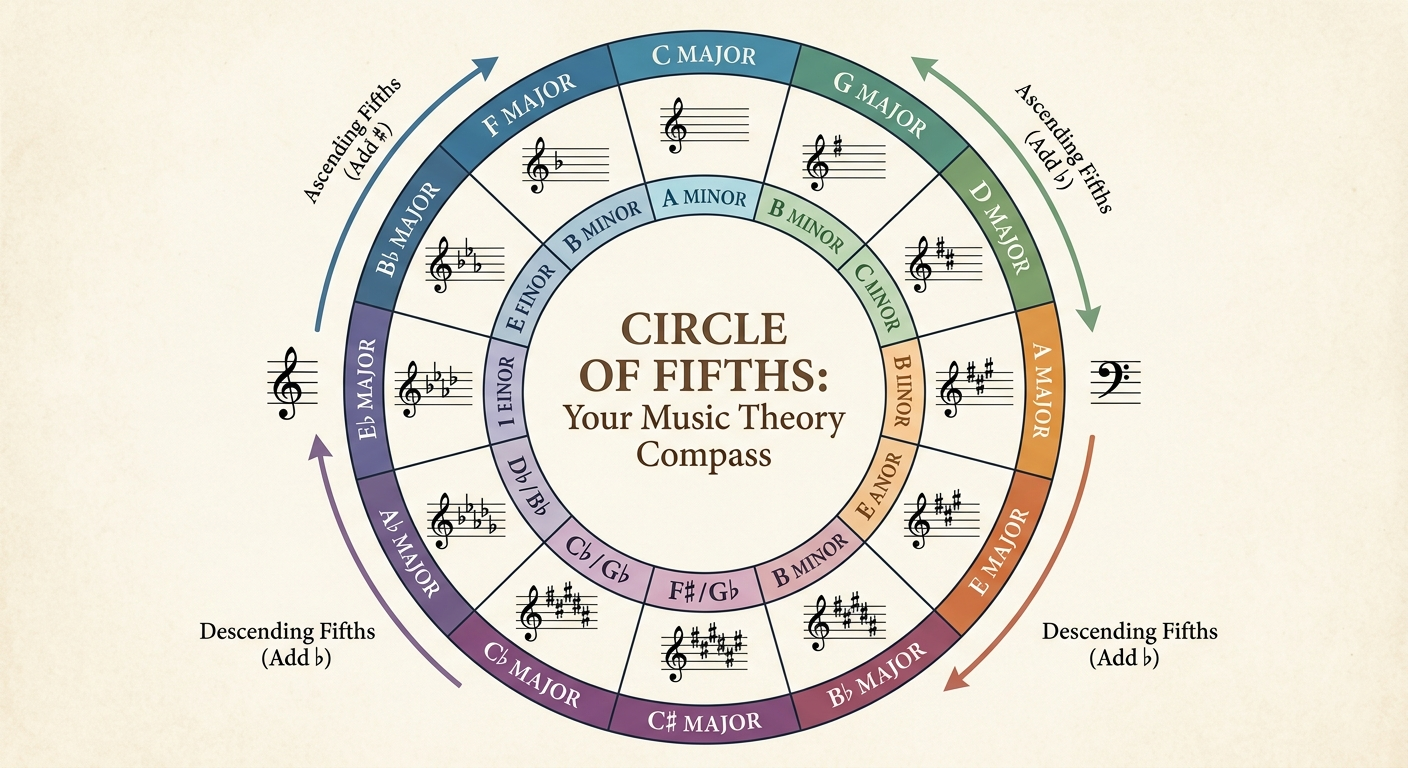
The circle of fifthsis useful, but many beginners meet it too early.
It helps with:
- understanding key signatures
- seeing related keys
- spotting major/minor pairs
- transposing patterns into new keys
It does notneed to be your first theory lesson. Learn the keyboard map, intervals, one major scale, and a few basic chords first. Then the circle becomes a map you can actually use.
Chords Are Where Piano Theory Becomes Practical
For many learners, this is where theory stops sounding academic and starts sounding musical.
A chordis more than multiple notes played together. It is a way of organizing harmony. The most important first step is the triad, a three-note chord built by stacking thirds.
How To Build Major And Minor Triads
A major triadcontains:
- root
- major 3rd
- perfect 5th
A minor triadcontains:
- root
- minor 3rd
- perfect 5th
For example:
- C major = C-E-G
- C minor = C-E♭-G
That one change, from major 3rd to minor 3rd, is enough to change the color of the chord.
Diminished And Augmented Triads
Once major and minor are clear, the other basic triads make more sense:
- Diminished triad= root, minor 3rd, diminished 5th
- Augmented triad= root, major 3rd, augmented 5th
Beginners do not need to live in these immediately, but they should know they exist. They complete the core triad family.
Inversions And Why They Matter On Piano
An inversion changes which note is in the bass.
For C major:
- Root position: C-E-G
- First inversion: E-G-C
- Second inversion: G-C-E
For pianists, inversions are extremely practical. They help your hands move less, make accompaniment smoother, and create cleaner chord transitions. If chords feel jumpy, inversions are often the missing piece.
Diatonic Chords And Roman Numerals
Every major key contains a family of chords built from its own scale notes. These are diatonic chords.
In C major, they are:
- I = C major
- ii = D minor
- iii = E minor
- IV = F major
- V = G major
- vi = A minor
- vii° = B diminished
This is one of the most useful concepts in piano chord theory because it explains why certain chords regularly appear together in songs.
Roman numerals matter because they describe function, not just letter names. If you understand I-IV-Vin one key, you understand that same pattern in every key. That makes transposition and pattern recognition much easier.
Chord Progressions Explain Why Songs Move
A chord progressionis not just a chain of chords. It is a pattern of movement, tension, and resolution.
This is where the earlier framework becomes important again:
- You seethe chord shapes
- You namethem by letter or Roman numeral
- You buildthem from the scale
- You usethem in songs
Three Progressions Worth Learning Early
I-IV-V
This is the classic beginner progression. It teaches the basic feeling of departure and return.
I-V-vi-IV
This progression appears in a huge amount of modern popular music. It is a great way to hear how familiar harmonic patterns support melodies.
Ii-V-I
This is a valuable next step because it sharpens your sense of preparation and resolution.
A Worked Example In C Major
Use C major as your test key.
- Build the scale: C-D-E-F-G-A-B-C
- Build the I chord: C-E-G
- Build the IV chord: F-A-C
- Build the V chord: G-B-D
- Play I-IV-V-Iand listen for the return home
Now try this:
- Left hand: C - G - Am - F
- Right hand: improvise only using notes from the C major scale
You will hear something important very quickly: the scale gives you a safe note pool, but some notes sound more stable than others over each chord. That is the beginning of harmonic hearing.
How To Practice Piano Theory Without Getting Stuck In Study Mode
Theory only matters if it changes what you can do. If it stays trapped in definitions, it becomes background noise.
The best practice is usually small, frequent, and tied directly to the keyboard.
Use Micro-Drills
Try a five-minute cycle like this:
- name every C on the keyboard
- build one major scale
- build one minor triad
- play one progression in two keys
- read one bar in treble clef and one in bass clef
That kind of loop keeps theory active. It also stops you from turning theory into a separate subject that never touches your playing.
Learn Notation And Chords In Parallel
A common beginner question is whether you should learn sheet music first or chords first. For most people, the best answer is both, lightly, at the same time.
Learn enough notation to read simple music. Learn enough chord theory to play real music early.
That balance keeps motivation high without leaving large gaps in understanding.
One Common Mistake
A common mistake is studying theory away from the instrument for too long. Piano theory becomes much clearer when every new idea turns into a sound and a shape within minutes.
If you learn a scale formula, build it. If you learn a triad, play it. If you learn a progression, hear it in more than one key.
What Counts As Advanced Piano Music Theory
Advanced piano music theory is not a different universe. It is what happens when the basics become strong enough to support richer ideas.
That usually includes:
- seventh chords
- chord extensions like 9ths, 11ths, and 13ths
- slash chords
- modulation
- modal interchange
- chromatic harmony
- deeper harmonic analysis
- chord-scale relationships
- more deliberate voice leading
Harmonic Function Beyond Basic Triads
At a higher level, chords are not only shapes or labels. They have jobs inside a key. Some create stability. Some prepare movement. Some build tension that wants to resolve.
Understanding that function is one of the biggest differences between basic and advanced theory. You stop thinking only in terms of “which chord is this?” and start asking “what is this chord doing here?”
Modulation And Richer Color
Modulationmeans changing key. That can be subtle or dramatic. It allows music to shift emotional center and create contrast.
Advanced learners also begin to hear how borrowed chords, modal color, and chromatic movement expand a progression beyond simple diatonic harmony. The key point is that these advanced sounds still grow out of the same fundamentals: intervals, scales, chord construction, and function.
The Fastest Path From Theory To Real Music
Not every pianist needs the same first emphasis. Your goal should influence what you practice first.
If You Want To Read Sheet Music
Focus on:
- keyboard layout
- middle C and staff landmarks
- treble and bass clef note reading
- rhythm and note values
- rests, dotted notes, and ledger lines
- key signatures
If You Want To Play By Chords
Focus on:
- interval recognition
- major and minor triads
- inversions
- Roman numerals
- common progressions in several keys
If You Want To Improvise Or Write Songs
Focus on:
- scales and keys
- chord tones
- diatonic harmony
- progression feel
- ear training
- transposition
That is the practical truth about piano music theory: it becomes much more efficient once you match the theory you study to the music you want to make.
Frequently Asked Questions
Do I Need Theory To Play Piano?
No. You can begin without much theory, but even basic theory helps you read, remember, improvise, and understand what you play more efficiently.
What Is Basic Piano Theory?
Basic piano theory includes keyboard layout, note names, treble and bass clef reading, rhythm, intervals, scales, keys, and simple chords.
What Should Beginners Learn First In Piano Theory?
Start with the keyboard map, note names, and rhythm. Then move into intervals, scales, chords, and simple progressions.
How Much Theory Is Enough For Beginners?
Enough to identify notes, count basic rhythm, build a few scales, and play common chords and progressions. You do not need advanced harmony to make real progress.
Can I Teach Myself Piano Music Theory?
Yes, if the material is sequenced well and you apply each concept at the keyboard instead of only reading about it.
What Is Advanced Piano Music Theory?
Advanced piano music theory usually includes harmonic function, seventh chords, extensions, modulation, modal interchange, and deeper analysis of how music moves.
Final Thought
Piano music theory is not a pile of rules to survive. It is a pattern system that helps you make better musical decisions.
Start with one key. Build one scale. Play one triad. Hear one progression return home. That is where theory stops feeling abstract and starts becoming musicianship.