The Ultimate Guide To The Best MIDI Keyboards By Workflow
The best MIDI keyboard is the one that fits your hands (key size/action), your workflow (knobs/pads/faders), and your setup (DAW + ports)-without making you fight it.
If you’re still deciding on hardware, you can test your workflow in the browser first with an online MIDI piano.
Quick Pick
- Best portable (mini keys):Akai MPK Mini Mk4 - tiny footprint, pads + screen. Alt:Arturia MiniLab 3 (more knobs + MIDI out).
- Best keyboard action (piano feel):Studiologic SL88 Grand - flagship hammer action. Alt:Kawai VPC1 (piano-only master feel).
- Best for music production:Arturia KeyLab Mk3 (49/61) / KeyLab 88 Mk3 - faders/encoders/pads + modern control. Alt:Novation Launchkey 49/61 Mk4.
- Best for live performance (keyboard):NI Komplete Kontrol S61 Mk3 - deep NKS workflow. Alt:Novation SL MkIII 49.
- Best for Ableton (pads):Novation Launchpad X - clip workflow. Alt:Launchkey Mk4 (keys + pads).
- Best pad controller (MPC workflow):Akai MPC Studio - MPC-style creation. Alt:MPK Mini Mk4.
- Best for FL Studio:Novation FLkey 49 - FL-focused mapping. Alt:Launchkey 49 Mk4.
- Best for beginners:Nektar Impact LX49+ - full keys + faders/pads without complexity. Alt:M-Audio Keystation 49.
Availability snapshot:Data as of March 2026. Models and stock change by region; always confirm on the brand’s official page or a major retailer.
Index By Key Count
- 25–32 keys:MPK Mini Mk3/Mk4, MiniLab 3, KeyStep, Komplete Kontrol A25, M32, SE25, microKEY Air-25, Piano M, Seaboard M
- 37 keys:Launchkey 37 Mk3, iRig Keys 2 (your entry), KeyStep (32 but similar role)
- 49 keys:MPK249, KeyLab 49 MkII/Mk3, Komplete Kontrol S49, Alesis V49 MKII, VI49, FLkey 49, Launchkey 49 Mk4, Roland A-49, LX49+, SE49, Keystation 49
- 61 keys:MPK261, KeyLab 61 MkII/Mk3, Komplete Kontrol S61, Impulse 61, Launchkey 61 Mk4, Keystation 61, VI61, A61
- 88 keys:Kontrol S88, KeyLab 88 Mk3, SL88 Studio/Grand, Hammer 88, VPC1
Index By Use Case
- Beginners:LX49+, Keystation 49, MPK Mini Mk4, MiniLab 3
- Ableton-friendly:Launchkey Mk4 line, SL MkIII, Launchpad X (pads)
- FL Studio:FLkey 49
- Piano feel:SL88 Grand/Studio, VPC1, Hammer 88, Kontrol S88
- Hardware rigs:KeyStep, SL MkIII, KeyLab Mk3 (MIDI I/O and workflow features)
- Portable:MPK Mini Mk4, MiniLab 3, microKEY Air-25, SE25
Below you’ll find quick simple chooser, then a full, model-by-model breakdown.
Pick Your Path
- Pick your key count:25–32 for travel/tight desks, 49for most home studios, 61for two-hand parts, 88for piano technique. Quick clarification before you choose: “MIDI keyboard” and “MIDI controller” get used interchangeably, but they’re not always the same thing in practice-here’s a simple breakdown of MIDI controllers vs MIDI keyboardsso you buy the right tool for your workflow.
- Pick your focus:notes (key feel + sustain), beats (pads + repeat/scale tools), automation (faders + endless encoders), hardware (MIDI out/CV).
- Choose integration:basic = manual mapping, DAW-ready = templates/scripts, ecosystem = browsing + consistent mappings (NKS/Analog Lab).
- Confirm connections:USB-C vs USB-A for computers; iPad needs adapter/power plan; hardware needs MIDI out (DIN/TRS) and sometimes CV/Gate.
- Don’t overbuy controls:if you won’t use faders/pads weekly, spend that budget on a better keybed instead.
- Final sanity check:if it doesn’t fit your desk and your hands, it won’t get used.
A simple way to choose
| Your main use case | Must-have features (minimum) |
| Home studio songwriting | 49+ keys, sustain input, transport controls |
| Beatmaking + clips | 16 pads (or great 8), encoders, scale/chord mode |
| Mixing + automation | 8–9 faders, endless encoders, clear banking |
| Ableton performance | proven Ableton control-surface support/auto-detect |
| Logic workflow | control-surface support + reliable transport/mixer mapping |
| FL Studio power user | controller scripting support + FL-focused mappings |
| Hardware synths/modular | 5-pin/TRS MIDI out and/or CV/Gate |
How We Evaluate MIDI Keyboards
I rate controllers by a five-part “fit” lens. You can apply this to any model you’re considering:
- Keys: count + action + consistency (does it invite playing?)
- Controls: do pads/faders/encoders match your bottleneck?
- Integration: does your DAW have official setup guidance or profiles?
- Connectivity: USB-C/A, iPad viability, Bluetooth, MIDI out, CV/Gate as needed.
- Expression: aftertouch/poly-aftertouch/MPE support if your instruments can use it.
A controller becomes “best” when it scores high in the category you actually live in-not when it checks every box.
Top Best MIDI Keyboards
1. Akai MPK Mini Mk3
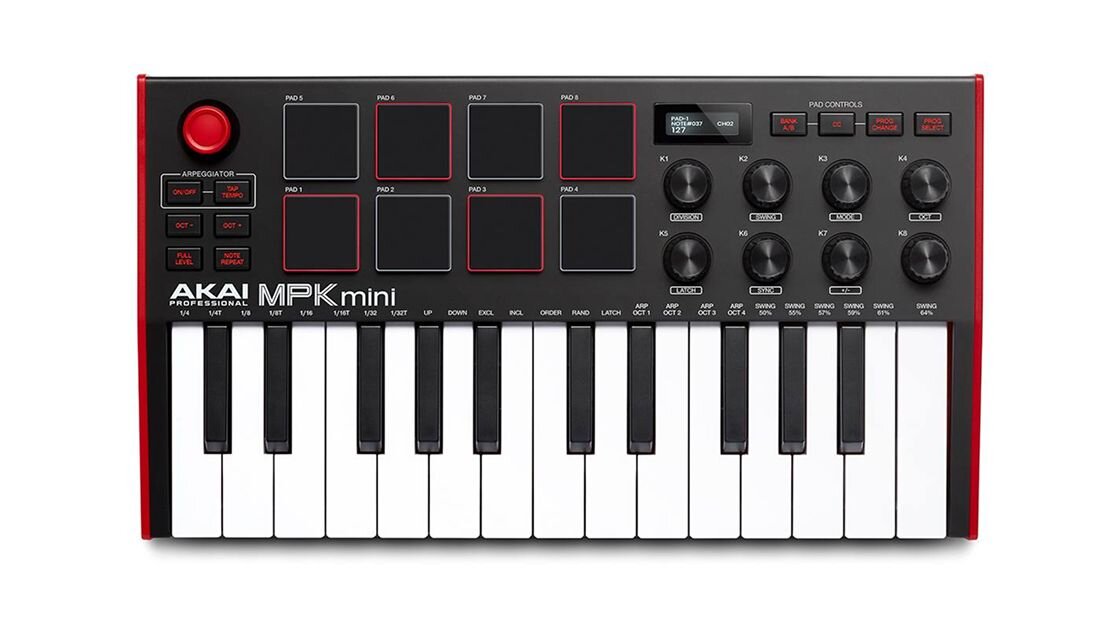
A 25‑key ultra‑portable MIDI controller with MPC pads and assignable knobs.
- Best for:budget portable beatmaking and quick melody sketching.
- Avoid if:mini keys make you tense up when playing two-handed parts.
- Integration:Basic (maps easily; deep control depends on DAW templates).
Specifications
- Compatibility:Mac/PC/iOS
- Keys:25 mini-keys
- Key type:Velocity-sensitive
- Controls:8 MPC pads, 8 knobs, 4-way thumbstick, arpeggiator, note repeat
- Connectivity:1 x USB Type-B port (MIDI and Power), 1/4" sustain, 5-pin MIDI out
- Power:USB bus power
- Dimensions:31.8 x 18.1 x 4.4 cm
- Weight:0.75 kg
- Price Range:~$99–$119
- Availability:Current product page active
2. Akai MPK Mini Mk4
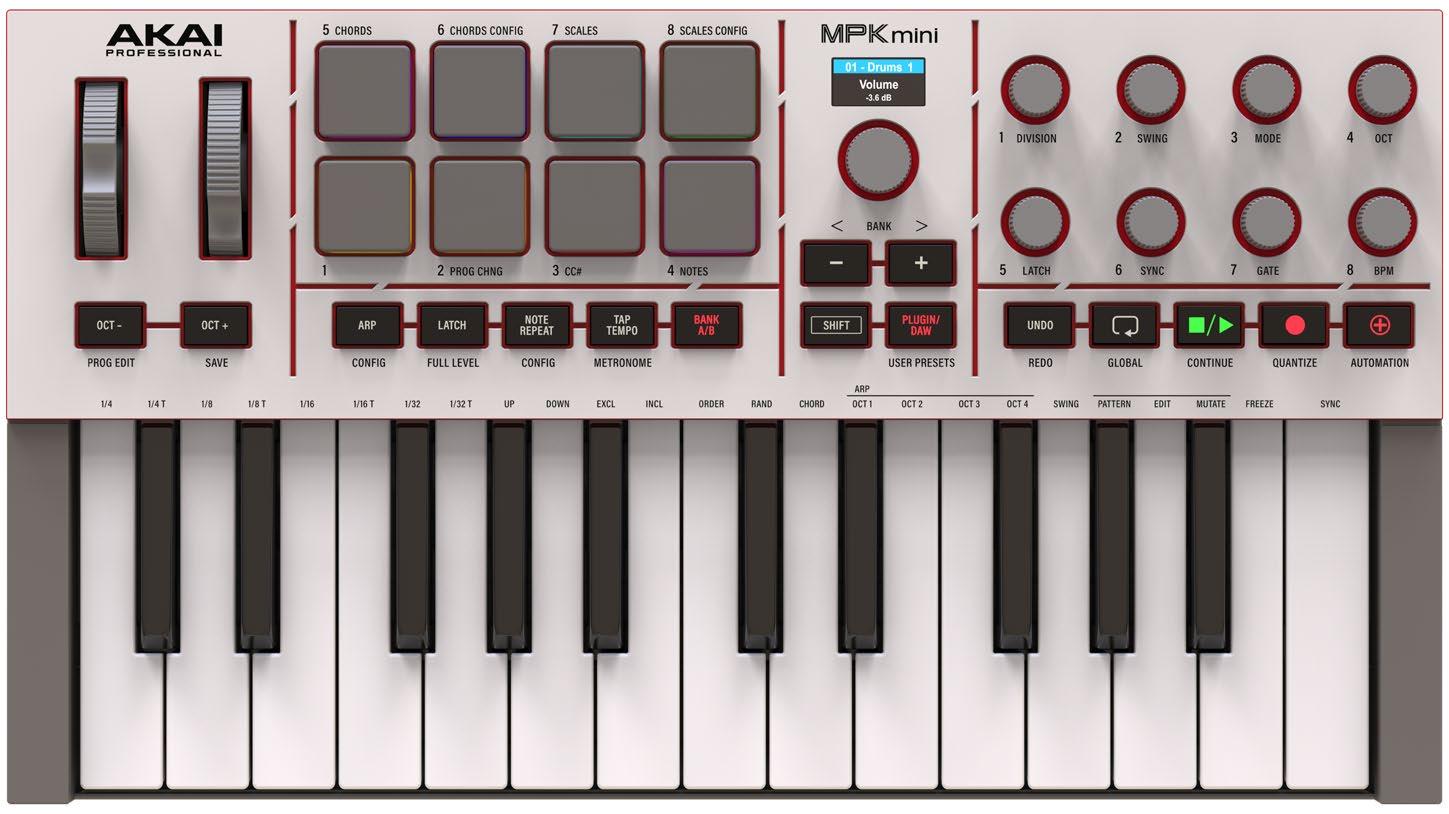
The newer MPK Mini refresh adds a screen and dedicated pitch/mod wheels, which sounds small on paper but feels big in daily use.
- Best for:portable writing with better on-device feedback (screen + wheels).
- Avoid if:you need full-size keys for technique or long sessions.
- Integration:Basic to Template (depends on DAW + mappings).
Specifications
- Compatibility:Mac (macOS 10.13+), Windows 10/11, and iOS/iPadOS.
- Keys:25 mini-keys
- Key type:Velocity-sensitive
- Controls:8 RGB pads, 8 knobs, pitch wheel, mod wheel, transport buttons, screen + nav encoder
- Connectivity:USB-C, Full-size 5-pin MIDI DINoutput, 1/4” TS sustain pedal input.
- Power:USB powered
- Dimensions:34.8 × 19.3 × 4.6 cm
- Weight:1.05 kg
- Price Range:~$99.00 – $109.99
- Availability:Current product page active
3. Akai MPK225
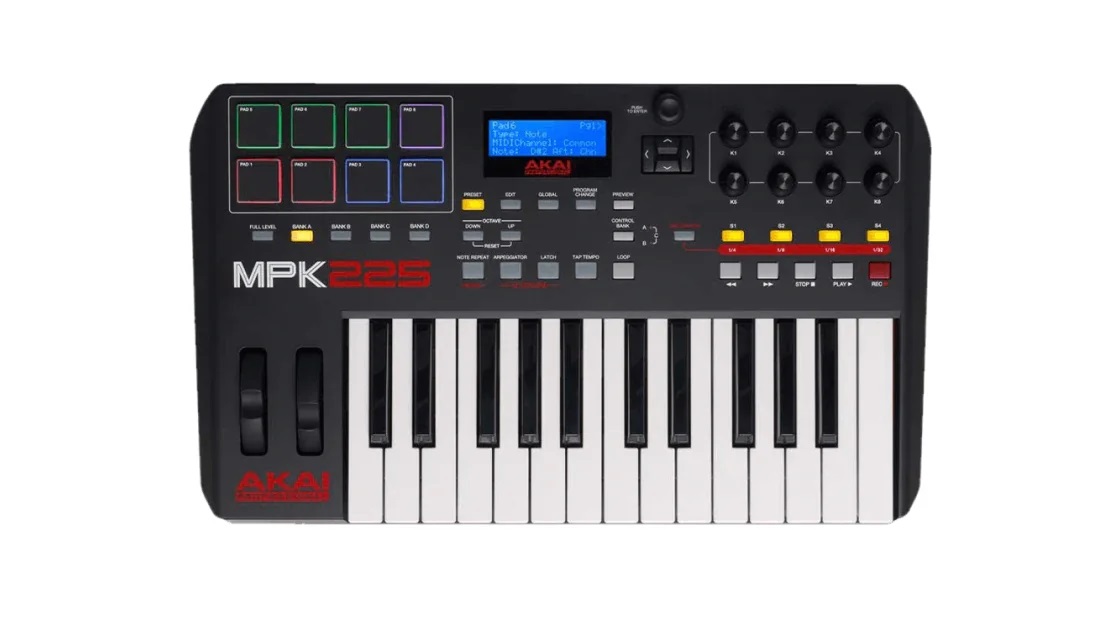
The MPK225 is the bridge between portable convenience and professional "big board" feel.
- Best for:compact “real controller” feel with faders + pads.
- Avoid if:you want more than 25 keys for two-hand work.
- Integration:Template (stronger when using DAW mappings).
Specifications
- Compatibility:Mac (macOS 10.13+), Windows (10/11), and iOS (via Apple Camera Connection Kit).
- Keys:25 (full-size)
- Key type:Velocity-sensitive with Assignable Aftertouch.
- Controls:8 pads, 8 knobs, 8 faders, transport + controls (multi-bank)
- Connectivity:1 x USB Type-B, 5-pin MIDI in/out, 1 x 1/4" Expression pedal input, 1 x 1/4" Sustain/Footswitch input.
- Power:USB bus power / optional 6V DC adapter
- Dimensions:48.9 cm x 29.8 cm x 9.2 cm
- Weight:2.76 kg
- Price Range:~$249.00 – $269.00
- Availability:Current product page active
4. Akai MPK249
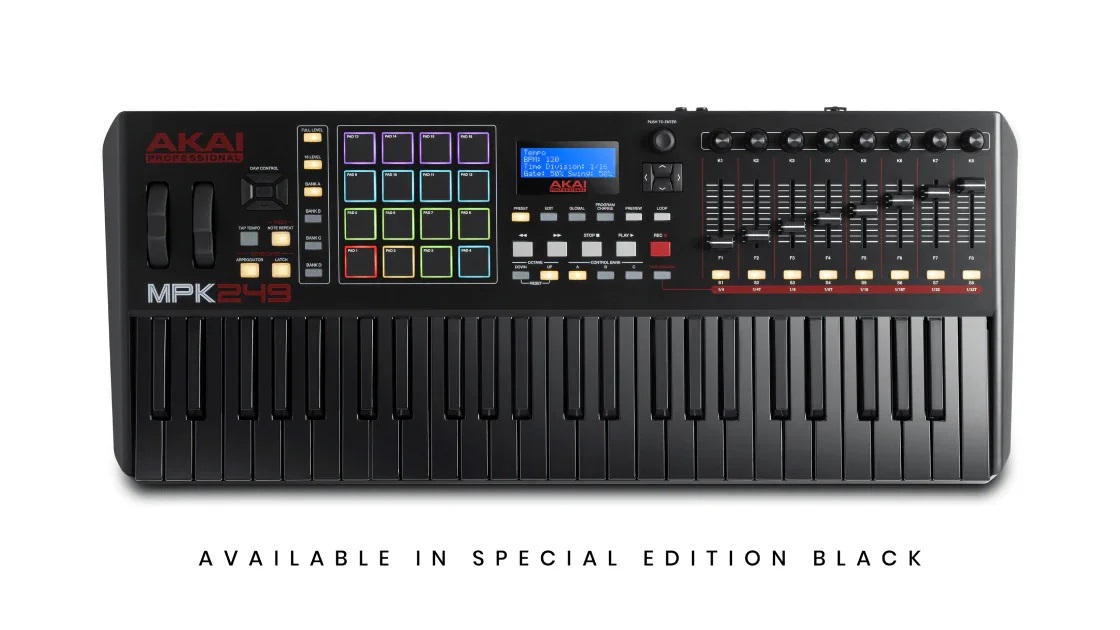
The “do everything” size: 49 keys plus a full control surface. If your desk can handle it, your workflow usually improves.
- Best for:all-in-one studio control (keys + pads + faders).
- Avoid if:desk depth is tight-this needs space to feel comfortable.
- Integration:Template (solid once mapped).
Specifications
- Compatibility:Mac (macOS 10.13+), Windows 10/11, and iOS (via Apple Camera Connection Kit).
- Keys:49 full-size
- Key type:Velocity-sensitive with Assignable Aftertouch.
- Controls:16 pads, 8 faders (3 banks), 8 encoders (3 banks), 8 switches (3 banks)
- Connectivity:USB, 5-pin MIDI in/out, sustain + expression
- Power:USB bus power / optional 6V DC adapter
- Dimensions:73.7 x 31.1 x 8.6 cm
- Weight:5.72 kg
- Price Range:~$149.00 to $469.00
- Availability:Current product page active
5. Akai MPK261
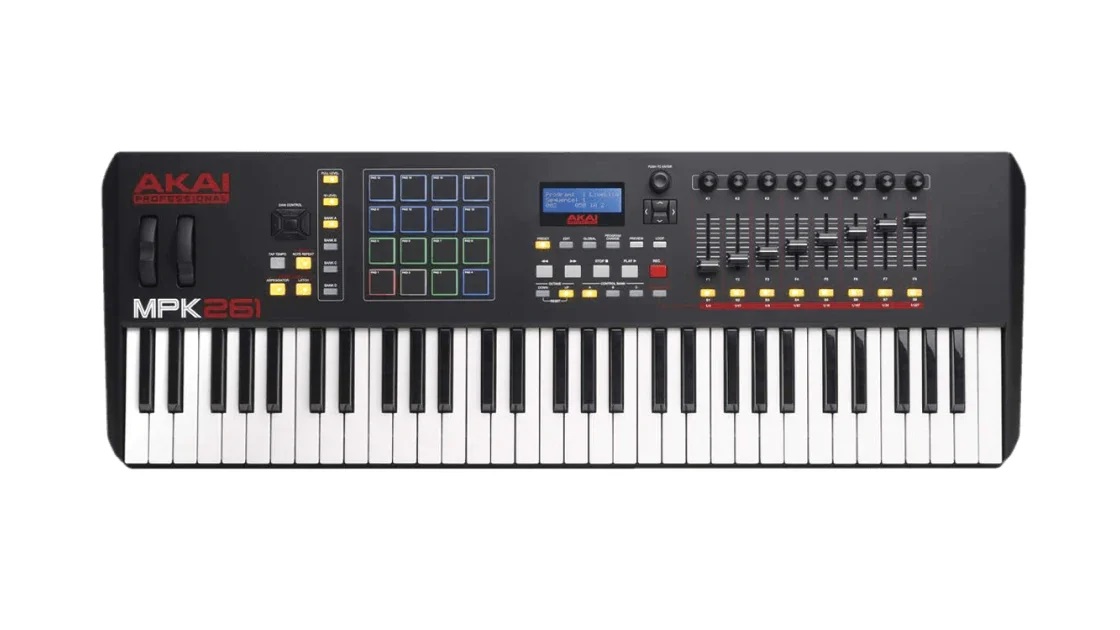
If you play with two hands and want lots of physical controls, 61 keys hits the sweet spot.
- Best for:two-hand playing with a full control surface.
- Avoid if:you rarely play two-handed; 49 keys may be plenty.
- Integration:Template.
Specifications
- Compatibility:Mac/PC
- Keys:61 Full
- Key type:Semi-weighted, velocity-sensitive, aftertouch
- Controls:16 pads, 8 faders (3 banks), 8 encoders (3 banks), 8 switches (3 banks)
- Connectivity:USB, 5-pin MIDI in/out, sustain + expression
- Power:USB bus power / optional 6V DC adapter
- Dimensions:90.5 x 31.1 x 8.6 cm
- Weight:6.84 kg
- Price Range:~$439.24 to $685.00
- Availability:Current product page active
6. Native Instruments Kontrol S88
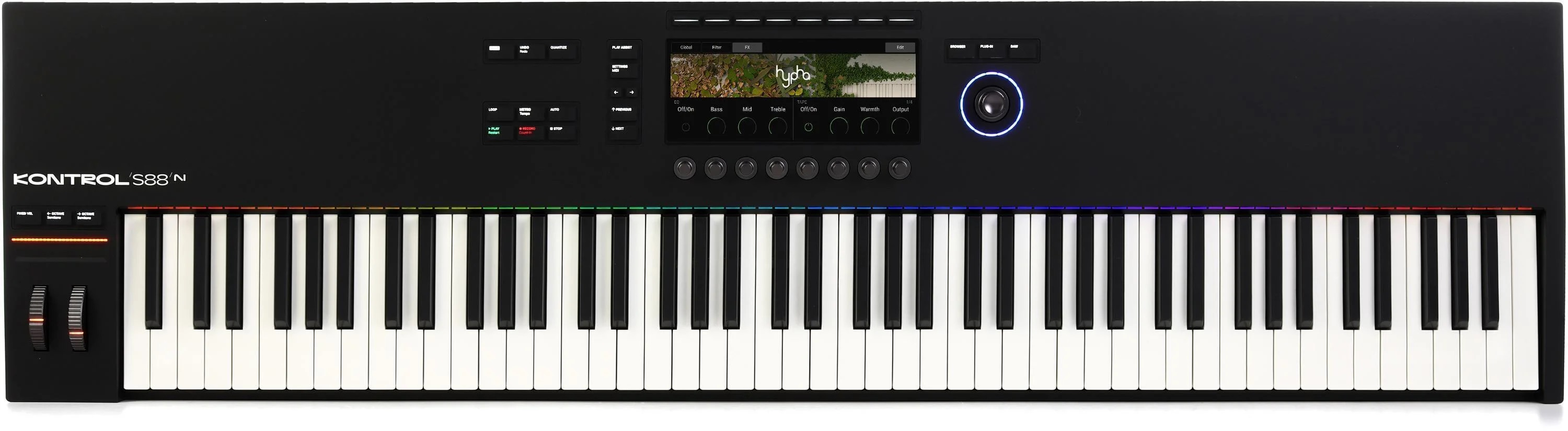
The Kontrol S88 Mk3 is the definitive high-end master controller for the Komplete ecosystem.
- Best for:premium piano-range control + NKS browsing/mapping.
- Avoid if:you don’t use NI/NKS-compatible instruments-value drops if you don’t.
- Integration:Ecosystem (NKS) + DAW-ready.
Specifications
- Compatibility:Mac: macOS 13 or higher (macOS 12 supported in MIDI 1.0 mode); Intel Core i5 or Apple M1/higher. Windows 10 or higher
- Keys:88 Fully Weighted, Hammer-action keys
- Key type:Velocity-sensitive with Polyphonic Aftertouch
- Controls:8 touch-sensitive RGB-backlit encoders + 1 4-directional push encoder, wheels, touch strip, transport.
- Connectivity:2 x USB-C, 5-pin DIN In/Out, 4 x 1/4" jacks (Sustain, Expression, and 2 x Assignable).
- Power:USB-C Bus Powered
- Dimensions:135.3 × 34.7 × 12.0 cm
- Weight:13.5 kg (29.76 lbs).
- Price Range:~$1,299.00.
- Availability:Current product page active
7. Arturia KeyLab 49 MkII
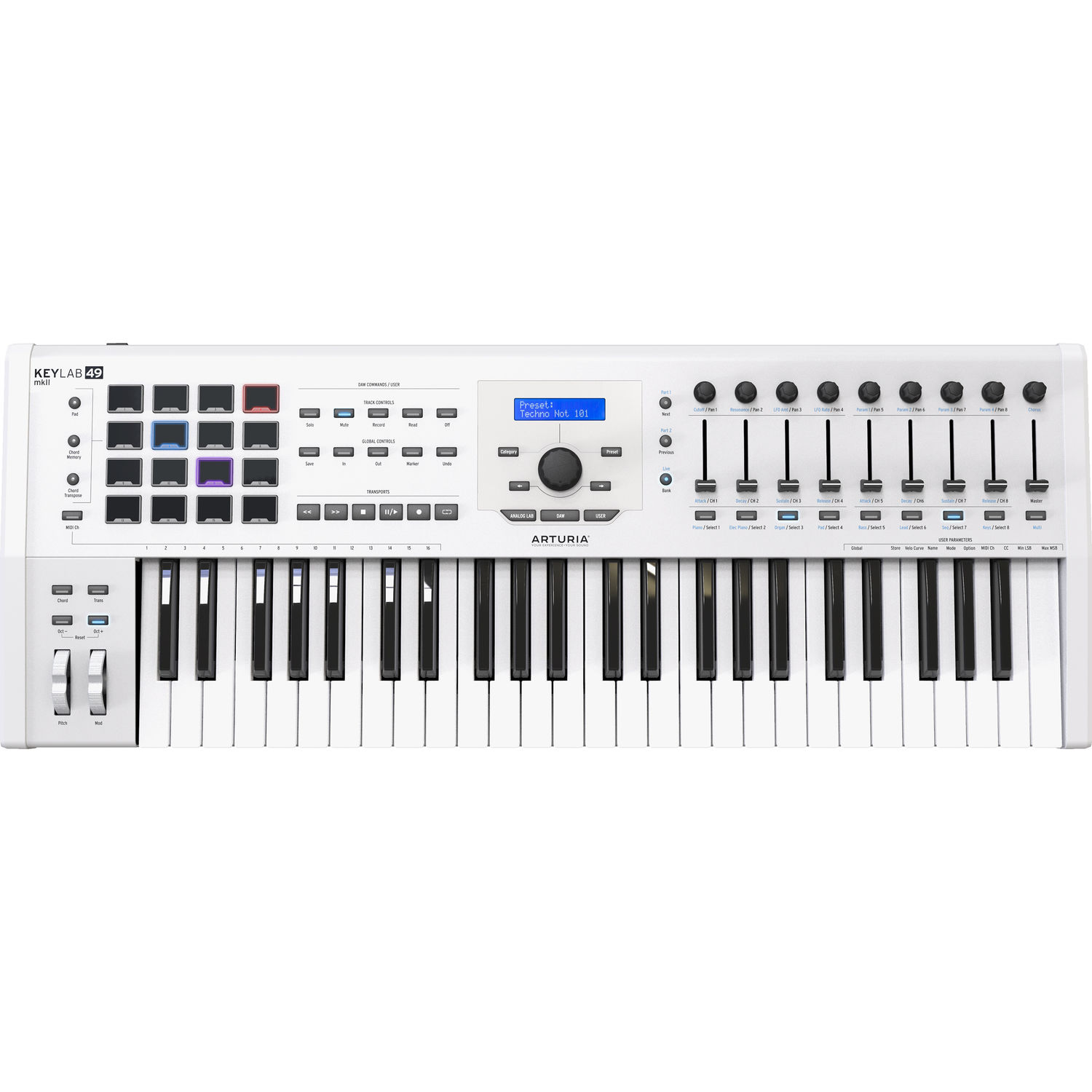
The KeyLab 49 MkII is Arturia’s professional "Command Center," designed to bridge the gap between software instruments, modern DAWs, and vintage analog modular gear.
- Best for:hybrid studios that want DAW control plus MIDI/CV-friendly workflow.
- Avoid if:you want the newest KeyLab Mk3 workflow and screen features.
- Integration:Template/Ecosystem (strong with Analog Lab).
Specifications
- Compatibility:Windows 10/11, macOS 10.13+.
- Keys:49 full-size "Pro-Feel" semi-weighted keys
- Key type:Velocity-sensitive with Channel Aftertouch.
- Controls:16 RGB backlit performance pads, 9 large faders, 9 rotary encoders, 5 expression control inputs, 4 CV output jacks, Smart category controls, pedals
- Connectivity: USB Type-B port, 5-pin MIDI In and Out, 4 CV output jacks (Pitch, Gate, Mod 1, Mod 2) + 1 CV Input jack for modular synth integration.
- Power:USB bus powered or optional 9V DC adapter (sold separately).
- Dimensions:793 × 297 × 53 mm.
- Weight:6.3 kg
- Price Range:~$379.00 – $449.00
- Availability:Current listing active on Arturia
8. Arturia KeyLab 61 MkII
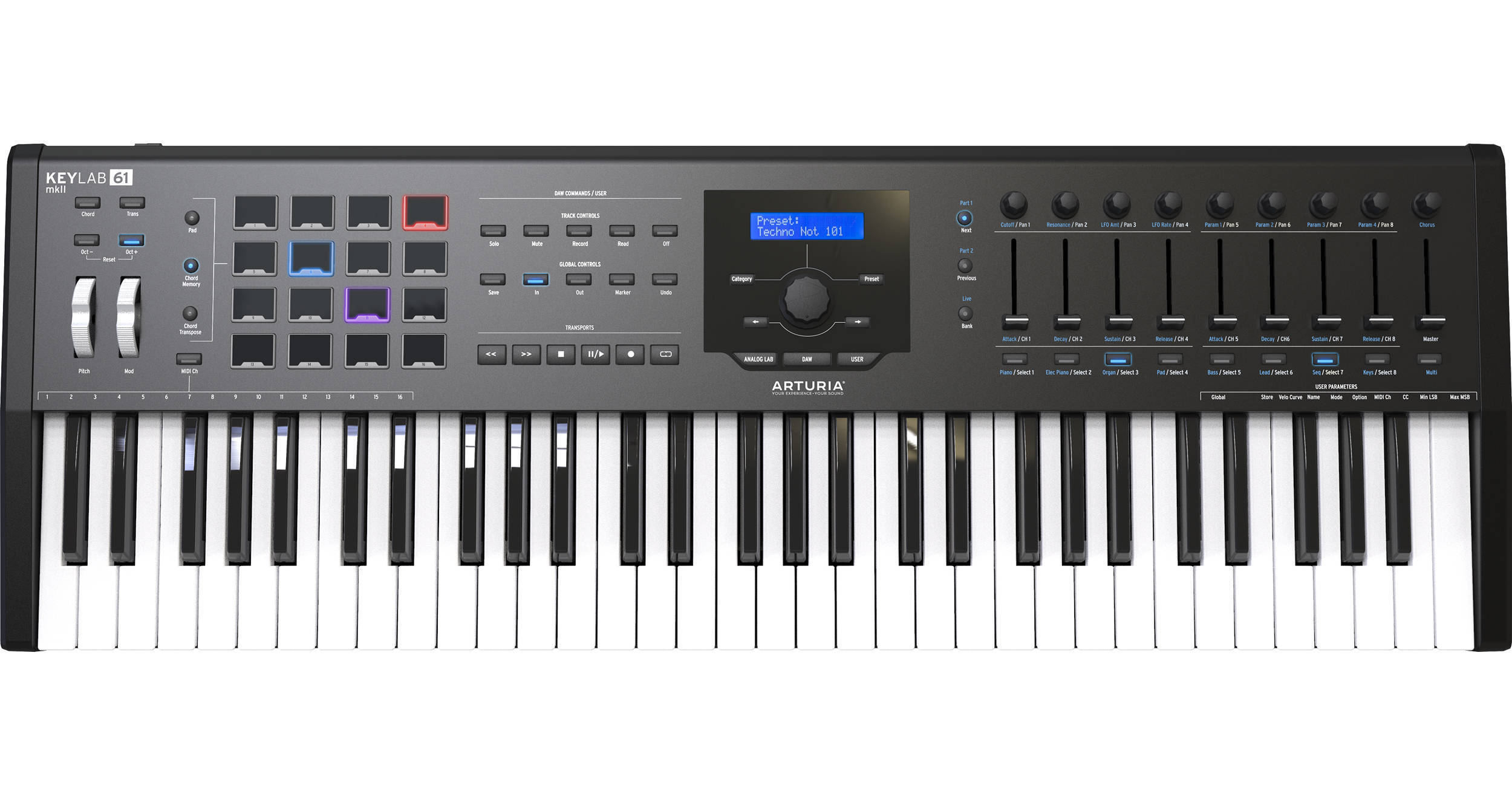
The KeyLab 61 MkII is Arturia’s professional centerpiece, designed for users who need a high-performance keyboard that can simultaneously control a DAW, software instruments, and vintage analog hardware.
- Best for:a “one keyboard does most things” studio centerpiece.
- Avoid if:you need weighted keys for piano technique.
- Integration:Template/Ecosystem.
Specifications
- Compatibility:Windows 10/11, macOS 10.13+ (Universal Binary for Intel/Silicon).
- Keys:61 full-size "Pro-Feel" semi-weighted keys
- Key type:Velocity-sensitive with Channel Aftertouch.
- Controls:16 RGB backlit performance pads, 9 large faders, 9 rotary encoders, 5 expression control inputs, 4 CV output jacks, Pedals
- Connectivity:USB Type-B port, 5-pin MIDI In and Out, CV/Gate
- Power:USB bus powered or optional 9V 1.0A DC adapter (center-positive).
- Dimensions:875 × 297 × 53 mm.
- Weight:7.0 kg
- Price Range:~$449.00 – $549.00
- Availability:Current listing active on Arturia
9. Arturia KeyLab 49-key Mk3
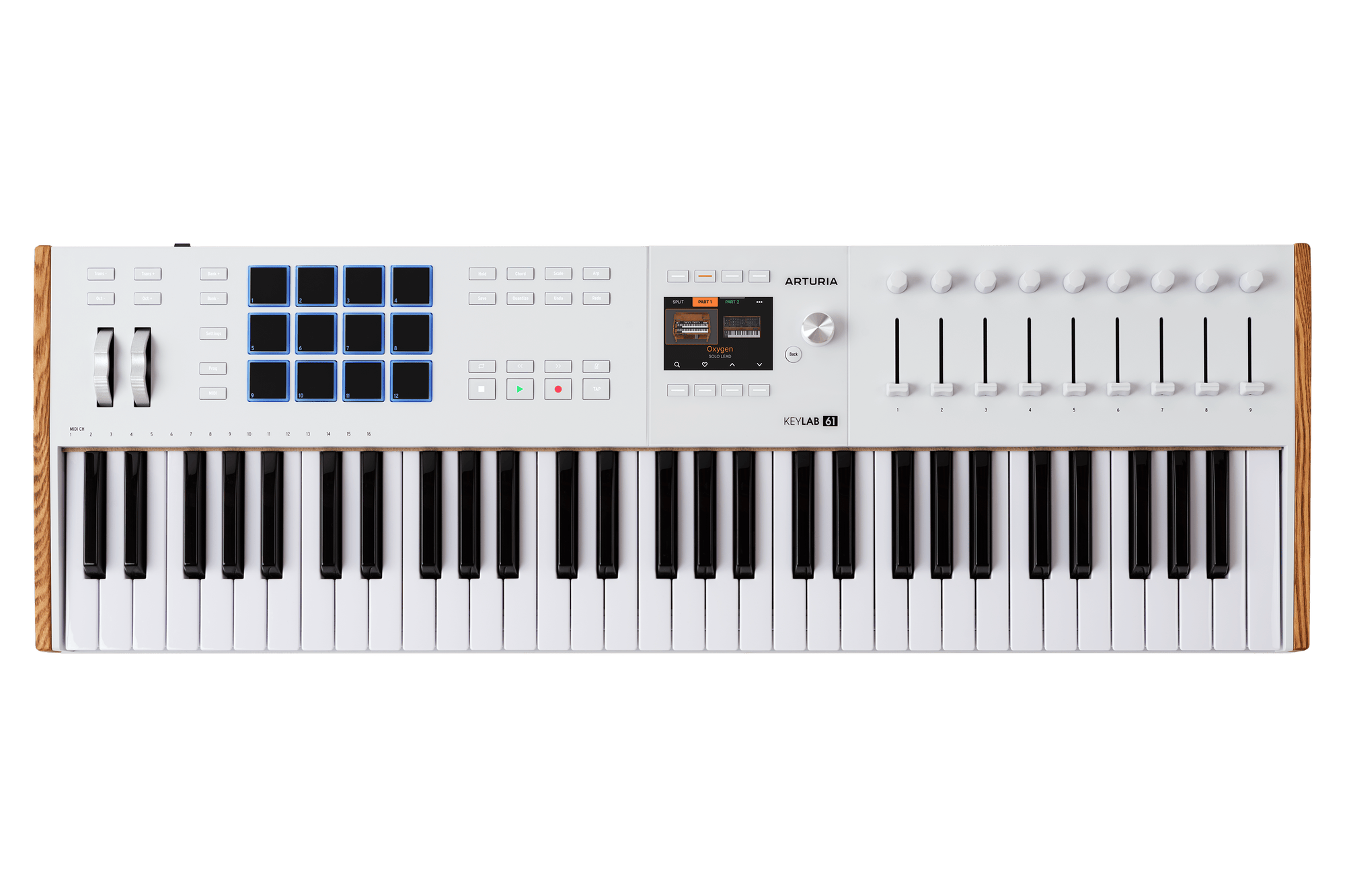
The KeyLab mk3 is Arturia’s premier semi-weighted controller, designed for musicians who want an uninterrupted creative flow.
- Best for:modern Arturia workflow with updated controls and navigation.
- Avoid if:you want a cheaper controller and don’t need deep control surface features.
- Integration:Ecosystem (Analog Lab) + Template.
Specifications
- Compatibility:OS: Windows 10+ (64-bit), macOS 11.0+.
- Keys: 49 full-size, semi-weighted piano-style keys.
- Key type:Redesigned velocity-sensitive action with Channel Aftertouch.
- Controls:12 velocity and pressure-sensitive RGB backlit pads, 9 touch-sensitive Encoders, 9 touch-sensitive Faders, wheels.
- Connectivity:USB-C, 5-pin DIN MIDI In and MIDI Out, 3 x 1/4" jacks for Sustain, Expression.
- Power:USB-C Bus Powered
- Dimensions:78.7 x 27.9 x 7.4 cm
- Weight:6.1 kg - Note: The shipping box weight is ~7.9 kg.
- Price Range:~$479.00 – $529.00
- Availability:Current Arturia store listings active
10. Arturia KeyLab 61-key Mk3
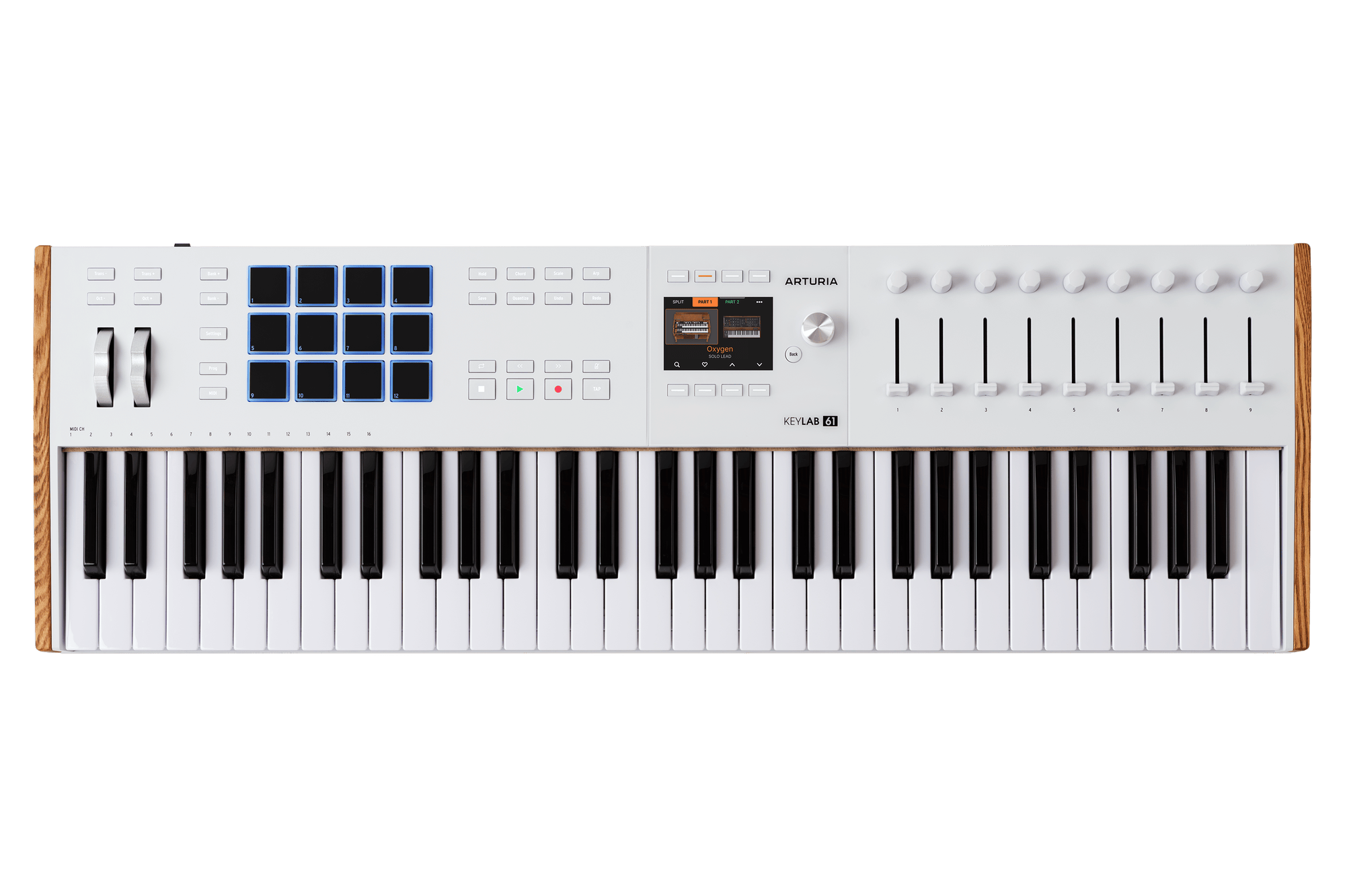
The KeyLab 61 mk3 is the professional standard for the "hybrid" studio.
- Best for:producers who want 61 keys + modern “command center” control.
- Avoid if:you mostly click-notes and only need basic input.
- Integration:Ecosystem + Template.
Specifications
- Compatibility:OS: Windows 10+ (64-bit), macOS 11.0+.
- Keys: 61 full-size, semi-weighted keys.
- Key type:Velocity-sensitive with Channel Aftertouch.
- Controls:12 velocity and pressure-sensitive pads, 9 x 360° Potentiometers Encoders, 9 Faders, transport.
- Connectivity:1 x USB-C, 5-pin DIN MIDI In and Out
- Power:USB-C Bus Powered
- Dimensions:2.3" (H), 34.4"(W), 11"(D)
- Weight:18.7 lbs
- Price Range:~$549.00 – $599.00.
- Availability:Current Arturia store listings active
11. Arturia KeyLab 88 Mk3
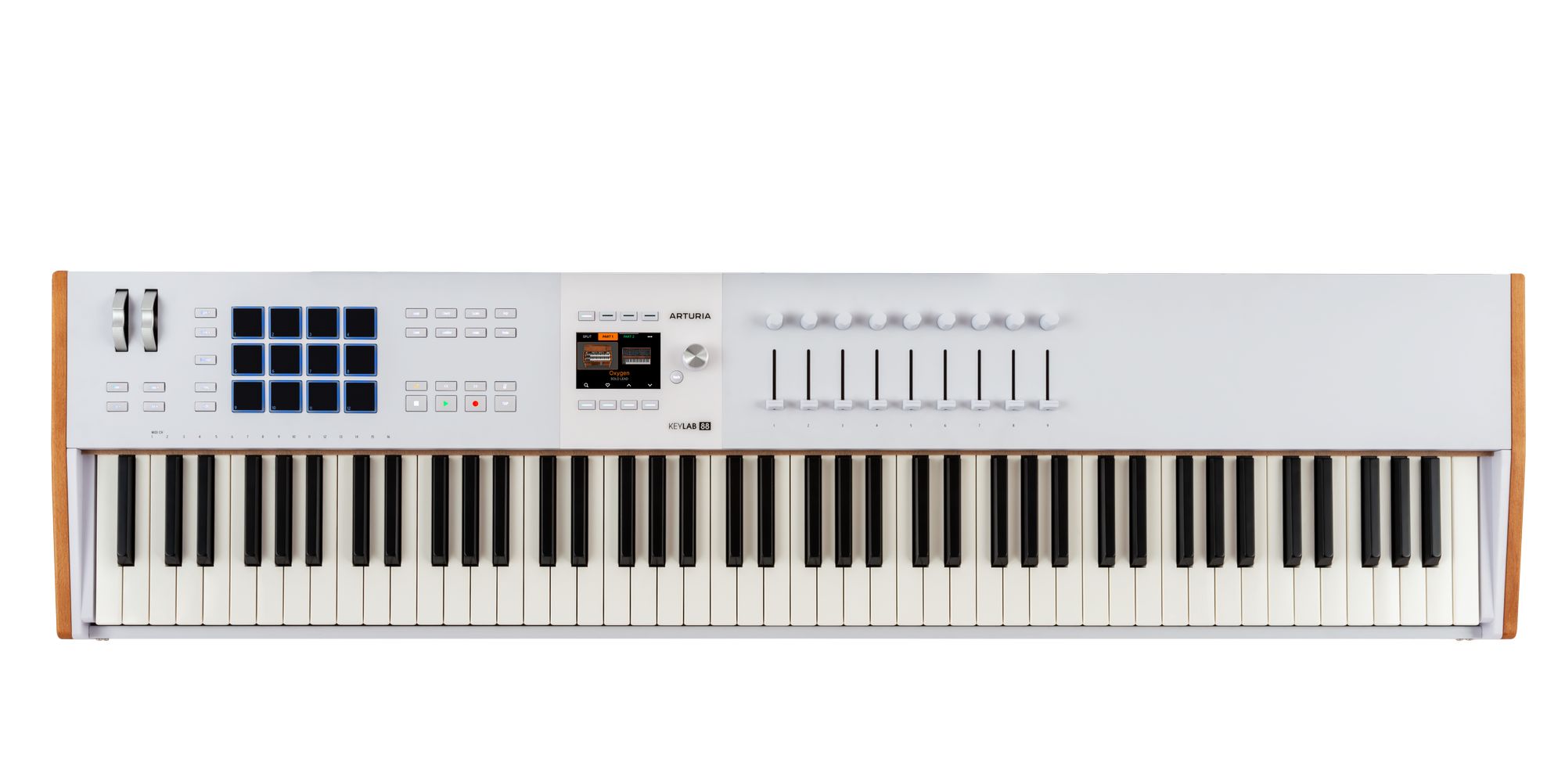
The KeyLab 88 mk3 is Arturia’s premier weighted controller, combining a refined Fatar hammer-action keybed with the advanced digital workflow of the Mk3 series.
- Best for:piano-range playing with modern controller workflow.
- Avoid if:you need something lighter for travel or gigging frequently alone.
- Integration:Ecosystem + Template.
Specifications
- Compatibility:Windows 10/11, macOS 11+ (Apple Silicon/Intel).
- Keys: 88-key professional Fatar TP/110 hammer-action keybed.
- Key type:Fully weighted, piano-style keys with Channel Aftertouch and velocity sensitivity.
- Controls:3.5-inch (480 x 320) full-color screen with 8 contextual buttons, 12 RGB pads(4 banks for 48 assignments), 9 Encoders, 9 Faders & transport.
- Connectivity:USB-C (Bus-powered and data), 5-pin MIDI In and Out, Sustain, Expression, and 1 x Auxiliary pedal input.
- Power:USB Powered, AC Adapter (sold seperately)
- Dimensions:1295 × 323 × 113 mm
- Weight:15.7 kg
- Price Range:~$999.00
- Availability:Current Arturia store listings active
12. Native Instruments Komplete Kontrol A61
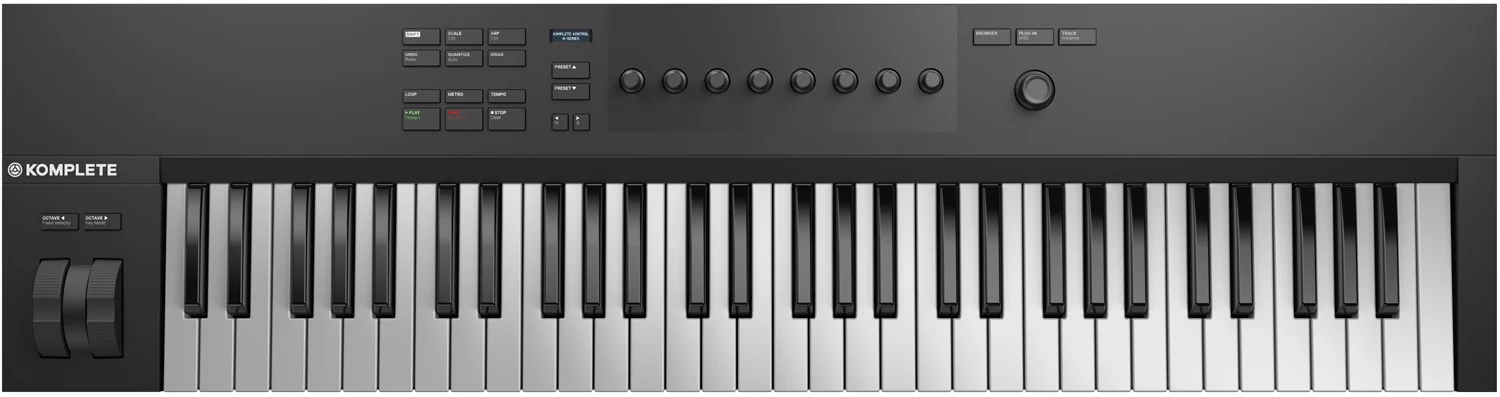
A smart, streamlined 61-key controller that serves as the perfect entry point into the Native Instruments ecosystem.
- Best for:entry into NI workflow with full-size keys at a lower price.
- Avoid if:you expect premium screens/feel like S-Series.
- Integration:Ecosystem-lite (NI software) + Basic DAW.
Specifications
- Compatibility:OS: Windows 10/11 (64-bit); macOS 13, 14, and 15 (Native Apple Silicon supported).
- Keys:61 full-size semi-weighted keys.
- Key type:Custom NI semi-weighted keybed (velocity-sensitive).
- Controls:8 touch-sensitive control knobs, Navigation, wheels, Smart Play.
- Connectivity:1 x USB 2.0 (Type-B), 1 x 1/4" TRS pedal input.
- Power:USB bus powered.
- Dimensions:98.4 x 25.7 x 8.9 cm
- Weight:4.7 kg
- Price Range: ~$169.00 – $279.00
- Availability:Current product page active
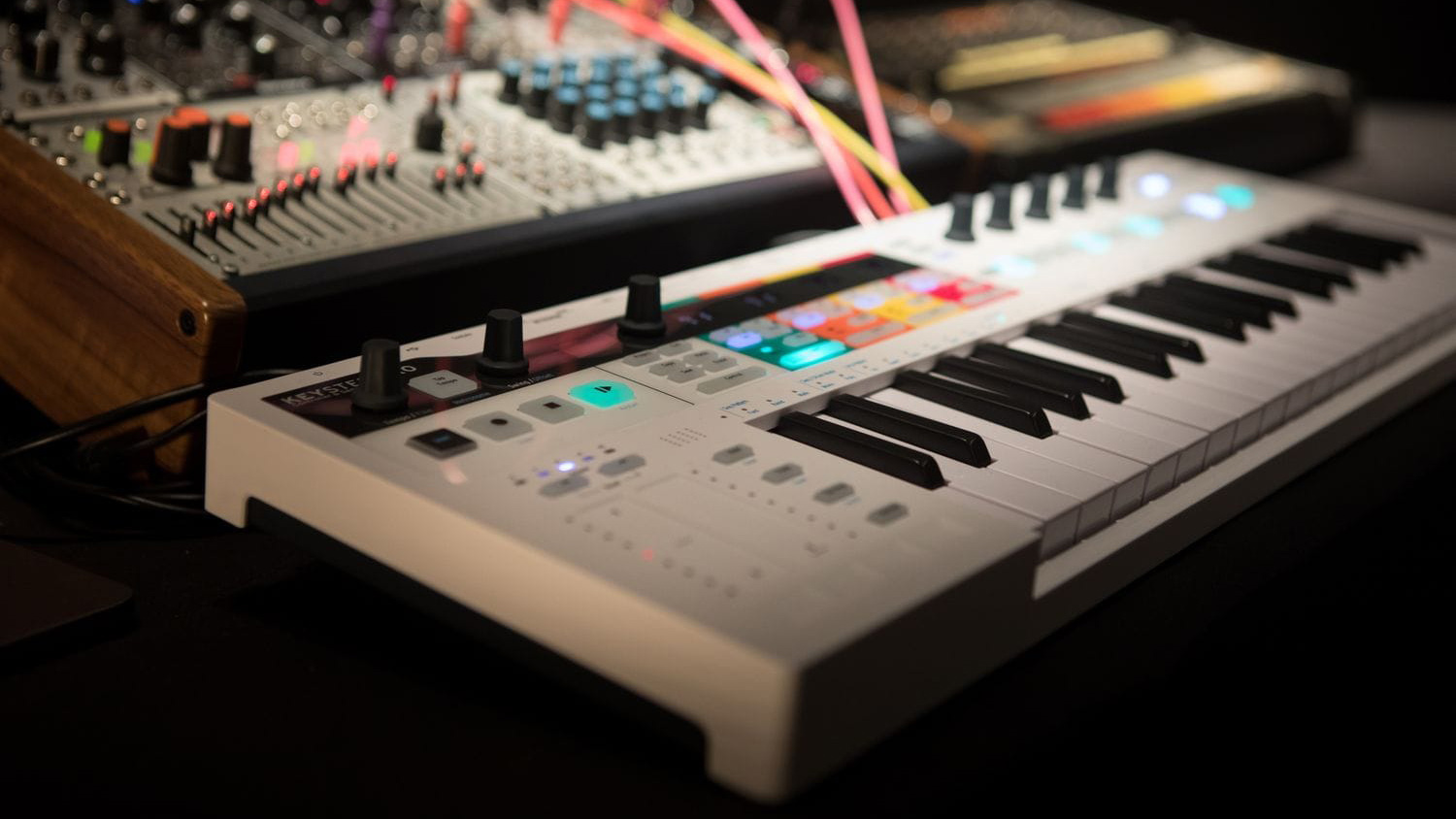
13. Arturia KeyStep (Series)
The KeyStep series is the industry standard for "hybrid" sequencing, famous for its ability to bridge the gap between vintage analog gear (via CV/Gate), modern hardware (via 5-pin MIDI), and software (via USB).
- Best for:bridging software + hardware (sequencing + MIDI/CV thinking).
- Avoid if:you just want a normal keyboard controller with lots of faders/pads.
- Integration:Hardware-first + Basic DAW.
Specifications (KeyStep mk2)
- Compatibility:Windows 10/11, macOS 11+, iOS/Android (Class Compliant).
- Keys:32 "Slimkey" keys.
- Key type:Velocity-sensitive with Channel Aftertouch.
- Controls:capacitive pitch/mod strips, transport buttons (Rec, Play, Stop), a step-sequencer (8-note polyphony), and an arpeggiator with 16 modes.
- Connectivity:USB-C (Power & MIDI), Full-size 5-pin MIDI In/Out, 1/4" Sustain/Expression input.
- Power:USB-C Bus Powered
- Dimensions:50 x 484 x 145 mm
- Weight:1.1 kg
- Price Range: ~$169.00.
- Availability:Current product page active
14. Arturia MiniLab 3
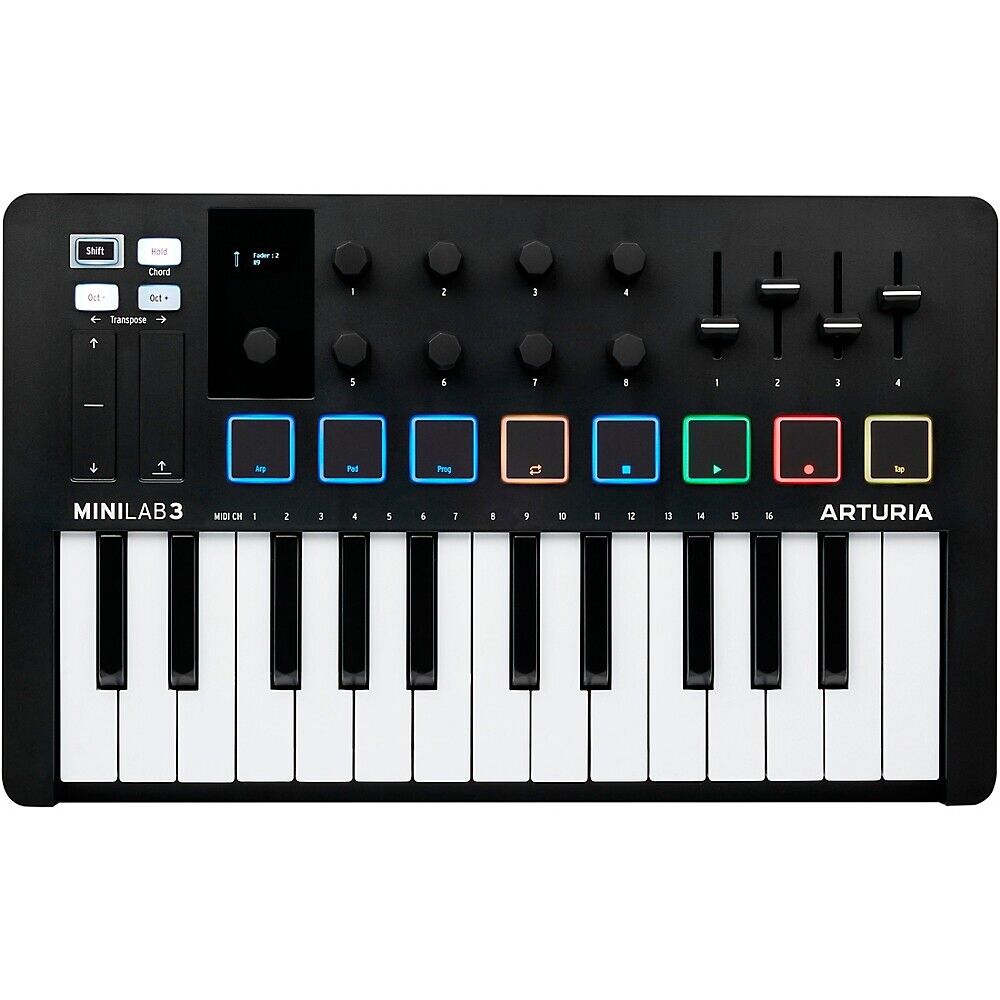
The MiniLab 3 is the industry standard for portable "everything" controllers.
- Best for:compact desks that still want knobs/pads + MIDI out.
- Avoid if:you need full-size keys for longer two-hand parts.
- Integration:Ecosystem-lite (Analog Lab) + Basic.
Specifications
- Compatibility:OS: Windows 10+ (64-bit); macOS 11.0+ (Native M1/M2/M3/M4 supported).
- Keys:25 Slim/mini
- Key type:Velocity-sensitive
- Controls:2 banks of 8 pads, encoders, sliders, display/encoder, touch sensors
- Connectivity: 1 x USB-C, 1 x 5-pin DIN MIDI Output, 1 x 1/4" input (Sustain, Expression, or Footswitch).
- Power: USB powered
- Dimensions:54 x 356 x 219 mm
- Weight:1.5 kg
- Price Range:~$99.00 – $119.00
- Availability:Current product page active
15. Alesis VI61
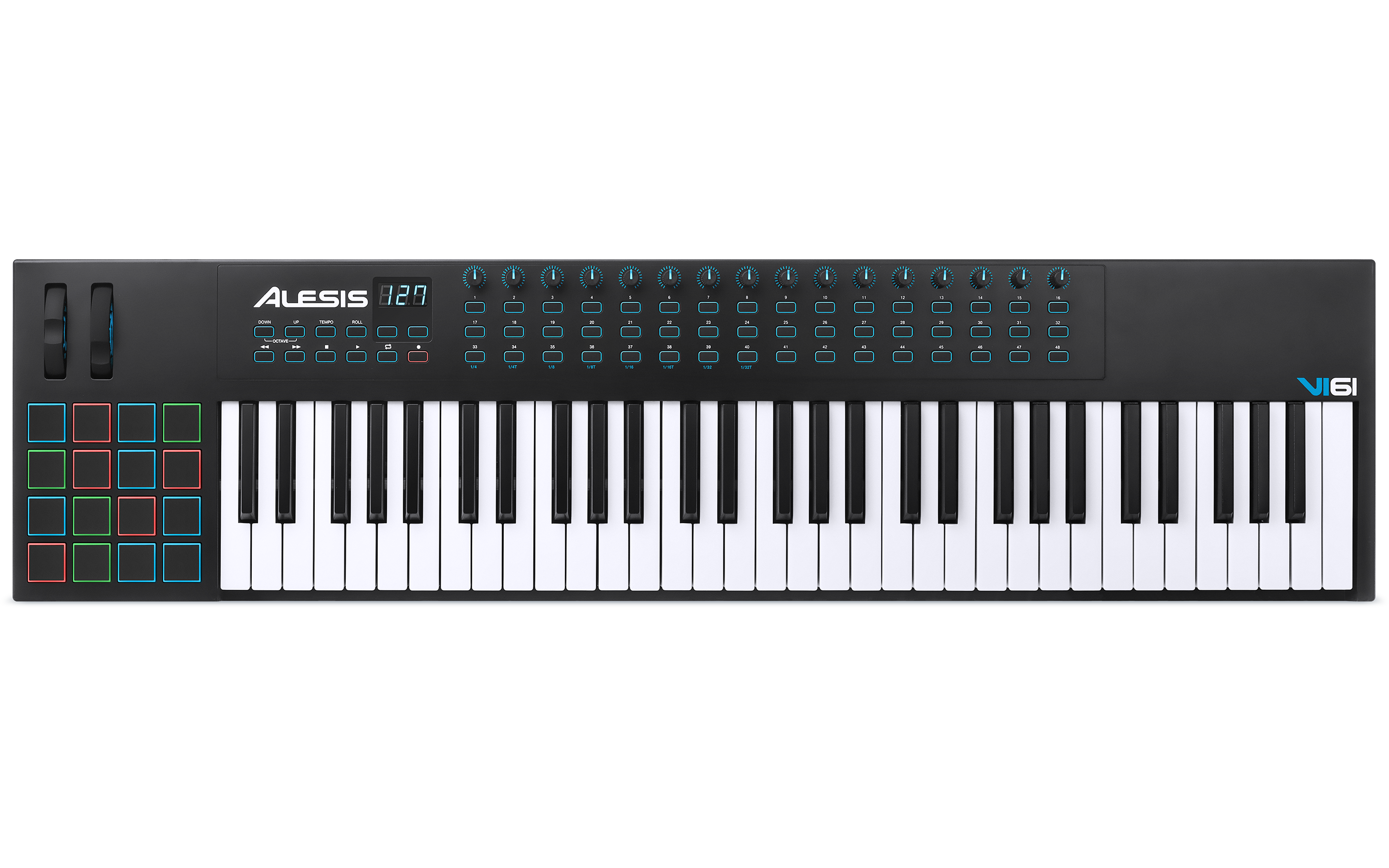
The Alesis VI61is a high-performance USB/MIDI keyboard controller that combines semi-weighted keys with a massive array of assignable pads, knobs, and buttons for total DAW command.
- Best for:lots of assignable controls for DAW and hardware in one board.
- Avoid if:you want a modern display-driven workflow.
- Integration:Basic/Template.
Specifications
- Compatibility:Plug-and-play support for Mac (OS X 10.11 or later) and PC (Windows 7 or later).
- Keys:61 Full-sized, square-front.
- Key Type:Semi-weighted with Aftertouch.
- Controls: 16 Velocity-sensitive pads, 16 Assignable knobs, 48 Assignable buttons, Pitch and Modulation wheels
- Connectivity: USB MIDI, 5-pin MIDI Out for controlling external hardware.
- Power: USB powered
- Dimensions:1120 x 256 x 71 mm
- Weight:5.9 kg
- Price Range:~$220 – $299
- Availability:Current product page active
16. IK Multimedia IRig Keys 2 Mini
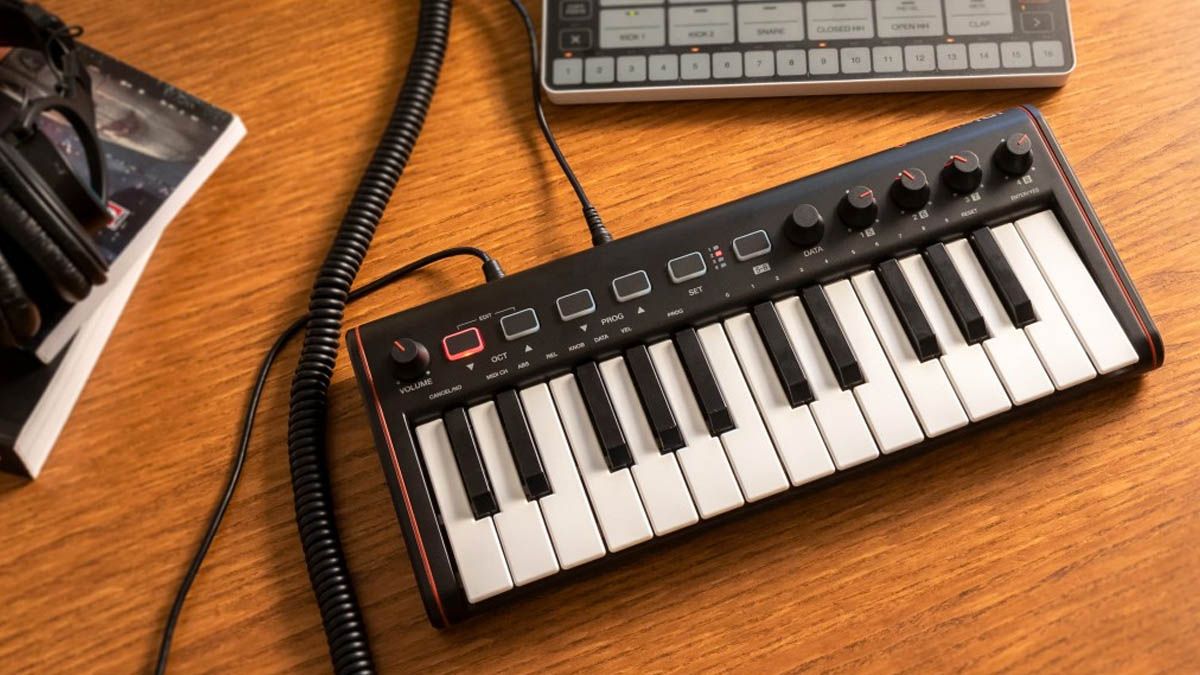
The iRig Keys 2 (37-key version) is a highly versatile, ultra-slim controller designed for the musician on the move.
- Best for:ultra-slim travel rigs and mobile composing.
- Avoid if:you need full-size keys or lots of hands-on controls.
- Integration:Basic.
Specifications
- Compatibility:Not stated
- Keys:37 Mini
- Key type:Velocity-sensitive (as described)
- Controls:Pitchbend and Modulation, 1 x Assignable Push Encoder, 4 x Assignable Knobs
- Connectivity:1 x Type Micro-B, 2 x 2.5mm TRS Type-A (In/Out), 1 x 1/8" TRS Headphone Jack, 1 x 1/4" TRS
- Power:USB bus powered (Mobile/Desktop).
- Dimensions: 518 × 139 × 54 mm
- Weight:0.87 kg
- Price Range:~$129.99 to US$149.99.
- Availability:Current product page active
17. Kawai VPC1
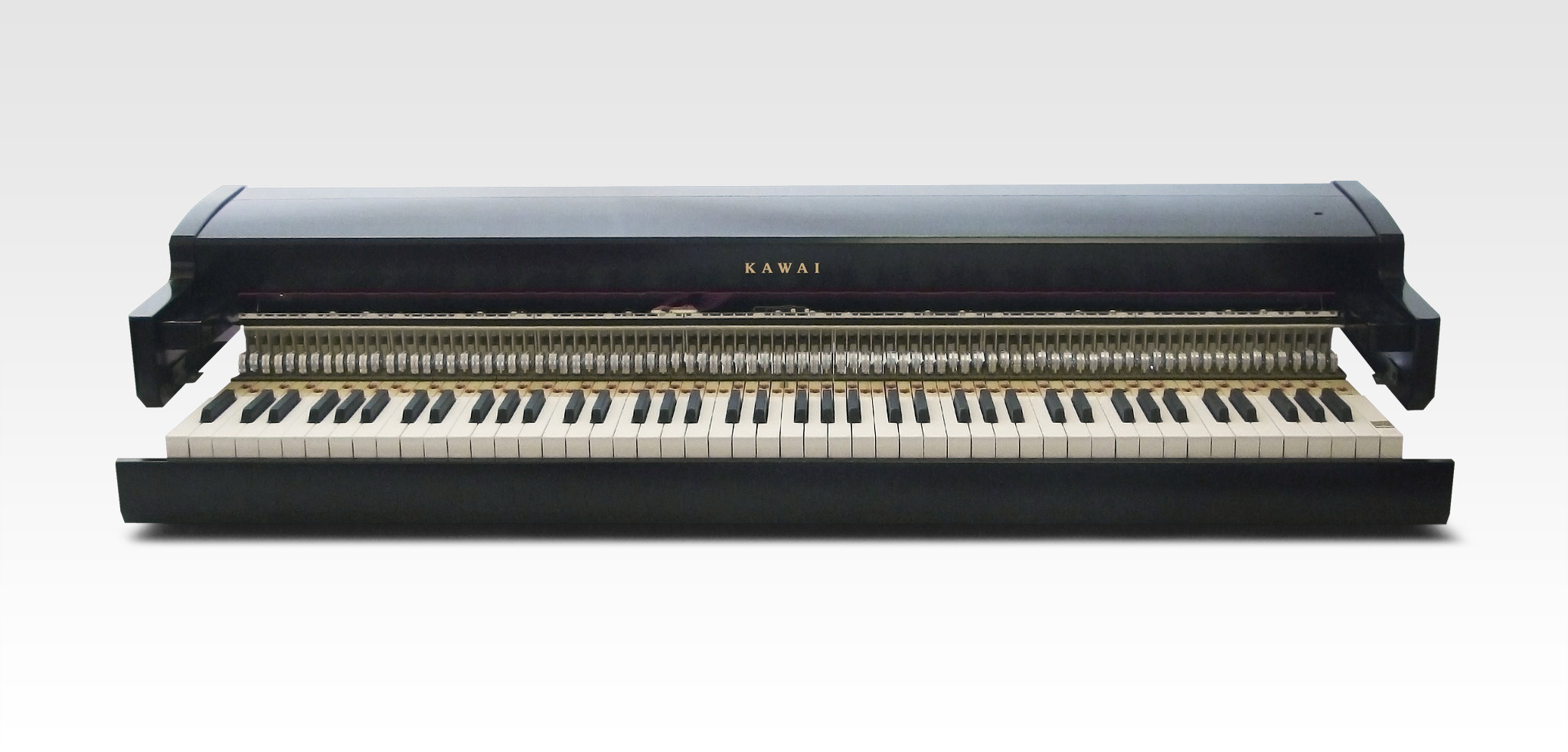
The Kawai VPC1 remains the gold standard for virtual piano enthusiasts, offering a specialized wooden-key action usually reserved for high-end digital pianos.
- Best for:virtual piano players who want a dedicated master action.
- Avoid if:you want knobs/pads/faders-this is about playing, not controlling.
- Integration:Basic (piano-first).
Specifications
- Compatibility:Windows and Mac
- Keys:88 Full-size
- Key type:RM3 Grand II action
- Controls: Triple pedal unit included
- Connectivity:USB + MIDI In/Out
- Power:USB bus-powered / AC adaptor option (as specified)
- Dimensions: 138 × 42.5 × 18.5 cm
- Weight:29.5 kg
- Price Range:~$2,399 – $2,599.
- Availability:Current product page active
18. Korg MicroKEY2 Air-25
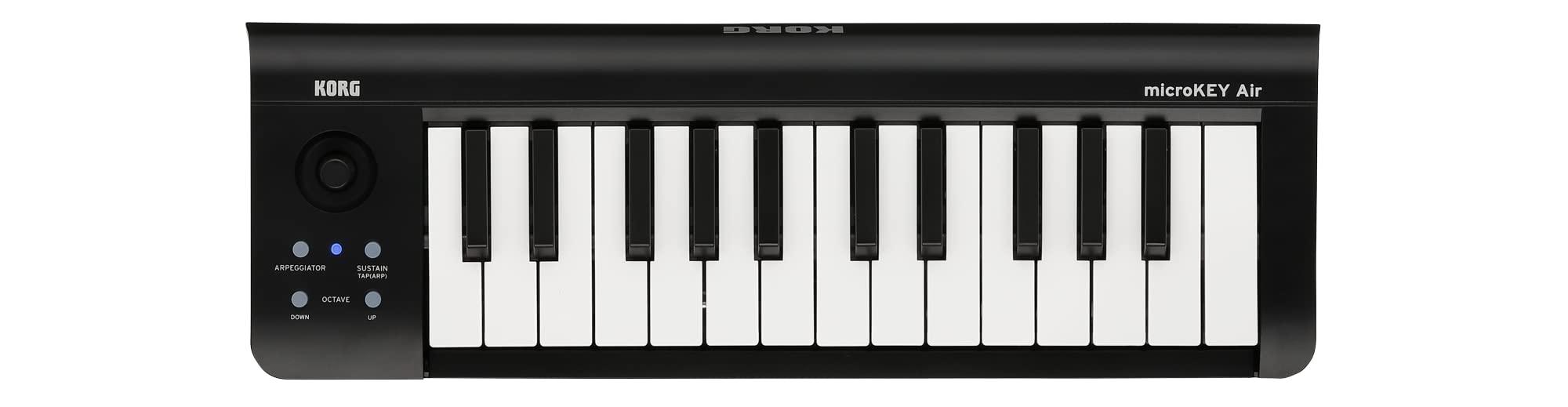
The MicroKEY2 Air-25 is a compact, wireless MIDI powerhouse designed for mobility without sacrificing the playing experience.
- Best for:cable-free writing and iPad-friendly mobility.
- Avoid if:Bluetooth reliability is a concern for your environment/live use.
- Integration:Basic.
Specifications
- Compatibility:Bluetooth LE MIDI (Apple BLE MIDI spec compliant)
- Keys:25 Mini (“Natural Touch mini-keyboard”)
- Key type: Not stated
- Controls: Pitch/Modulation joystick, arpeggiator, sustain/tap, and octave shift buttons.
- Connectivity:1 x Type-B, Bluetooth v4.2 LE
- Power:2×AA (wireless) or USB bus power
- Dimensions: 395 × 131 × 52 mm
- Weight:670 g (without batteries)
- Price Range:~$88.00 to $144.49.
- Availability:Current product page active
19. M-Audio Hammer 88
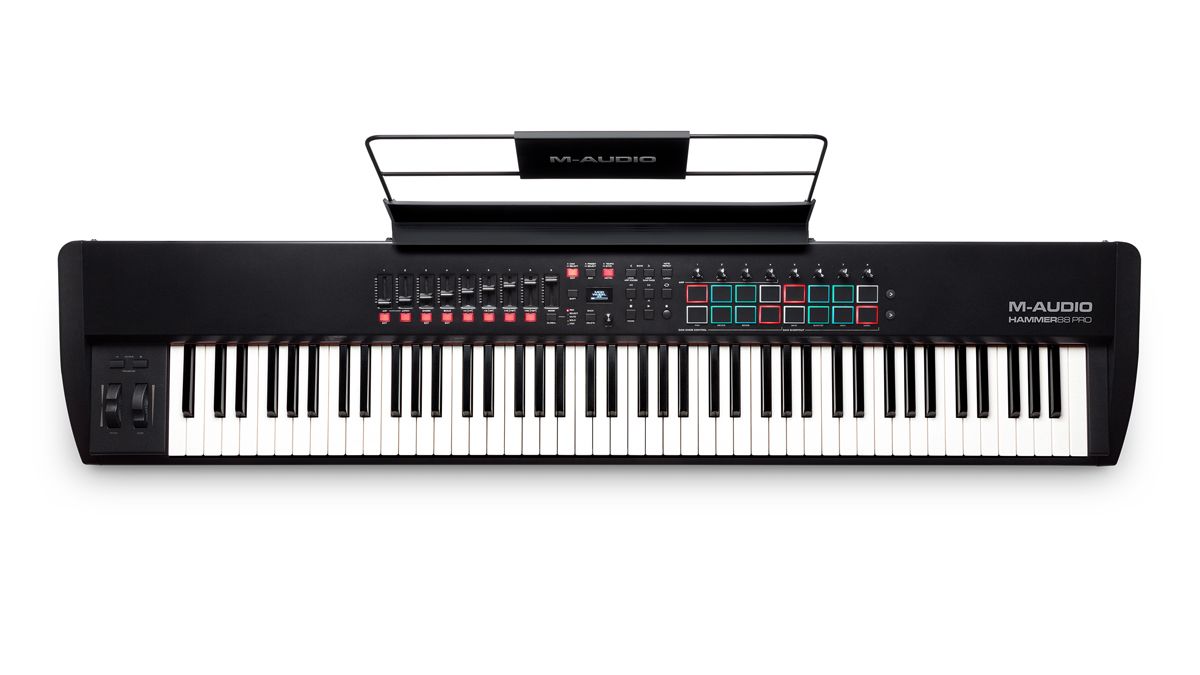
The Hammer 88 is a no-compromise, professional-grade keyboard controller designed for players seeking an authentic grand piano feel.
- Best for:affordable hammer-action playing with simple controller needs.
- Avoid if:you want deep DAW control without adding another device.
- Integration:Basic.
Specifications
- Compatibility:Windows 7 SP1 or later; macOS 10.8 or later (fully compatible with macOS Sequoia and Apple Silicon).
- Keys:88 Full-size
- Key type:Fully-weighted hammer-action
- Controls:Pitch Bend, Modulation wheels, 4 assignable keyboard zones, 1 x Assignable Master Volume fader; 2 x Assignable Up/Down buttons.
- Connectivity:1 x USB Type-B, 1 x 5-pin DIN MIDI Output, 3 x 1/4" inputs (Sustain, Soft, and Expression).
- Power:USB bus powered
- Dimensions:142.2 x 30.2 x 12.7 cm
- Weight:17.5 kg
- Price Range:~$449.00 – $549.00.
- Availability:Current product page active
20. M-Audio Keystation 49
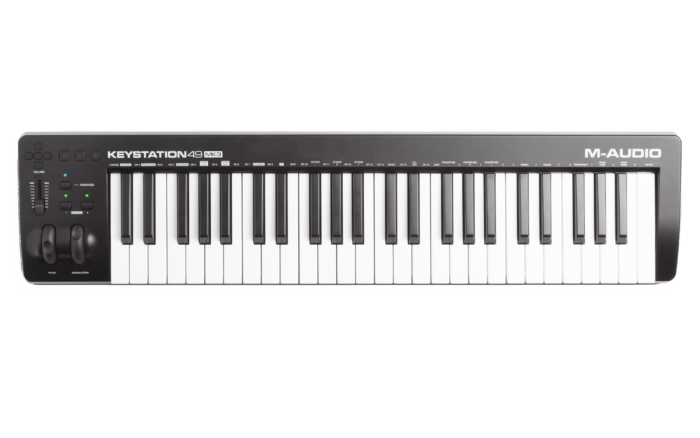
The Keystation 49 MK3 is the quintessential entry-level workhorse.
- Best for:beginners who just need full-size keys and simple controls.
- Avoid if:you want pads/faders for production workflow.
- Integration:Basic.
Specifications
- Compatibility:Windows 10/11 (latest Service Pack); macOS 13, 14, and 15 (Native M-Series/Silicon support).
- Keys: 49 Full-size
- Key type:Velocity-sensitive
- Controls:Pitch/mod wheels, transport buttons, fader, sustain input
- Connectivity:1 x USB Type-B, 1 x 1/4" TRS Sustain pedal input.
- Power:USB bus powered
- Dimensions: 822 × 189 × 68 mm
- Weight:2.14 kg
- Price Range:~$109.00 – $129.00
- Availability:Current model listed as Keystation 49 MK3
21. M-Audio Keystation 61 MK3
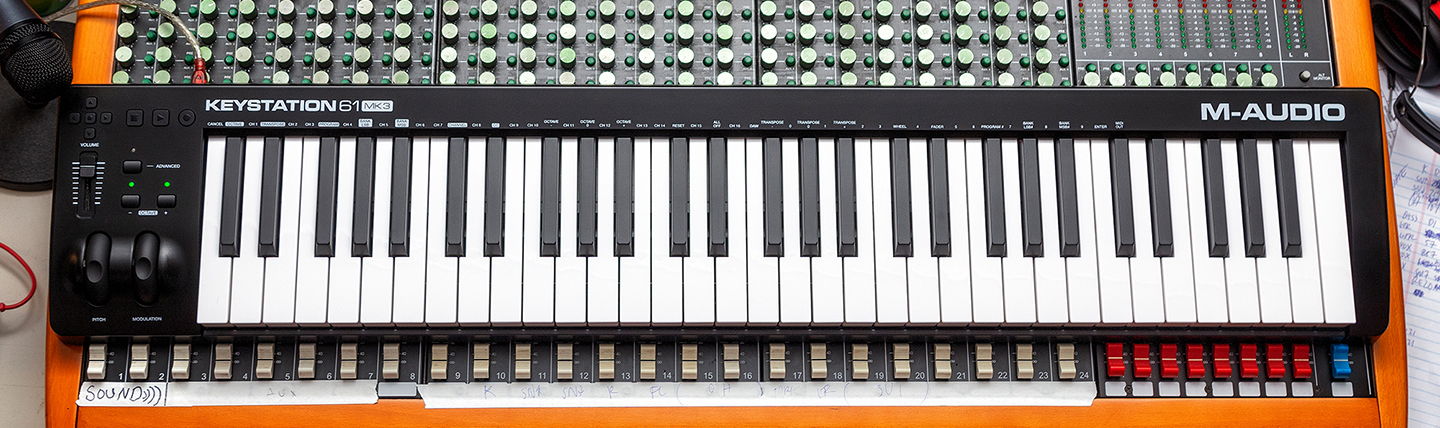
The Keystation 61 MK3 is a high-performance MIDI controller designed for sequencing music and playing virtual instruments on your Mac or PC.
- Best for:affordable 61-key range for learning two-hand parts.
- Avoid if:you need aftertouch or advanced control surface features.
- Integration:Basic.
Specifications
- Compatibility:Windows: Windows 10 (latest Service Pack) and Windows 11.
- Keys:61 Full-size
- Key type:Semi-weighted, velocity-sensitive
- Controls:1 x Assignable Volume fader, Transport, wheels, navigation
- Connectivity:1 x USB Type-B port, 1 x 5-pin DIN MIDI Output, 1 x 1/4" TRS Sustain pedal input.
- Power:USB or DC 9V optional
- Dimensions:995 × 189 × 68 mm
- Weight:4.1 kg
- Price Range: ~$189.00 – $229.00
- Availability:Current product page active
22. M-Audio Oxygen Series
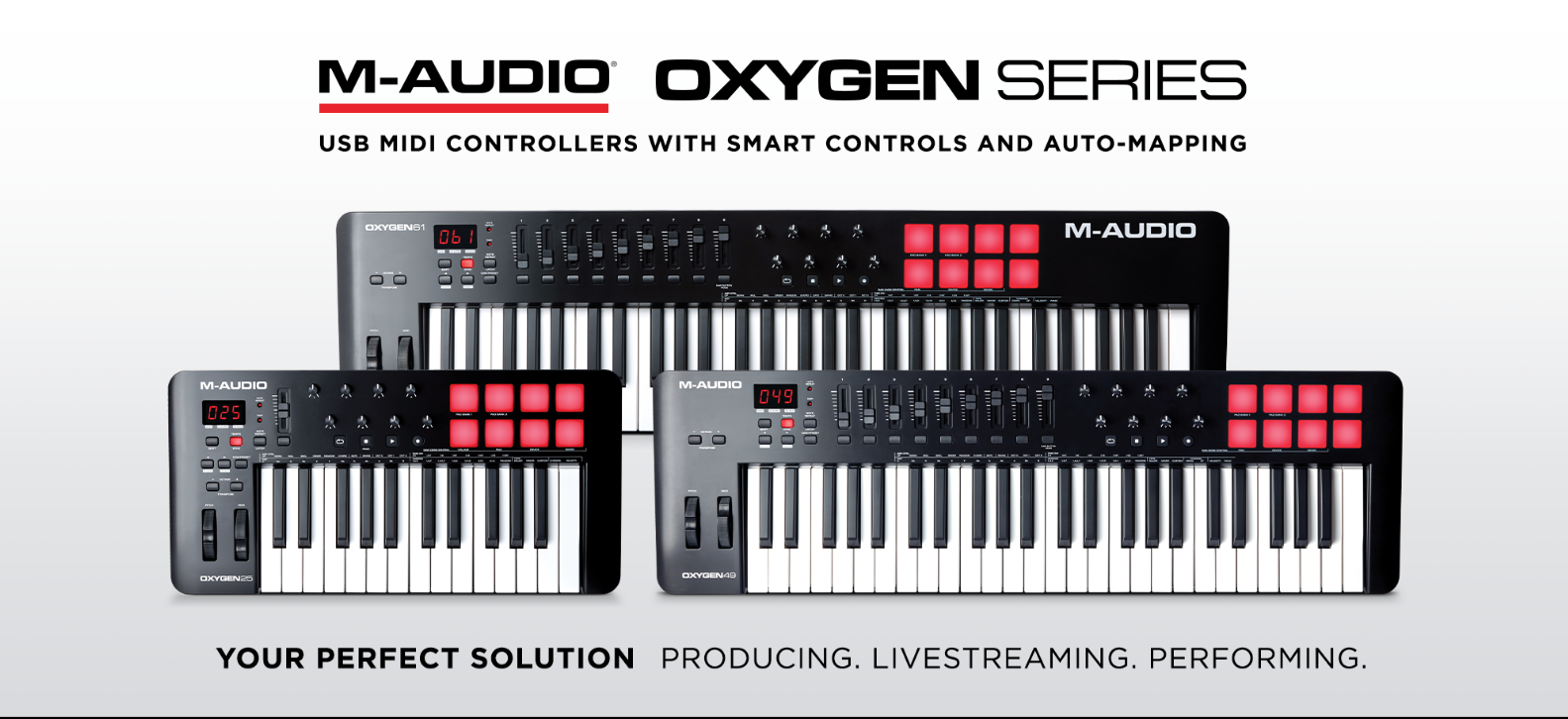
The Oxygen MKV series provides a comprehensive control surface for producers who need to mix and perform simultaneously.
- Best for:an all-around production controller line across multiple key sizes.
- Avoid if:you want premium keybeds or ecosystem-level browsing.
- Integration:Template (varies by model/DAW).
Specifications
- Compatibility:Windows 10/11; macOS 13+ (Ventura/Sonoma/Sequoia).
- Keys:25 Full-size, 49 Full-size, 61 Full-size (Varients)
- Key type:Synth-action (Velocity)
- Controls:8 (RGB Backlit) pads, Faders, Knobs
- Connectivity:1 x USB Type-B (Bus-powered), 1 x 1/4" Sustain pedal input.
- Dimensions:19.3" x 9.6" x 3.7" (Oxygen 25), 32.0" x 9.6" x 3.7" (Oxygen 49), 38.4" x 9.6" x 3.7" (Oxygen 61)
- Weight:1.8 kg (Oxygen 25), 2.9 kg (Oxygen 49), 3.4 kg (Oxygen 61)
- Price Range:~$129.00 (Oxygen 25 (MKV)), ~$179.00 (Oxygen 49 (MKV)), ~$229.00 (Oxygen 61 (MKV))
- Availability:Oxygen models are active in M-Audio’s current keyboard/controller catalog
23. Native Instruments Komplete Kontrol A25
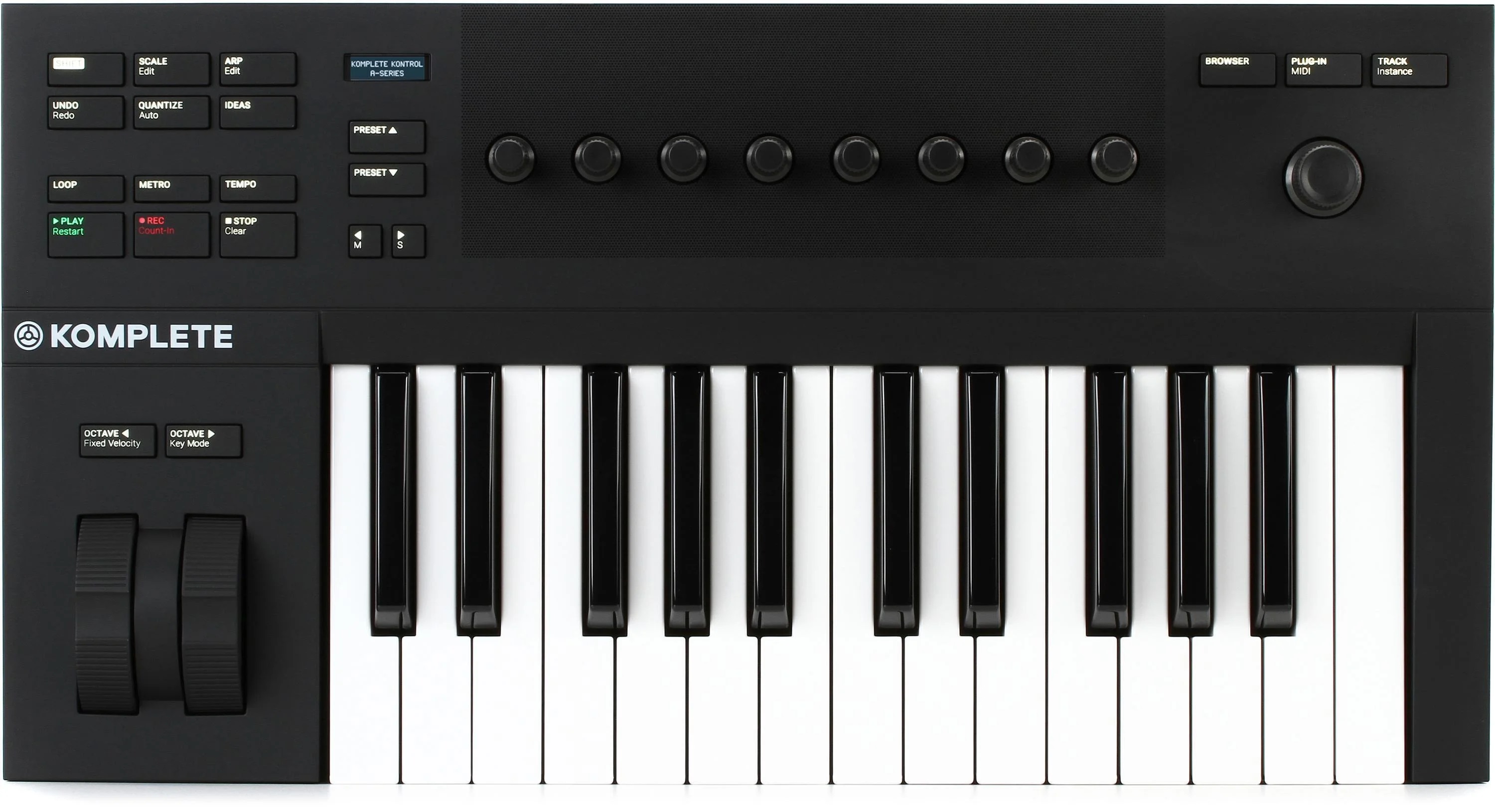
The Komplete Kontrol A25is the bridge between portability and professional "feel."
- Best for:small desks wanting NI workflow basics with full-size keys.
- Avoid if:you need pads or a big control surface.
- Integration:Ecosystem-lite.
Specifications
- Compatibility: Windows 10/11 (latest Service Pack); macOS 13, 14, and 15 (Native Apple Silicon/M-series support).
- Keys:25 Full-size (A-series keybed)
- Key type:Semi-weighted (A-series positioning)
- Controls:8 touch-sensitive knobs, pitch/mod wheels, encoder
- Connectivity:USB + TRS pedal input
- Power:USB 2.0 bus powered
- Dimensions:488 × 257 × 89 mm
- Weight:2.4 kg
- Price Range:~$159.00 – $169.00.
- Availability:Current product page active
24. Native Instruments Komplete Kontrol M32
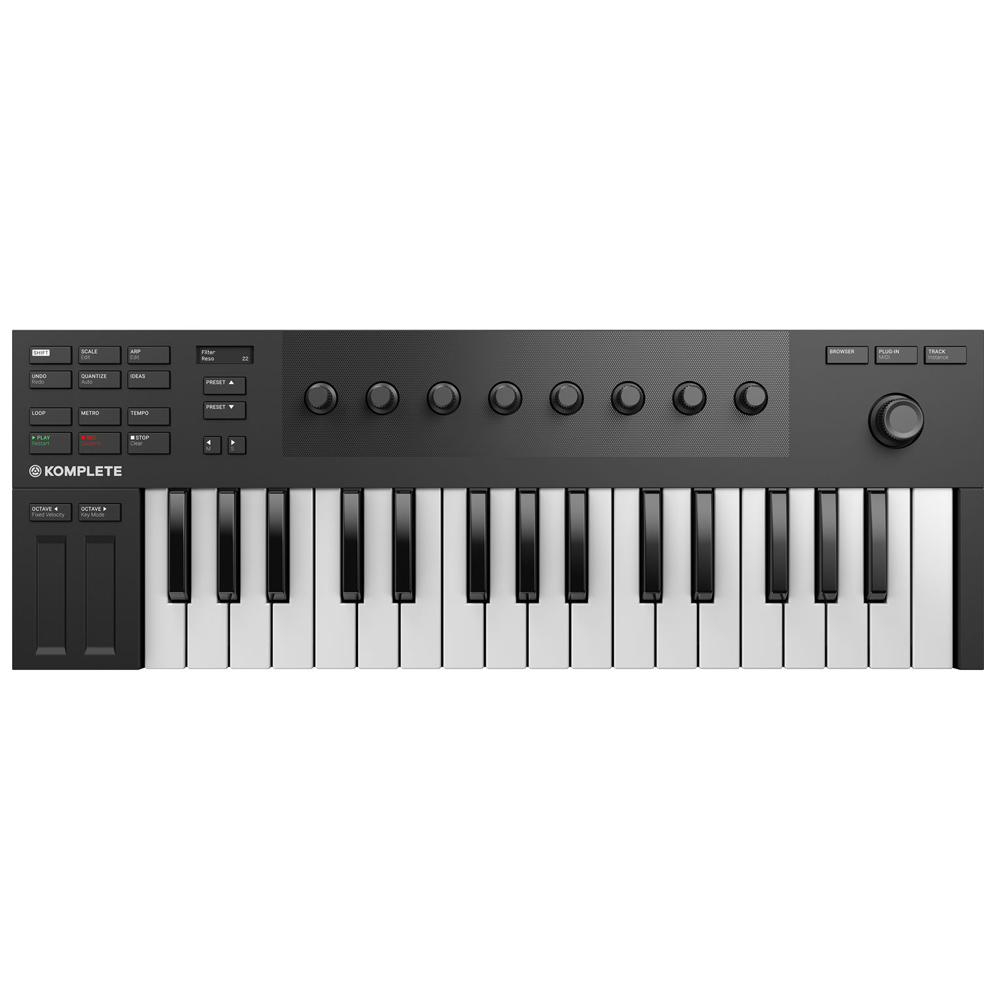
The M32 is the ultimate portable entry point into the Native Instruments ecosystem.
- Best for:portable NI control with extra mini keys (32) and browsing.
- Avoid if:mini keys are uncomfortable for your hands.
- Integration:Ecosystem-lite.
Specifications
- Compatibility: OS: Windows 10/11 (64-bit); macOS 13, 14, and 15 (Native Apple Silicon/M-series support).
- Keys:32 Mini
- Key type:Synth-action
- Controls:8 touch-sensitive knobs, 2 touch strips, encoder, OLED
- Connectivity:USB + TRS pedal input
- Power:USB 2.0 bus powered
- Dimensions:475 × 167 × 50 mm
- Weight:1.03 kg
- Price Range:~$139.00.
- Availability:Current product page active
25. Native Instruments Komplete Kontrol S49 Mk3
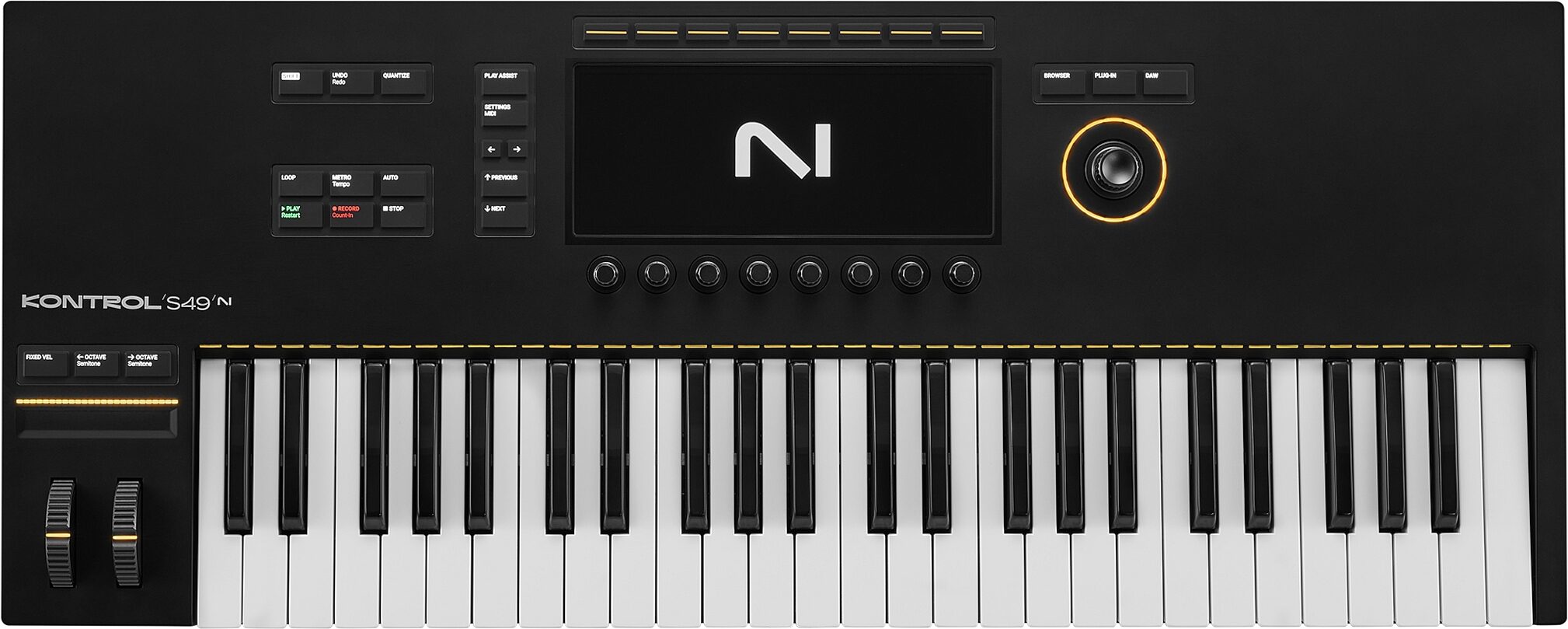
The Kontrol S49 Mk3 is a premium "smart" controller that provides an unparalleled direct connection to Kontakt and the NKS ecosystem.
- Best for:premium NI/NKS workflow in a 49-key footprint.
- Avoid if:your budget is tight and you don’t need ecosystem browsing.
- Integration:Ecosystem (NKS) + DAW-ready.
Specifications
- Compatibility:OS: Windows 10/11; macOS 13+ (Ventura/Sonoma/Sequoia). Supports macOS 12 in MIDI 1.0 mode.
- Keys:49 Full-size
- Key type:Semi-weighted (S-series positioning)
- Controls:Screen, encoders, pitch/mod wheels; multiple pedal inputs; MIDI I/O
- Connectivity: USB-C + MIDI in/out + 4×TRS pedal inputs
- Power: Bus-powered USB-C
- Dimensions: 802.2 × 323 × 86 mm
- Weight:5.5 kg
- Price Range:~$579.00 – $749.00.
- Availability:Current Kontrol S-Series line active
26. Native Instruments Komplete Kontrol S61 Mk3
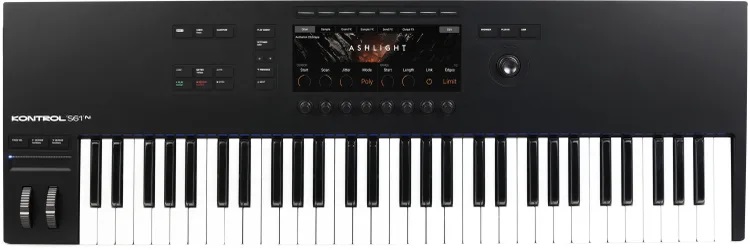
The Kontrol S61 Mk3 is the centerpiece of the modern professional studio.
- Best for:studio centerpiece for two-hand playing + NKS control.
- Avoid if:you rarely play two-handed; 49 keys might be enough.
- Integration:Ecosystem (NKS) + DAW-ready.
Specifications
- Compatibility:Mac: macOS 13 or higher (macOS 12 supported in MIDI 1.0 mode); Intel Core i5 or Apple M1/higher. Windows 10 or higher; Intel Core i5 or higher.
- Keys:61 Full-size
- Key type:Velocity-sensitive with Polyphonic Aftertouch
- Controls:Screen/encoders, pitch/mod wheels; MIDI/pedals
- Connectivity:USB-C + MIDI in/out + 4×TRS pedal inputs
- Power:Bus-powered USB-C
- Dimensions:96.7 × 32.3 × 8.6 cm
- Weight:6.0 kg
- Price Range:~$749.00 – $849.00.
- Availability:Current Kontrol S-Series line active
27. Nektar Impact GX61
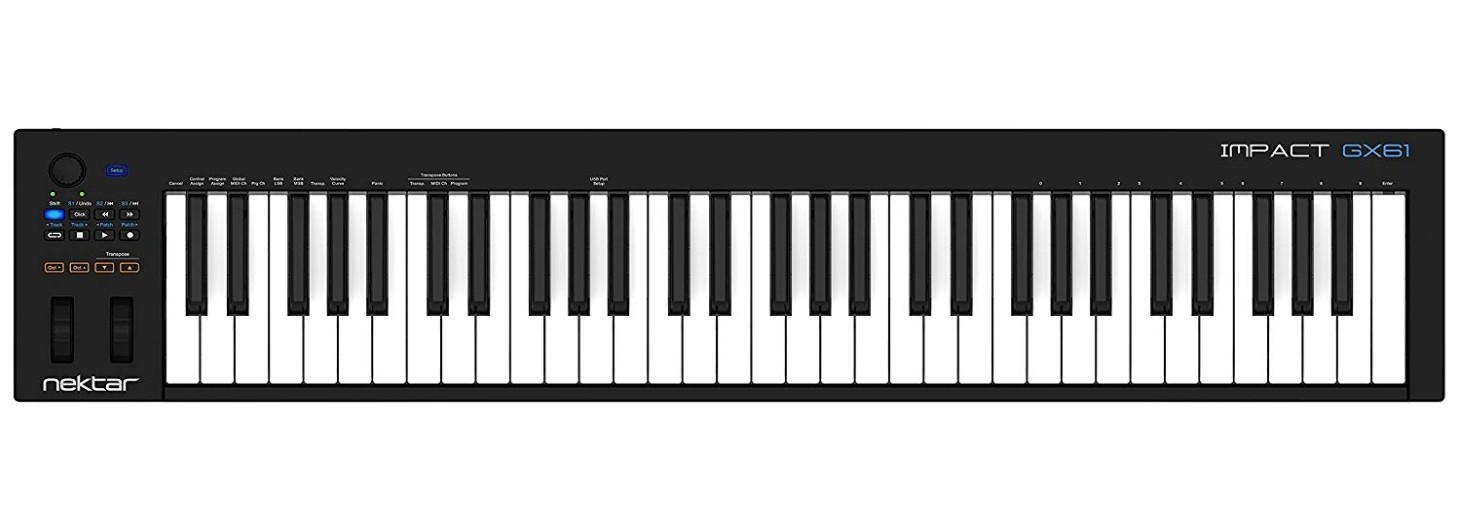
The Impact GX61 is a sleek, performance-oriented controller designed for composers and players who want a full five-octave range in a compact footprint.
- Best for:affordable 61-key playing with simple DAW control.
- Avoid if:you want pads and faders built in.
- Integration:Template/basic (depends on DAW).
Specifications
- Compatibility:OS: Windows 7 SP1 or later; Mac OS X 10.7 or later
- Keys:61, Full-size
- Key type:velocity-sensitive keys
- Controls:Pitch bend wheel, mod wheel, footswitch socket, 1 x assignable Potentiometer Encoders
- Connectivity:1 x USB Type-B, 1 x 1/4" TS jack
- Power:USB bus powered
- Dimensions:96.5 × 19.7 × 7.0 cm
- Weight:2.72 kg
- Price Range:~$119.00 – $139.00.
- Availability:Current product page active
28. Nektar Impact LX49+
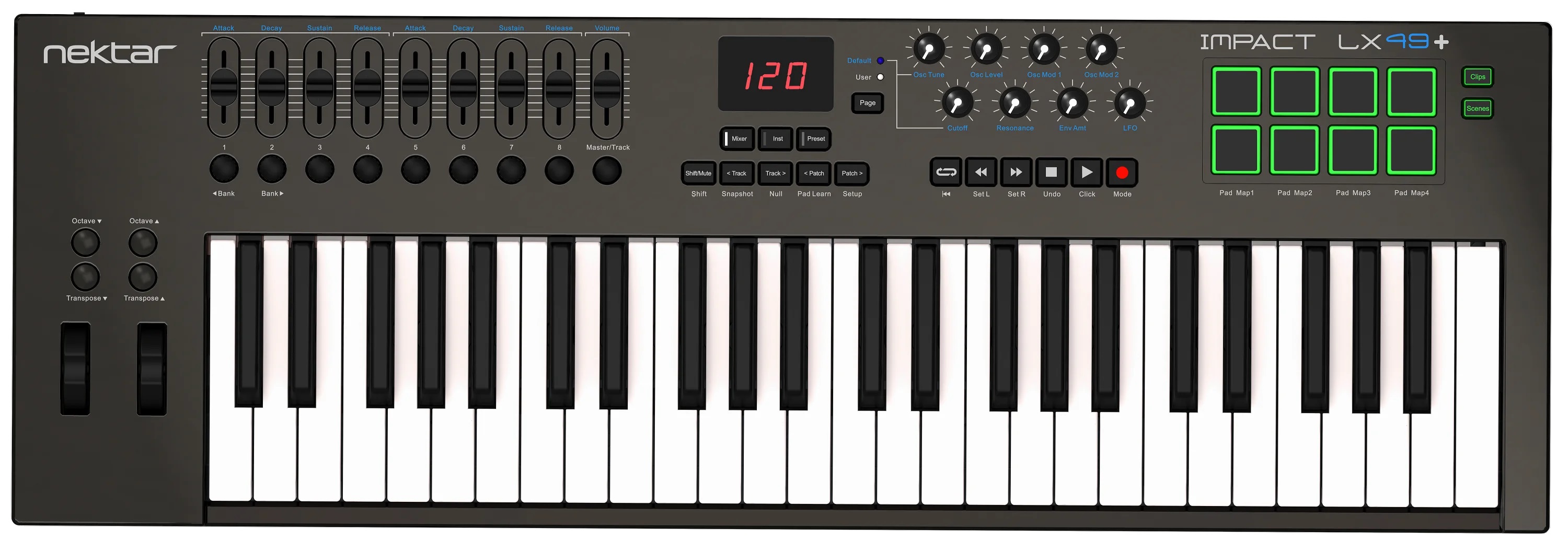
The Impact LX49+ is a powerful performance and production controller that punches above its weight class in terms of software integration.
- Best for:beginners and budget producers who want keys + pads + faders.
- Avoid if:you want premium key feel or a modern screen workflow.
- Integration:Template.
Specifications
- Compatibility:Listed DAW integrations + Windows 7, 8, 10, 11 or higher; Mac OS X 10.7 or higher
- Keys:49
- Key type:Velocity-sensitive synth-action
- Controls:8 LED Backlit Pads, 8 Encoders, 8 Faders, Buttons, Pitchbend, & Mod Wheel.
- Connectivity:1 x USB Type-B port, 1 x 1/4" TS jack footswitch input.
- Power:USB bus powered; includes a physical On/Off switch on the rear panel.
- Dimensions:80.3 x 26.7 x 7.6 cm
- Weight:3.18 kg (7 lbs)
- Price Range:~$159.00 – $179.00
- Availability:Current product page active
29. Nektar SE25
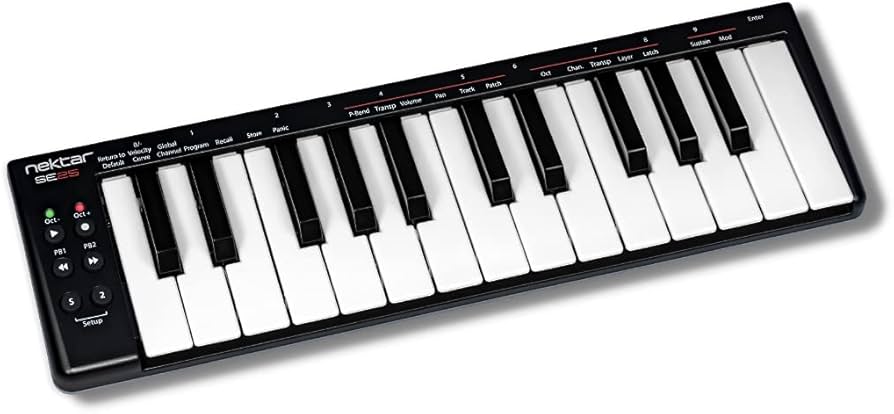
The SE25 is Nektar’s most portable controller, designed to fit in a laptop bag without sacrificing DAW control.
- Best for:ultra-portable composing and simple DAW shortcuts.
- Avoid if:you need traditional wheels, sustain input, or full-size keys.
- Integration:Basic.
Specifications
- Compatibility:OS: Windows XP, Vista, 7, 8, 10 or higher; Mac OS X 10.5 or higher; Linux (Ubuntu).
- Keys:25 velocity-sensitive mini keys.
- Key type:3 velocity curves (Default, Soft, Hard).
- Controls:6 function buttons + assignables
- Connectivity:Micro USB
- Power:USB
- Dimensions:335 × 100 × 21 mm
- Weight:0.4 kg
- Price Range:~$49.00 – $59.00
- Availability:Current product page active
30. Nektar SE49
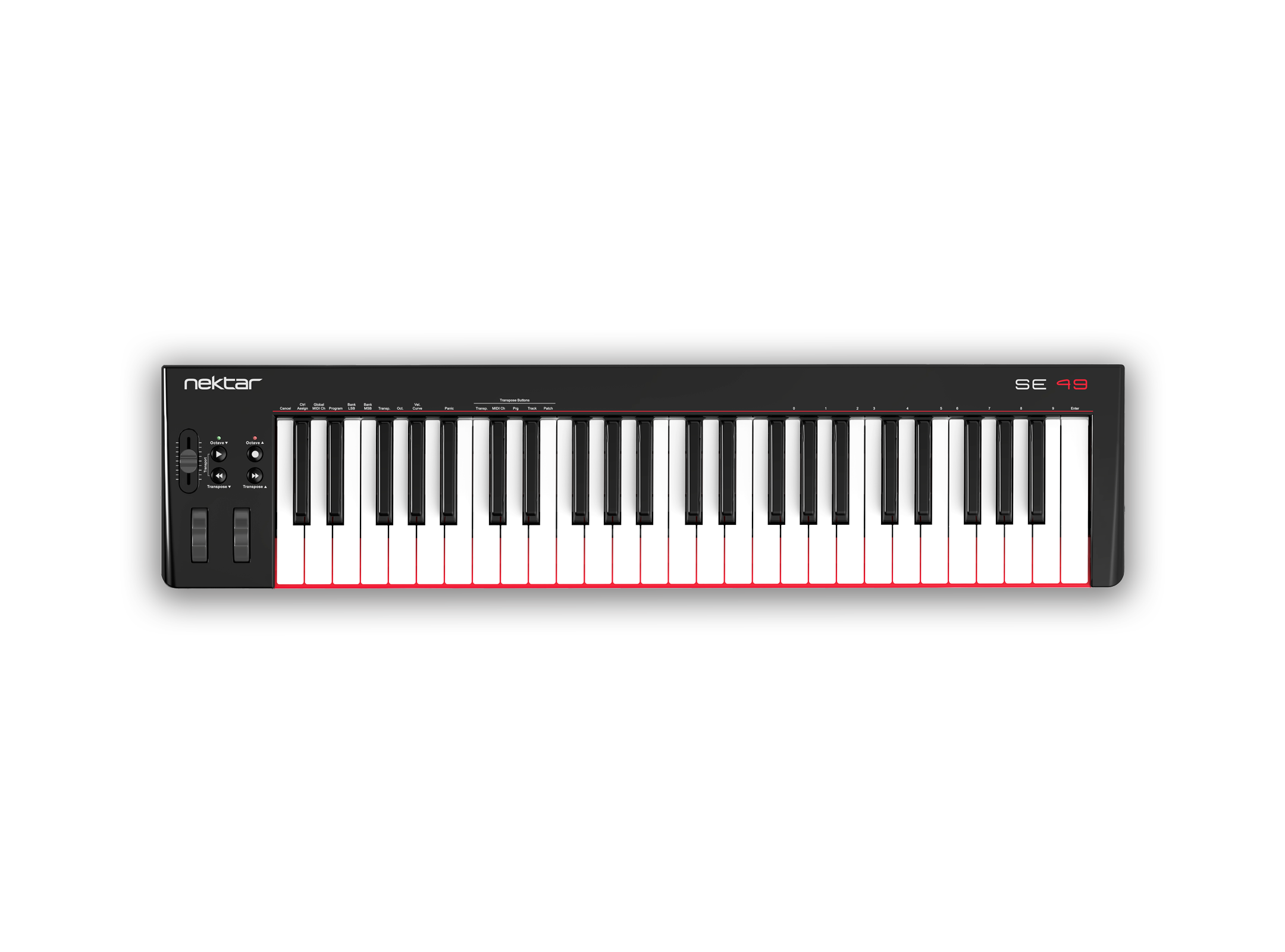
The SE series represents Nektar’s most accessible entry point, offering a focused, "no-nonsense" design that prioritizes a solid synth-action feel and essential DAW control without the bulk of pads or complex menus.
- Best for:full-size keys on a budget with minimal distractions.
- Avoid if:you need pads/faders for production workflow.
- Integration:Basic.
Specifications
- Compatibility:OS: Windows XP, Vista, 7, 8, 10 or higher; Mac OS X 10.5 or higher; Linux (Ubuntu).
- Keys:49 or 61 velocity-sensitive full-size keys (Synth-action).
- Controls:1 x 30 mm assignable volume fader, Octave Up/Down and Transpose Up/Down (multi-colored LED indicators), transport, Large Pitch Bend and Modulation wheels.
- Connectivity:1 x USB Type B port, 1 x 1/4” TS jack foot switch input (Sustain).
- Power:USB bus powered; no driver required (Class Compliant).
- Dimensions:80.5 x 19.7 x 6.9 cm
- Weight:2.2 kg
- Price Range:~$73–$79 (SE49) / ~$99.99 (SE61)
- Availability:Current product page active (SE49/SE61 page)
31. Novation FLkey 49
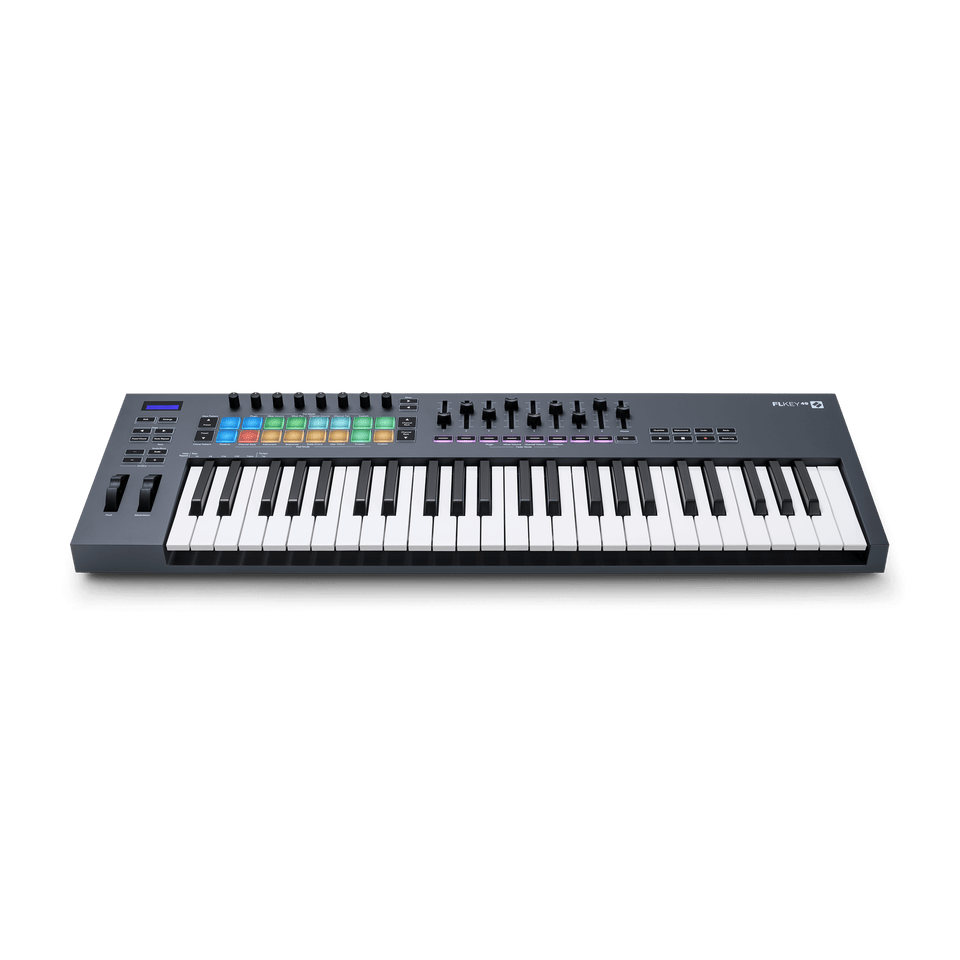
The FLkey 49 is the ultimate full-size keyboard for FL Studio production.
- Best for:FL Studio users who want common controls mapped quickly.
- Avoid if:you bounce between multiple DAWs every week.
- Integration:Template/DAW-focused.
Specifications
- Compatibility:Windows (11, 10, 8.1), MacOS (13, 12, 11, 10.15)
- Keys:49 velocity-sensitive, synth-action keys.
- Controls:8 pots, 9 faders, Maps 16 RGB pads to the FL Studio Step Sequencer, Instrument Control.
- Connectivity:USB-B socket (Bus powered), USB-B socket (Bus powered), 1/4” Sustain pedal jack.
- Power:USB bus powered
- Dimensions:789 × 258 × 77 mm
- Weight:3.03 kg
- Price Range:~$249.99–$289.99
- Availability:Current product page active
32. Novation Impulse 61
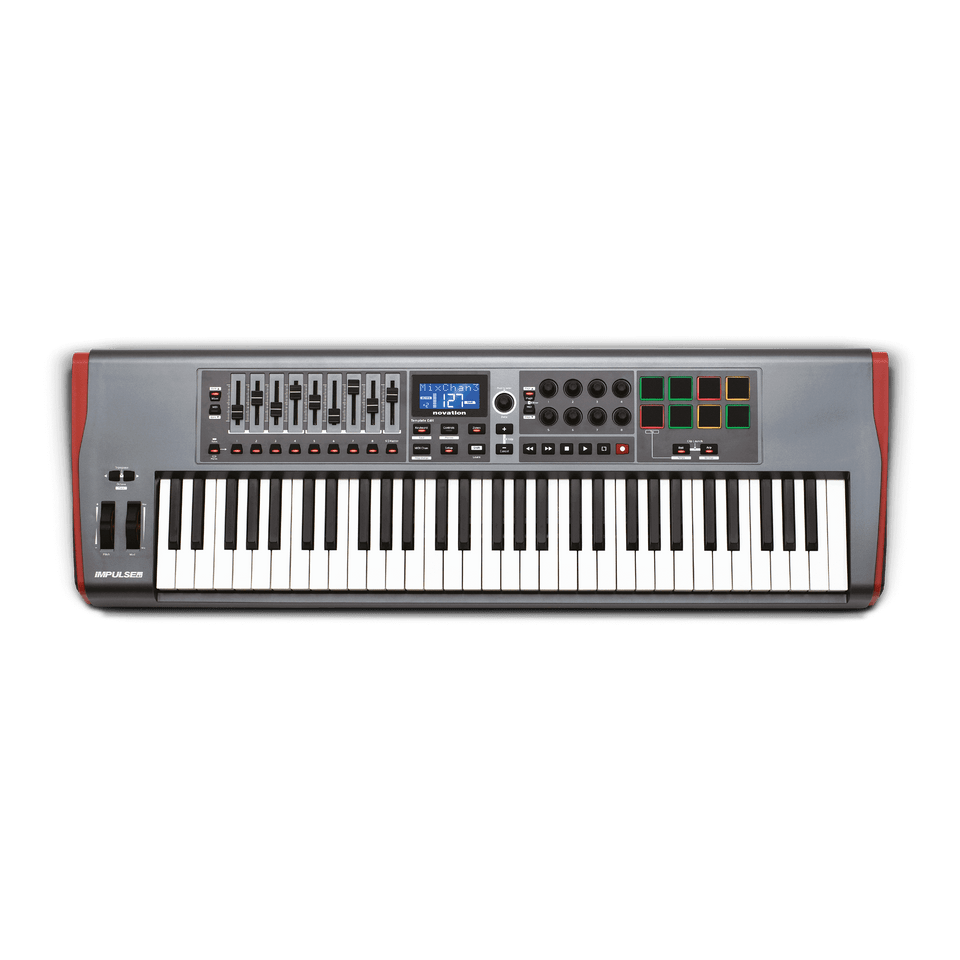
The Impulse 61 is designed as a "player’s keyboard," featuring High Rate Scan (HRS) technology that samples the keybed 10,000 times per second to capture every nuance of a performance.
- Best for:players who want semi-weighted keys + aftertouch + solid controls.
- Avoid if:you want a newer-generation workflow with modern displays.
- Integration:Template.
Specifications
- Compatibility:Windows 10/11 and macOS (Intel/Apple Silicon). Class-compliant MIDI over USB.
- Keys:61 full-size, piano-style keys with Semi-weighted action.
- Controls:8 Pads/8 encoders/9 sliders/transport
- Connectivity:USB B 2.0 (Bus powered), 5-pin MIDI In and MIDI Out, 1/4” Sustain pedal jack and 1/4” Expression pedal jack & DC power socket.
- Power:USB bus powered
- Dimensions: 1022 × 332 × 100 mm
- Price Range:~$379.99–$479.99
- Availability: Current product page active
33. Novation Launchkey 25 MK4
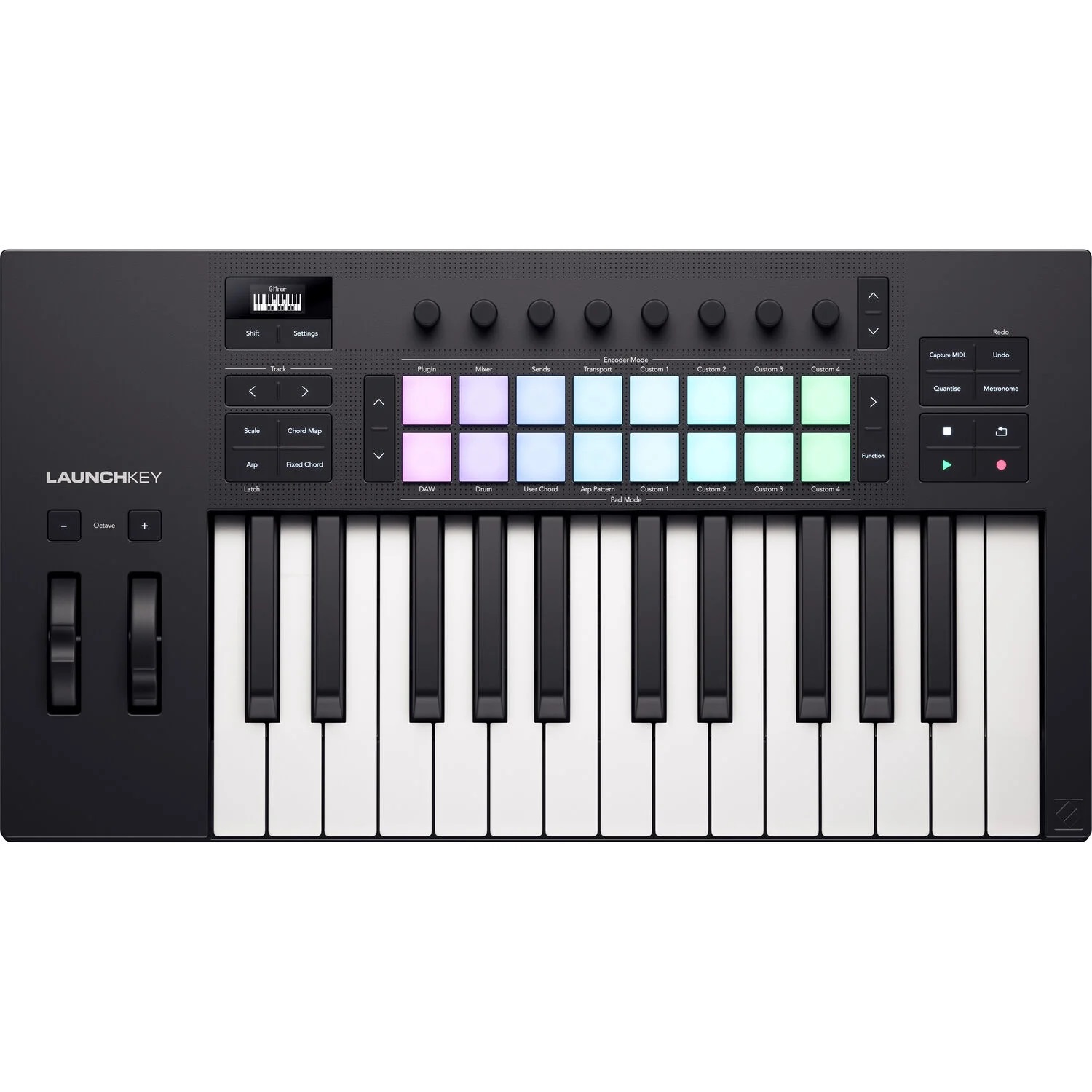
The Launchkey 25 Mk4 is the ultimate compact creative hub.
- Best for:compact DAW control with full-size keys and pads.
- Avoid if:you need wider playing range for two-hand parts.
- Integration:Template/DAW-ready.
Specifications
- Compatibility:OS: Windows 10/11, macOS 10.13+, and iOS/iPadOS (Class-compliant USB-C).
- Keys: 25 full-size synth-style keys.
- Key type:Velocity-sensitive synth-action.
- Controls:16 RGB backlit, velocity-sensitive FSR pads, 8 endless rotary encoders, Pitch Bend and Modulation wheels.
- Connectivity:USB-C socket (Bus powered), 5-pin MIDI Out, 1/4” Sustain pedal jack.
- Power:USB bus powered (power supply not included).
- Dimensions:461 × 251 × 79 mm
- Weight:1.8 kg
- Price Range:~$189.99–$209.99
- Availability:Launchkey 25 MK4 is current
34. Novation Launchkey 37 Mk3
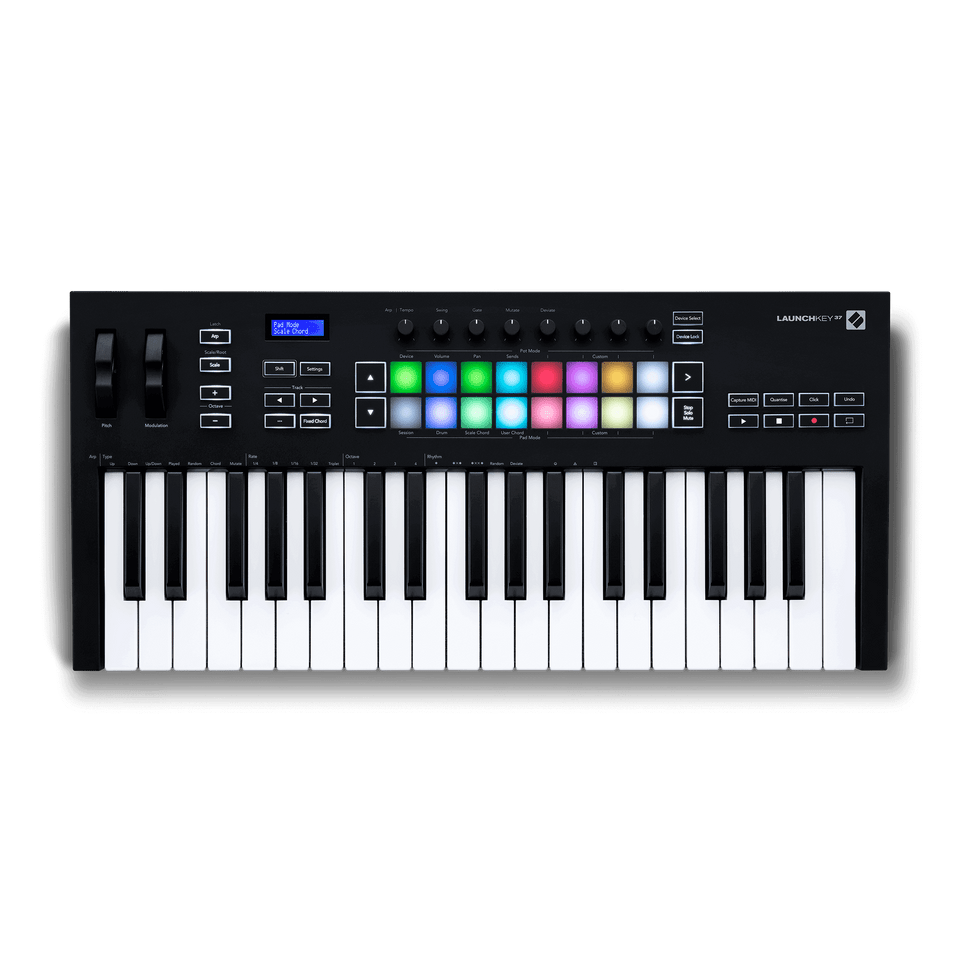
The Launchkey 37 Mk3 is a versatile, mid-sized controller that offers three octaves of full-size keys.
- Best for:three octaves in a compact footprint (older-gen value).
- Avoid if:you want the latest generation improvements and updated mappings.
- Integration:Template.
Specifications
- Compatibility:macOS (10.7+), Windows (7+), and iOS, Optimized for Ableton Live 10 or later (includes Ableton Live Lite).
- Keys:37 full-size, velocity-sensitive keys.
- Key type:Synth-action.
- Controls:16 RGB backlit, velocity-sensitive pads, 8 assignable rotary knobs, 16x2 character monochrome screen, Play, Stop, Record, and Loop buttons, Pitch Bend and Modulation wheels.
- Connectivity:USB-B socket (Bus powered), 5-pin MIDI Out socket, 1/4” Sustain pedal jack.
- Power:USB bus powered (power supply not included).
- Dimensions:555 × 258 × 77 mm
- Weight:~2.18 kg (4.8 lbs).
- Price Range:~$149.99–$169.99
- Availability:Previous generation (MK3) still listed on Novation site
35. Novation Launchkey Mini 25 Mk4
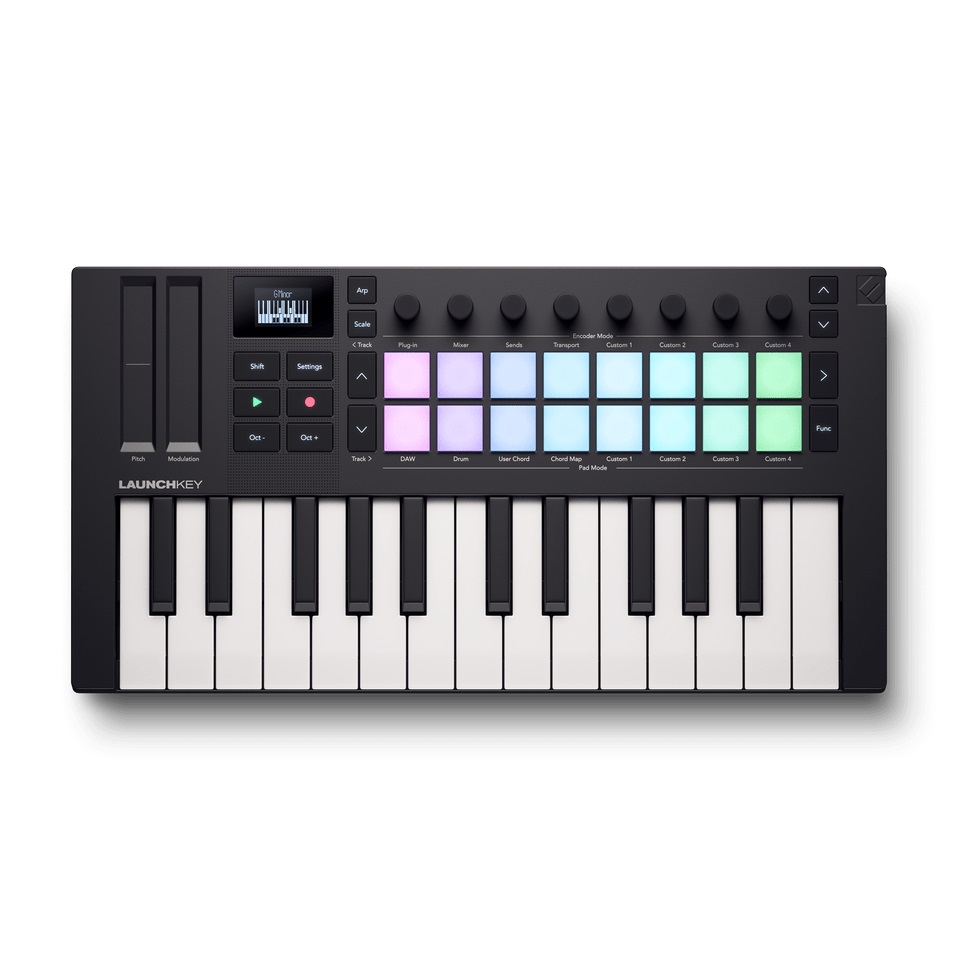
The Launchkey Mini 25 Mk4 is the ultra-portable member of the family.
- Best for:travel + clip/beat workflow in a tiny form.
- Avoid if:mini keys slow you down when writing chord voicings.
- Integration:Template/DAW-ready.
Specifications
- Compatibility:Windows 10/11, macOS 10.13+, and iOS/iPadOS (Class-compliant USB-C).
- Keys:25 synth-style mini-keys.
- Key type:Velocity-sensitive mini action
- Controls:16 RGB backlit, velocity-sensitive FSR pads, 8 endless rotary encoders, Capacitive pitch bend and modulation strips.
- Connectivity:USB-C socket (Bus powered), 3.5mm jack MIDI Out (Type A), 1/4” Sustain pedal jack.
- Power:USB bus powered
- Dimensions:338.5 × 176.8 × 49 mm
- Weight:0.78 kg
- Price Range:~$119–$139
- Availability:Current MK4 product pages active
36. Novation Launchkey 49 Mk4
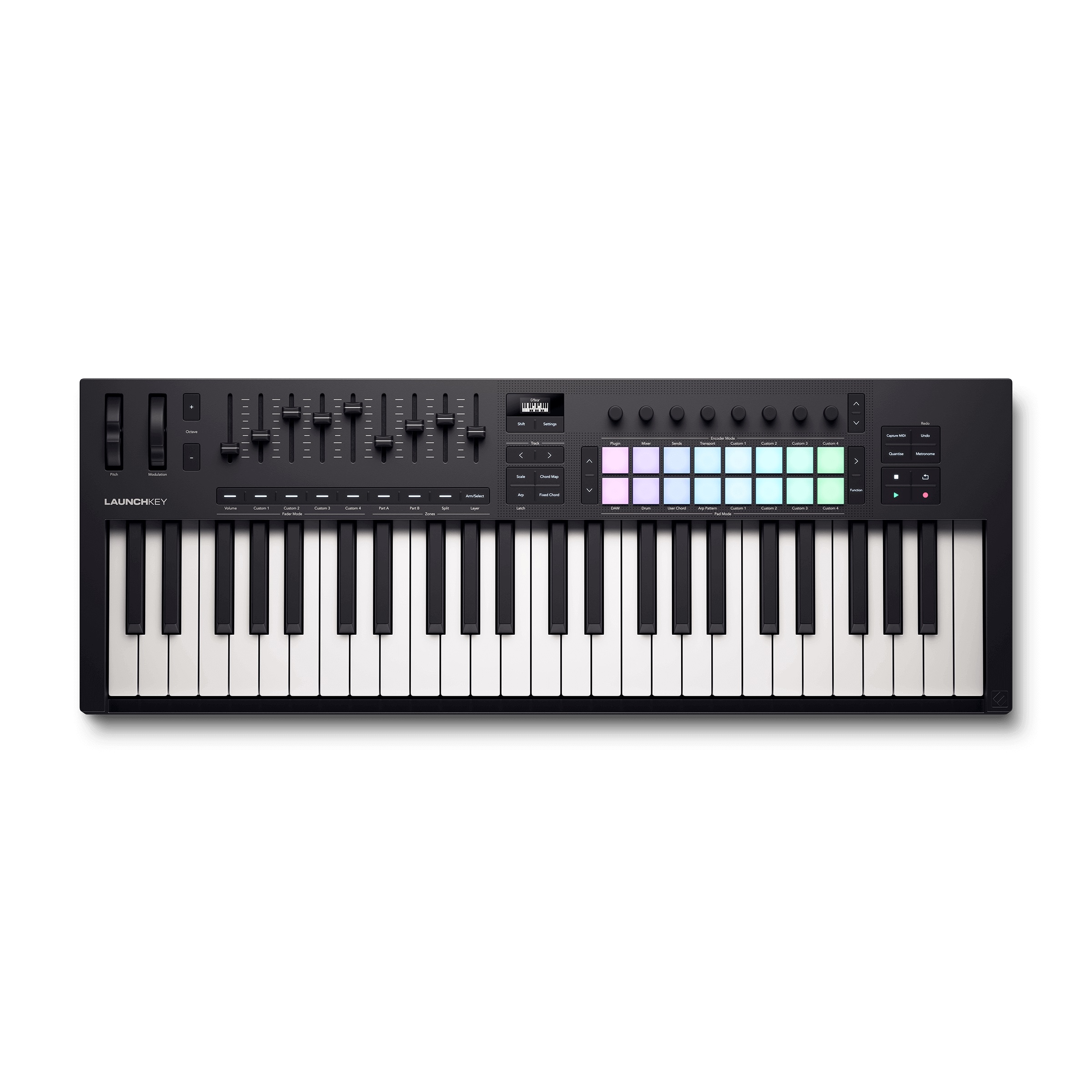
The Launchkey 49 is a comprehensive DAW controller designed for deep integration and creative chord generation.
- Best for:home studio “one keyboard” solution with strong DAW control.
- Avoid if:you want premium hammer-action feel.
- Integration:Template/DAW-ready.
Specifications
- Compatibility:Windows and macOS, iOS/iPadOS: Compatible via the Apple Camera Connection Kit or a USB-C to USB-C cable.
- Keys:49 semi-weighted, piano-style keys.
- Key type:Velocity-sensitive semi-weighted action
- Controls:16 RGB backlit, velocity-sensitive pads, 8 endless rotary encoders, 9 faders and 9 assignable buttons, Play, Stop, Record, Loop, Capture MIDI, Undo, Quantise, and Metronome buttons.
- Connectivity:USB-C socket (Bus powered), 5-pin MIDI Out socket, 1/4” Sustain pedal jack.
- Dimensions:730 × 263.5 × 93 mm
- Weight:4.08 kg
- Price Range:~$279.99 to $289.99
37. Novation Launchkey 61 Mk4
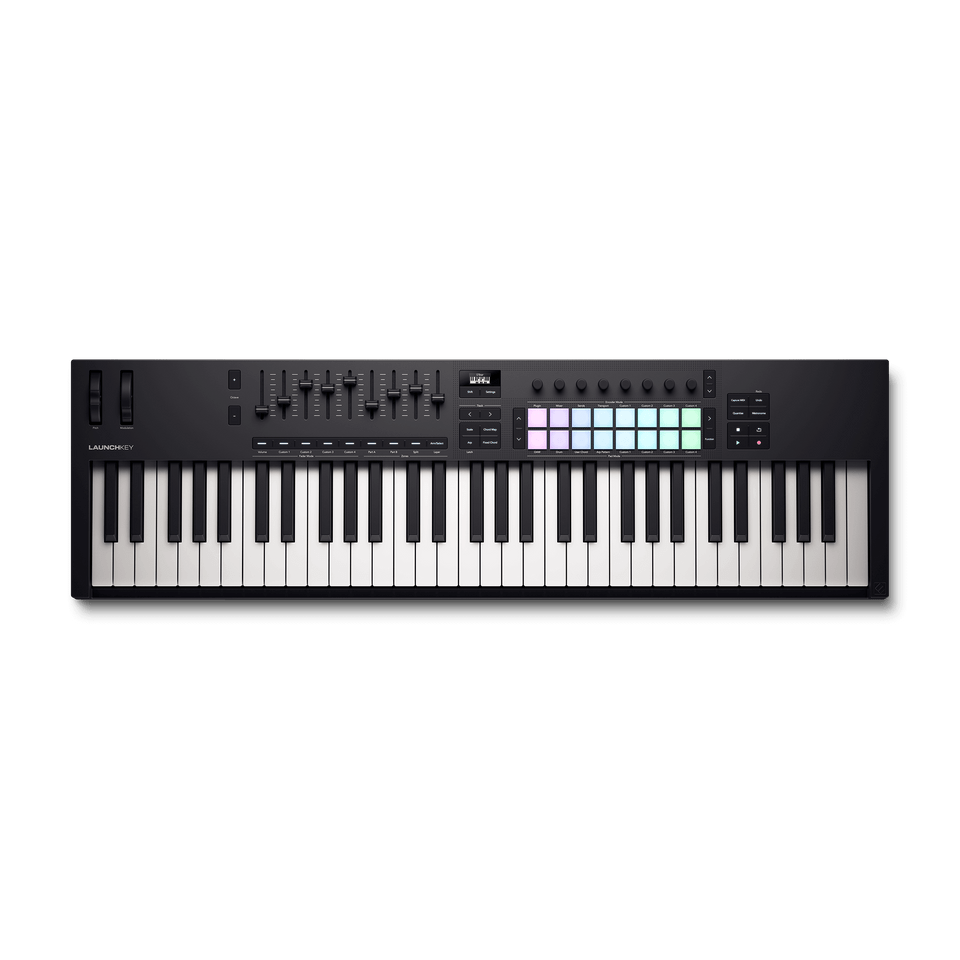
The 61-key variant is the full-sized powerhouse of the Mk4 range, offering a semi-weighted "piano-style" feel that is significantly more robust than previous generations.
- Best for:two-hand playing + production controls without 88-key bulk.
- Avoid if:desk space is tight-61 keys needs room.
- Integration:Template/DAW-ready.
Specifications
- Compatibility:Windows 10/11, macOS 10.13+, and iOS/iPadOS. (Class-compliant USB-C).
- Keys:61 semi-weighted piano-style keys.
- Key type:Velocity-sensitive semi-weighted action.
- Controls:16 RGB backlit, velocity-sensitive pads, 8 endless rotary encoders, 9 faders with 9 dedicated buttons, RGB backlit Pitch bend and Modulation wheels.
- Connectivity:USB-C socket (Bus powered), 5-pin MIDI Out, 1/4” Sustain pedal jack.
- Dimensions:895 × 263.5 × 93 mm
- Weight:4.78 kg
- Price Range:~$329.99 to $339.99
- Availability:Launchkey MK4 range is current; MK3 is listed as the previous generation
38. Novation SL MKIII (49SL MKIII)
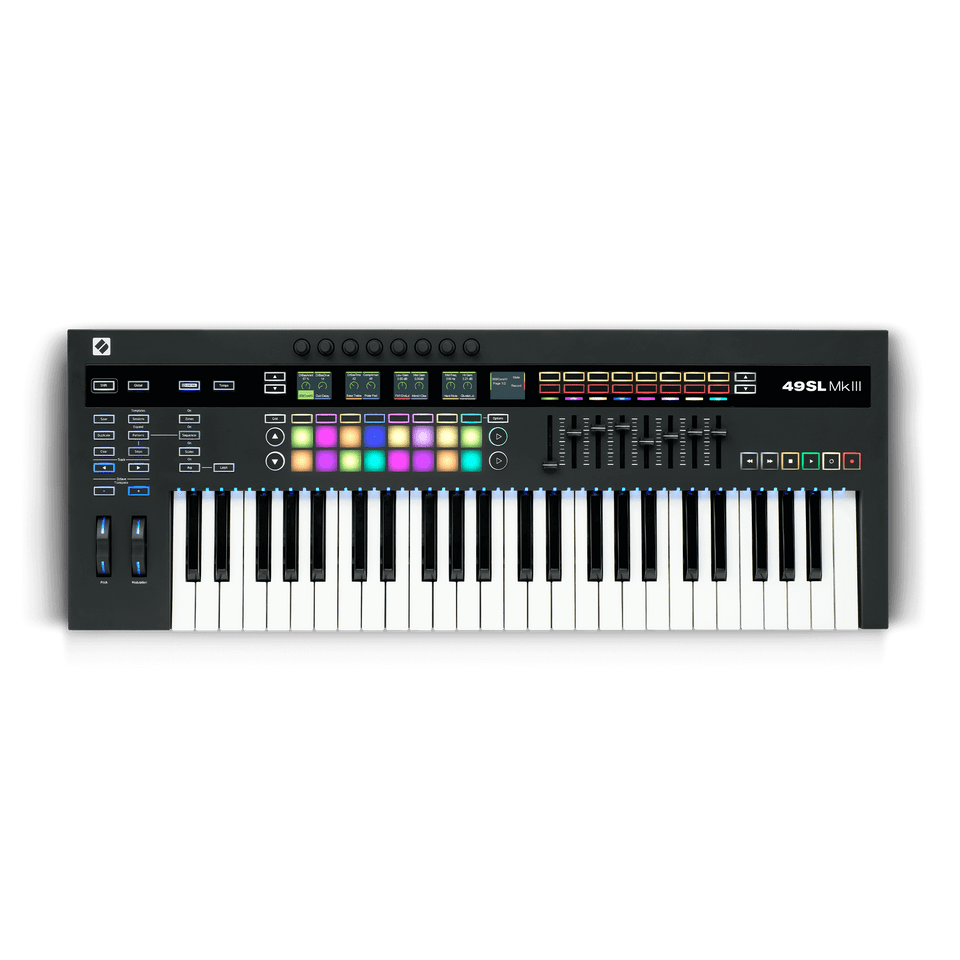
The 49SL MkIIIis a high-end hybrid controller featuring an internal 8-track sequencer and deep integration for Ableton Live, Logic Pro, and Reason, alongside comprehensive hardware control.
- Best for:hybrid setups (DAW + hardware) with sequencing and deeper control.
- Avoid if:you want something plug-and-play simple.
- Integration:Template + hardware-first.
Specifications
- Compatibility:Windows and macOS
- Keys:49 note, individually sprung, synth-style semi-weighted keyboard.
- Key type:Velocity-sensitive with Aftertouch
- Controls:16 Full-color RGB backlit velocity-sensitive pads, 8 Continuous rotary knobs and 5 RGB TFT LCD screens, 6 Dedicated transport controls, RGB backlit pitch bend and modulation wheels, 59 Backlit buttons with tact switches.
- Connectivity:USB B 2.0, MIDI:1 x In, 1 x Out, 1 x Out2/Thru (5-pin DIN), 2 Sets of CV Pitch, Gate, and Mod (3.5mm jacks) + Analog Clock Out.
- Power:DC 12V 1000mA (Power supply included; cannot be powered via USB).
- Dimensions:817 × 300 × 100 mm
- Weight:5.56 kg
- Price Range:~$779.99
- Availability:Current product page active
39. Roland A-49
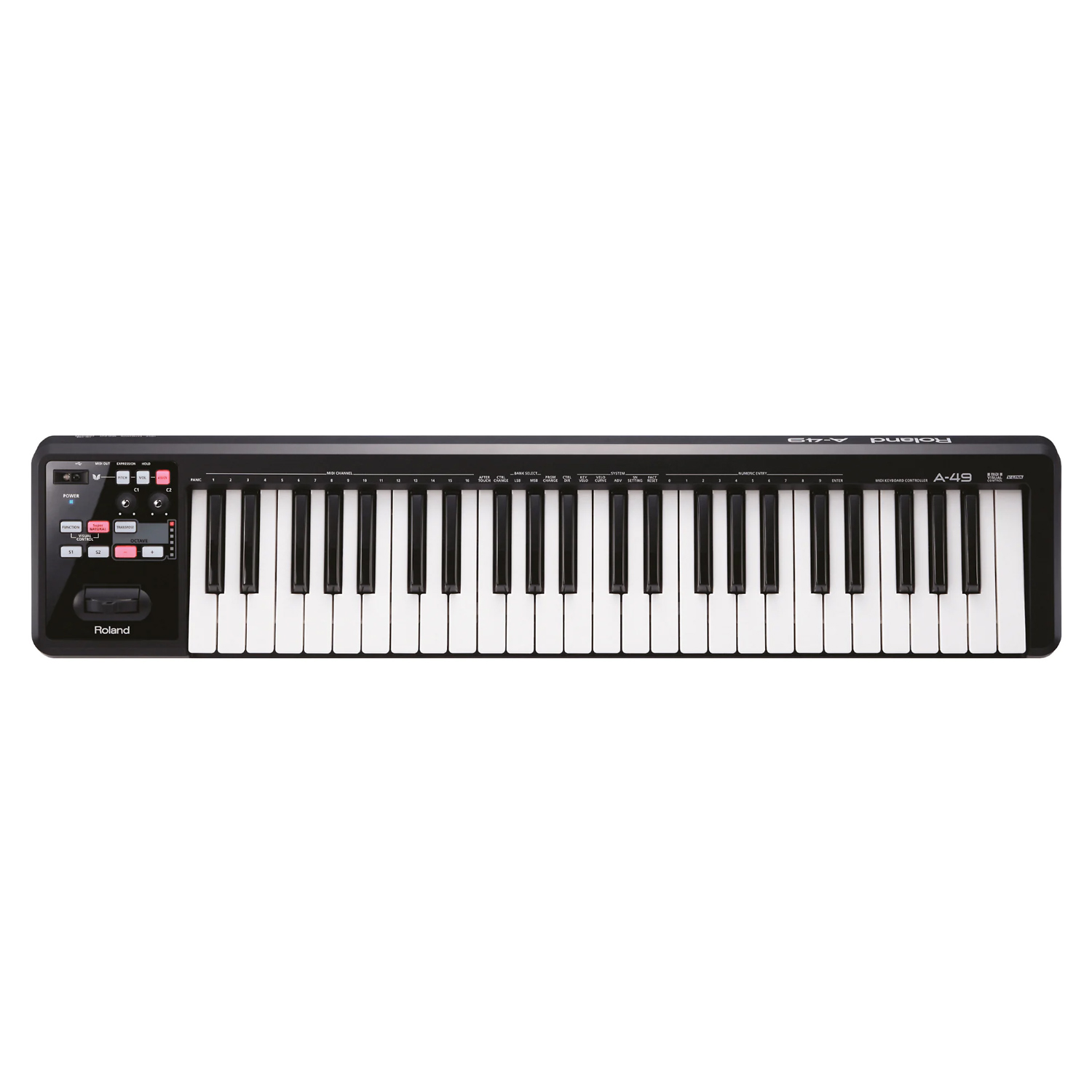
The Roland A-49 is a streamlined, professional-grade controller that prioritizes playability.
- Best for:players who want a clean, playable 49-key controller.
- Avoid if:you want pads/faders built in.
- Integration:Basic.
Specifications
- Compatibility:Windows (7 or later), macOS (10.13 or later), and iOS/iPadOS (via Apple Camera Connection Kit).
- Keys: 49 Full-size
- Key type:Velocity-sensitive
- Controls:2 knobs, 2 switches, D-BEAM, pitch/mod lever, pedal jacks (as listed)
- Connectivity:USB Type B + MIDI out + pedal inputs
- Power:USB bus powered
- Dimensions:836 × 182 × 84 mm
- Weight:2.5 kg
- Price Range:~$177 to $350 USD
- Availability:Product page and support pages active (older model, still supported)
40. ROLI LUMI Keys Studio Edition (ROLI Piano M)
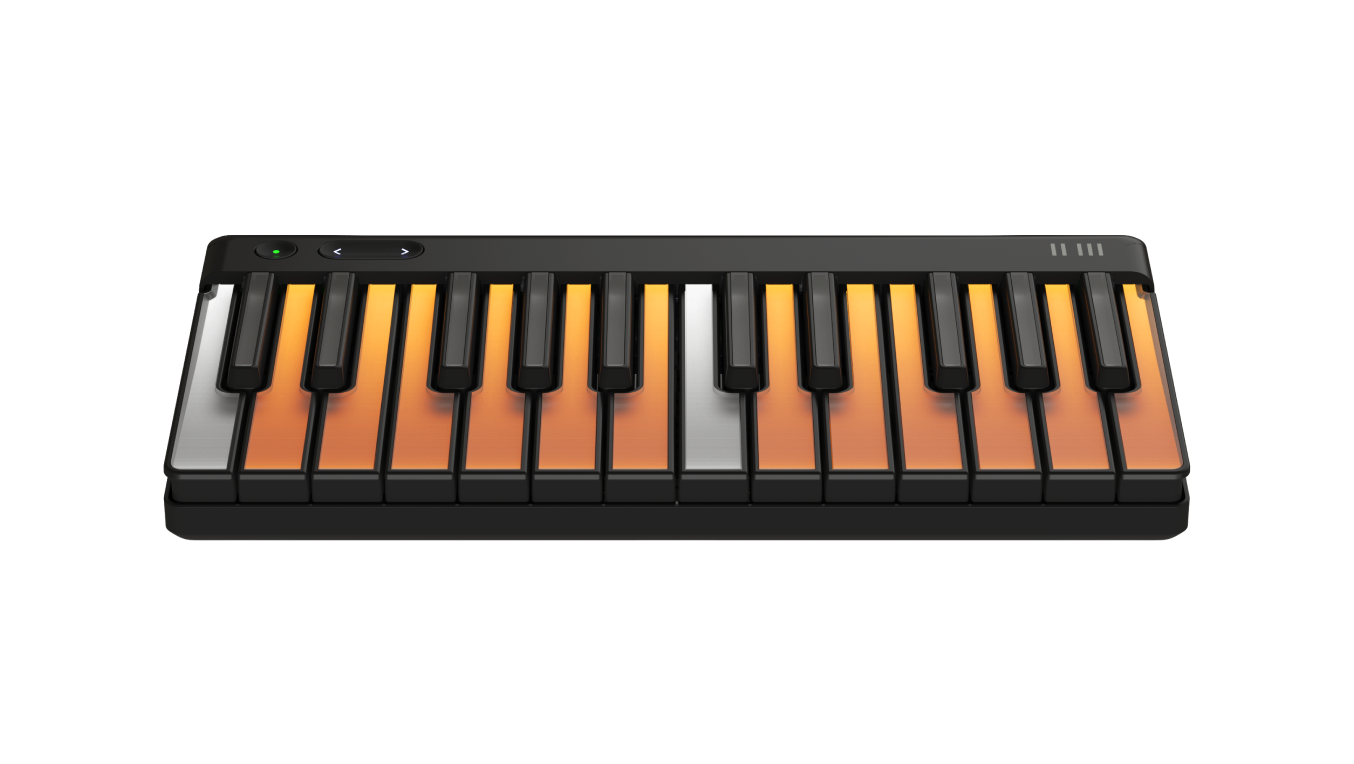
The Piano M is a high-performance, illuminated MIDI controller designed for both learning and professional MPE (MIDI Polyphonic Expression) performance.
- Best for:expressive playing and illuminated keys for learning/performance.
- Avoid if:you want traditional piano-style key travel and feel.
- Integration:Ecosystem/expressive (MPE-style workflow).
Specifications
- Compatibility:macOS 10.13+ and Windows 10/11, iOS/Android via Bluetooth 5.0
- Keys: 24 full-spectrum illuminated keys featuring ROLI Brightkey™ technology.
- Key size:DS 5.5® scale; 9.67 mm wide (high keys) / 19.4 mm wide (low keys).
- Key Type:Mechanical with a 10 mm key plunge
- Controls:4 DNA connectors (top, bottom, and sides) for magnetically daisy-chaining multiple Piano M or Seaboard M units.
- Connectivity:USB-C (Data and Charging), Bluetooth 5.0.
- Power:Internal 2,300 mAh rechargeable battery.
- Dimensions:28.2 × 14.1 × 2.7 cm.
- Weight:677 g.
- Price:~$249
- Availability:Renamed-now sold as ROLI Piano M (same product line)
41. ROLI Seaboard
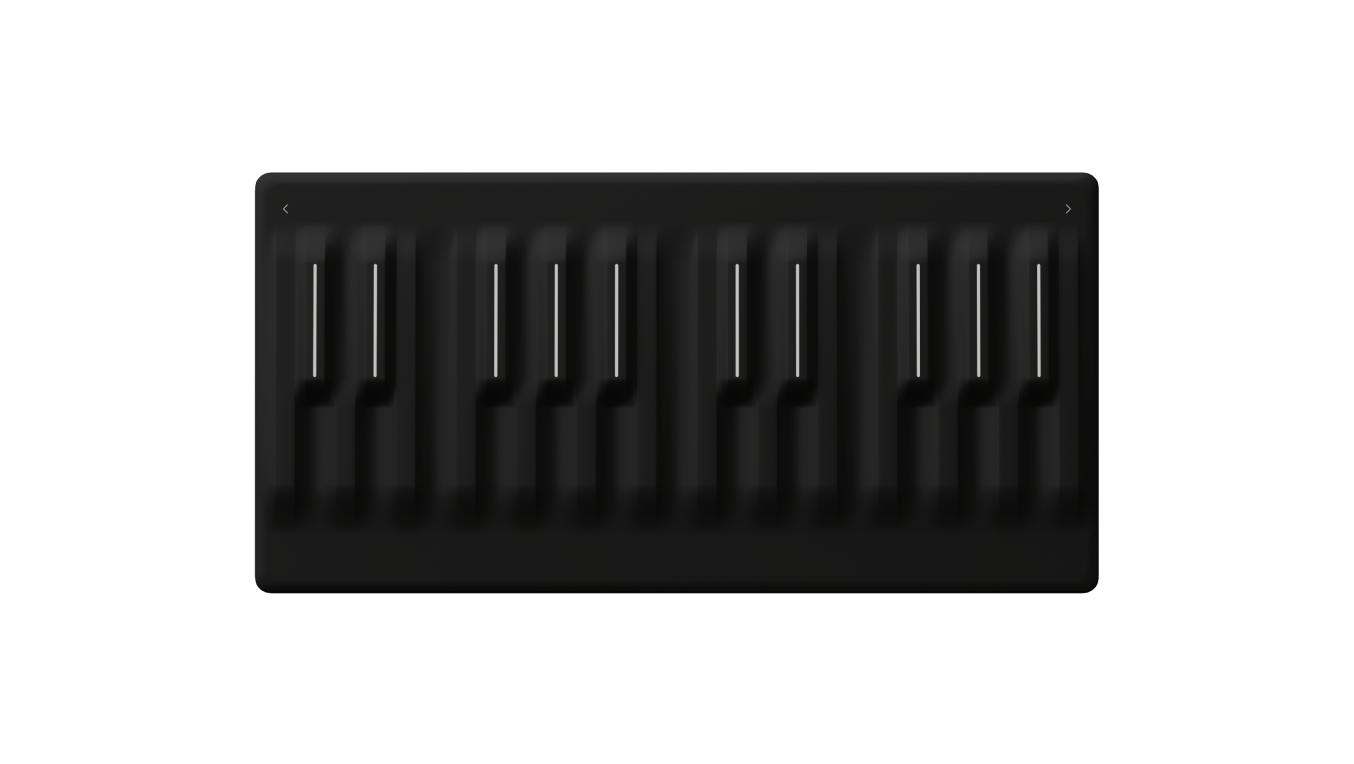
The Seaboard M is the portable, modular evolution of the Seaboard line, condensing the revolutionary 5D touch interface into a backpack-friendly format that can be expanded using magnetic connectors.
- Best for:deep expressive control (slides, pressure, per-note motion).
- Avoid if:you want standard black-and-white key technique training.
- Integration:Expressive ecosystem (MPE workflows).
Specifications (Seaboard M reference)
- Compatibility:macOS/Windows, iOS/Android via Bluetooth
- Keys:24-key continuous Keywave surface (approx. 2 octaves).
- Key size:Miniature Keywaves (optimized for portability).
- Controls:5D Touch (Strike/Press/Glide/Slide/Lift)
- Connectivity:USB-C + Bluetooth + TRS MIDI out
- Power:Internal 2,300mAh Rechargeable battery
- Dimensions:282 × 141 × 25 mm
- Weight: 650 g
- Price:$349.00 USD, £299.00, or €349.95.
- Availability:Seaboard M is current on ROLI’s site; other Seaboard generations vary-verify model
42. Studiologic SL88 Grand
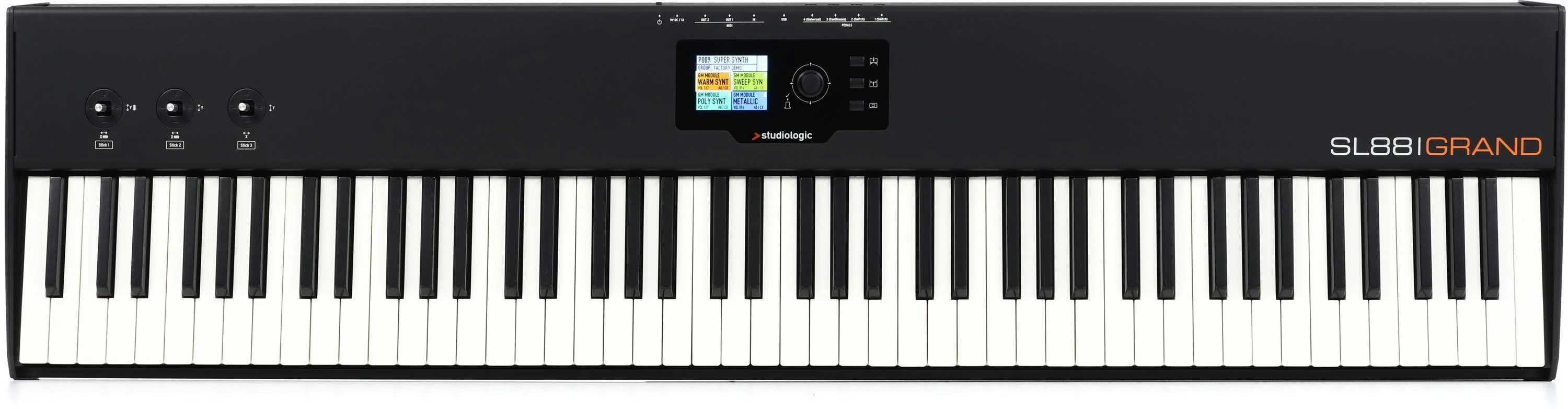
The SL88 Grand is Studiologic’s flagship controller, featuring the world-renowned Fatar TP/40WOOD keybed for an uncompromising, authentic piano feel.
- Best for:top-tier hammer action as a master controller.
- Avoid if:you need pads/faders integrated into the same unit.
- Integration:Basic (play-first).
Specifications
- Compatibility: Windows (7 or higher), macOS (10.9 or higher), and iOS/iPadOS (via Camera Connection Kit). Class-compliant MIDI over USB.
- Keys:88, Full-size
- Key type: TP/40WOOD graded hammer action
- Controls:Programmable zones, sticks/encoder/buttons; MIDI/USB/pedal connections
- Connectivity:MIDI In/Out1/Out2 + USB to Host
- Power: DC in 9V (adapter)
- Dimensions: 126 × 31 × 11 cm
- Weight:20.8 kg
- Price Range:~$1,049.95
- Availability:Current SL Keyboards line active
43. Studiologic SL88 Studio
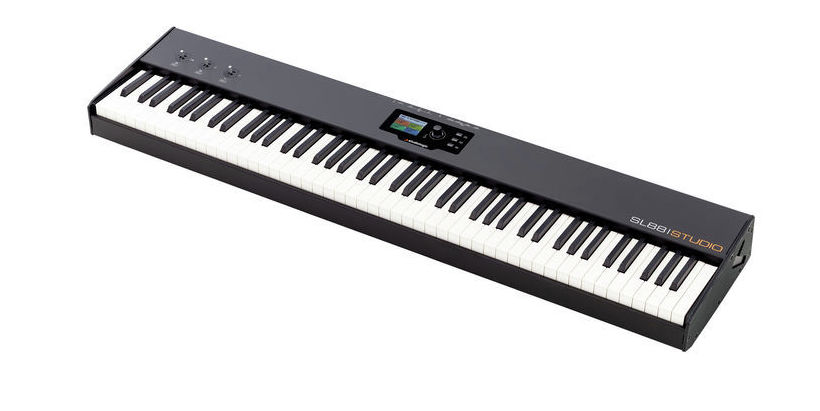
The SL88 Studio is a professional-grade MIDI controller that balances a high-end Fatar hammer-action feel with a surprisingly portable, rugged metal chassis.
- Best for:hammer action feel in a lighter, more portable 88-key option.
- Avoid if:you want wooden-key feel like the Grand.
- Integration:Basic (play-first).
Specifications
- Compatibility:Windows and macOS
- Keys:88, Full-size
- Key type: TP/100LR premium hammer action
- Controls:4 Programmable zones, sticks/encoder/buttons; MIDI/USB/pedal connections
- Memory:250 Programs organized into 12 groups.
- Connectivity:MIDI In/Out1/Out2 + USB to Host
- Power:DC in 9V (adapter)
- Dimensions: 126 × 31 × 12.5 cm
- Weight:13.7 kg
- Price Range:around $499.95 to $529.95
- Availability:Current SL Keyboards line active
44. Alesis V49 MKII
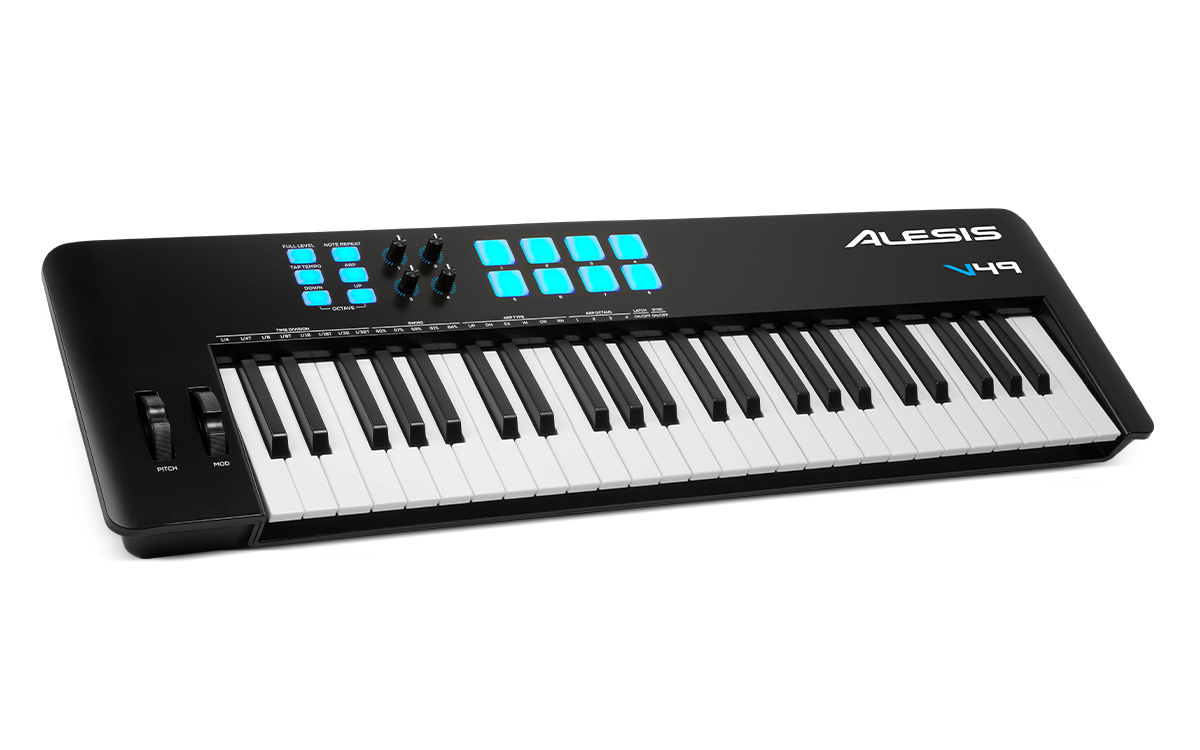
The Alesis V49 MKII is a streamlined, essential MIDI controller that prioritizes ease of use and portability.
- Best for:affordable 49-key production starter with pads and arp tools.
- Avoid if:you want aftertouch or deeper integration features.
- Integration:Basic/Template.
Specifications
- Compatibility:Windows: 8 (64-bit) or later, macOS: 10.13.6 or later, Standard USB 2.0 port required
- Keys:49, Full-size
- Key type:Velocity-sensitive synth-action
- Controls:8 pads, 4 knobs, pitch/mod wheels, arp controls
- Connectivity:1 x USB Type-B port , 1/4” TS Sustain pedal input
- Power:USB Bus Powered (Plug-and-play)
- Dimensions:81.2 × 24.4 × 9.4 cm
- Weight:2.75 kg
- Price Range:~$149 USD.
- Availability:Current product page active
45. Alesis VI49
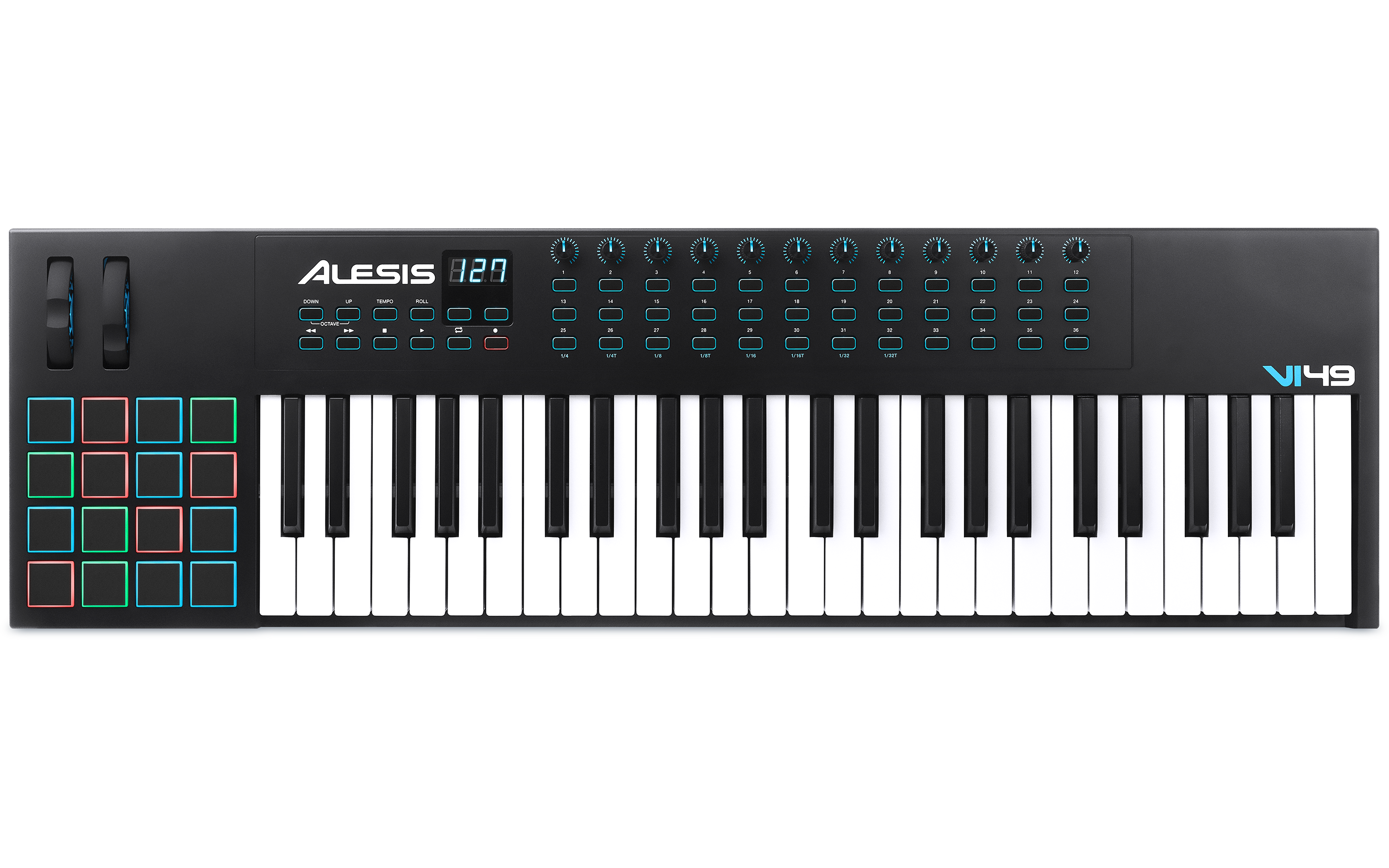
The Alesis VI49 is the mid-sized sibling in the VI series, striking a balance between portable footprint and professional-grade control.
- Best for:lots of controls + aftertouch in a 49-key controller.
- Avoid if:you want compact/lightweight hardware.
- Integration:Basic/Template.
Specifications
- Compatibility:Windows: 7 (32 or 64 bit), macOS: OS X 10.11
- Keys:49, Full-size
- Key type:Velocity-sensitive with aftertouch
- Controls:16 RGB pads, 12 knobs, 36 buttons, transport
- Connectivity:USB + 5-pin MIDI out + 1/4" footswitch input
- Power:USB bus / optional 9V adapter
- Dimensions:95.5 × 31.5 × 11.5 cm
- Weight:5.0 kg
- Price Range:~$139.99 to $369.89.
- Availability:Current product page active
Pad Controllers
Novation Launchpad X (Pad Controller)
A clip-launching and finger-drumming pad grid built for fast Ableton-style workflows.
- Best for:launching clips/scenes, drum programming, live performance.
- Avoid if:you want to play chords with two hands-this is pads, not keys.
- Integration:Template/DAW-ready (depends on setup).
- Real-world note:pads feel great for performance; learning curve is “grid thinking.”
- Availability:Current
Specifications
- Pads: 64-pad grid
- Controls:session/navigation/record workflow buttons
- Connectivity:USB
- Power:USB bus power
Akai MPC Studio (Pad Controller)
An MPC-style controller designed to drive MPC-style beatmaking workflows.
- Best for:MPC-style sequencing, beat creation, pad performance.
- Avoid if:you need keys for melodic playing (pair with a small keyboard).
- Integration:Ecosystem (MPC workflow).
- Real-world note:strongest when you commit to the MPC workflow instead of “generic MIDI.”
- Availability:Current
Specifications
- Pads:MPC pads (count varies by model revision; verify)
- Controls:transport/encoder workflow for MPC-style control
- Connectivity:USB
- Power:USB bus power
DAW Integration That Matters
What Matters In Practice Is:
- Does it have a dedicated script/template for your DAW?
- Does it send standard controls (MCU/HUI) when it doesn’t?
- Can it control instruments you actually use (NKS, Analog Lab, etc.)?
Example: Native Instruments’ Kontrol S-Series emphasizes deep DAW integration and provides physical dimensions/weights per model in their comparison specs. (Data as of Mar 2026; check latest official listing.)
Takeaway:DAW “compatibility” is easy; good mappingsare the difference between “fun” and “I hate this controller.”
Setup That Actually Works
This section gives you a repeatable setup routineso your new controller becomes productive on day one, not “a weekend project.”
Plug In + DAW Settings Checklist
Use this as your default first boot sequence:
- Plug the controller in (or pair Bluetooth).
- In your DAW, enable it as a MIDI input device. FL Studio documents this directly in its MIDI settings section.
- If the controller supports a control-surface profile, select it. Logic has dedicated control-surface support profiles.
- Verify: keys trigger a simple instrument; pads trigger notes; transport moves the DAW.
If you’re on iPad/iPhone and nothing happens, unlock the device first-Apple notes accessories often require unlock before connecting.
If you haven’t chosen a DAW yet, pick that first-your controller experience depends heavily on it. Here’s a practical shortlist of music production softwareby goal and device.
Takeaway: you’re aiming for “sound on key press” in under five minutes-everything else is optimization.
Mapping Knobs/pads Without Losing Your Mind
I treat mapping like labeling cables: if you don’t document it, you’ll redo it.
- Start with one bank: map 8 knobs to the 8 macros you actually touch (filter, resonance, envelope, reverb, delay).
- Name the bankin the controller/editor if possible, or keep a simple note (“Bank A = synth macros”).
- Prefer standards/ecosystemswhen available: NKS-style mappings exist to reduce setup time across supported instruments.
Ableton explicitly supports user configurations/scripts when a controller isn’t natively supported-useful if you’re customizing an “almost perfect” controller.
Takeaway: mapping is only “worth it” when it becomes repeatableacross sessions.
Common Problems: Power, Drivers, Latency, Stuck Notes
Most issues fall into four buckets:
- Power: some controllers draw more than a tablet/hub provides. If you’re on iPad, plan for powered hubs or proper power routing.
- Drivers: many controllers are class-compliant, but some features rely on vendor software-install only what you need.
- Latency: it’s usually your audio buffer, not MIDI. Reduce buffer size when recording; raise it when mixing.
- Stuck notes: learn your DAW’s “panic” or “all notes off” function; it’s the fastest sanity reset.
Takeaway: troubleshoot in this order-power → device enabled → control-surface selected → audio buffer-and you’ll solve most problems quickly.
Micro-glossary
- Aftertouch:pressure data after pressing a key-great for vibrato/filter without automation.
- Polyphonic aftertouch:pressure per note (chords can modulate differently).
- MPE:per-note expression for pitch/timbre/pressure (best with compatible instruments).
- TRS MIDI (Type A/B):3.5mm MIDI; cables/adapters must match the correct type.
- Endless encoder vs potentiometer:endless encoders avoid value jumps when switching tracks/banks.
- Synth-action vs semi-weighted vs hammer:light/fast → balanced → piano-style resistance.
Expressiveness & Future-proofing
This section helps you avoid paying for features you won’t use-and helps you recognize when expressive control will genuinely level up your playing.
Aftertouch Vs Poly-aftertouch
- Aftertouch(channel aftertouch) sends pressure data after the key is pressed-great for vibrato, filter sweeps, and evolving pads.
- Polyphonic aftertouchsends pressure per note, so a chord can open up on one note while the others stay steady.
Native Instruments notes polyphonic aftertouch across its Kontrol S-Series MK3 line, and highlights the S88 MK3 as a hammer-action polyphonic-aftertouch controller.
Takeaway: aftertouch matters when you want expression without extra automation lanes.
What MPE Changes (and When It’s Worth It)
MPE (MIDI Polyphonic Expression) is a recommended practice for sending multidimensional, per-note expressionusing MIDI 1.0 messages-think per-note pitch slides, timbre changes, and pressure that don’t collapse into a single “global” control.
When it’s worth it:
- You use instruments that support MPE and you want expressive performance (especially for modern synth textures). When it’s not:
- Your workflow is mostly piano parts, drums, and quick arrangement building.
Takeaway: MPE is powerful, but only when your controller + instruments + DAWare aligned.
MIDI 2.0: What’s Real Today Vs Later
The MIDI Association describes MIDI 2.0 as an extension of MIDI 1.0, designed to build on core principles while protecting backward compatibility, with MIDI-CI as a foundation for negotiation of capabilities.
How to use that in buying decisions:
- Treat MIDI 2.0 support as a bonus, not a requirement, unless you know your software/hardware ecosystem supports it end-to-end.
- Prioritize dependable MIDI 1.0 operation and integration today; that’s still the baseline that keeps sessions moving.
Takeaway: future-proofing is smart, but workflow-proofing is smarter.
FAQs
Can I Use A MIDI Controller In My Home Studio?
Yes-connect via USB (or MIDI interface), enable it as an input device in your DAW, then map controls or load a control-surface profile.
Do You Need Pads And Knobs?
Only if they match your workflow: pads help beats/clip launching, knobs/faders help sound design and automation. If you mainly play notes, you can skip them.
What Software Is Useful To Use In Conjunction With My MIDI Controller?
A DAW plus a few good instruments/effects is enough. If you want less setup, choose controllers with strong integration ecosystems (e.g., NKS-style workflows) or official DAW setup guides.
What Are The Best Midi Keyboards For Most People?
The best choice matches your key count, DAW integration, and connectivity needs. For many desks, 49 keys with solid DAW control is the sweet spot.
How Many Keys Do I Need On A MIDI Keyboard?
25 for portability, 49 for desk balance, 61 for two-hand parts, 88 for piano technique and full-range playing.
Is A MIDI Keyboard The Same As A Digital Piano?
No-digital pianos generate sound on their own. MIDI controllers mainly send performance data to software or external hardware.
Will A MIDI Keyboard Work With Ableton/Logic/FL Studio?
Most work as MIDI input. “Deep integration” depends on official control-surface support, scripts, or profiles in your DAW.
Do I Need MIDI Out For Hardware Synths?
If you want to control hardware directly, yes-look for 5-pin MIDI (or TRS MIDI) or CV/Gate for modular.
Can I Use A MIDI Keyboard With An IPad?
Often yes, but you may need adapters and sometimes extra power. Also, your iPad may require you to unlock it before the accessory connects.
What Is Aftertouch?
Aftertouch sends pressure data after a key is pressed, letting you control effects like vibrato or filter changes while holding notes.
What Is Polyphonic Aftertouch?
Polyphonic aftertouch sends pressure per note, enabling expressive chords where each note can modulate differently.
What Is MPE And Who Is It For?
MPE enables per-note multidimensional expression (pitch/timbre/pressure). It’s best for expressive synth playing when your instruments and DAW support MPE.
What Does “DAW Integration” Actually Mean?
It means pre-mapped transport/mixer/plugin control via scripts, profiles, or ecosystems-reducing manual MIDI Learn setup.
Is MIDI 2.0 Important When Buying A Controller Today?
It’s a future-proof bonus. MIDI.org describes MIDI 2.0 as an extension of MIDI 1.0 with backward compatibility as a core design goal.
Should Beginners Buy A 61-key Controller?
Only if you’ll play two-handed often. Otherwise, 25–49 keys are cheaper, easier to fit, and still cover full range with octave controls.
Final Thoughts
The "best" MIDI keyboard is the one that removes the most barriers between your ideas and your speakers. For most people, the Arturia KeyLab MkIII provides that professional feel and deep integration that makes music production feel like play rather than work.
Start with a size that fits your desk, ensure it has the software you need to get started, and don't be afraid to invest in a slightly better keybed-your hands will thank you after a ten-hour session.