Beginner's Guide To Learning The Piano
If you want to learn piano, the fastest reliable path is simple: practice 15–30 minutes most days, follow a clear step-by-step plan, play music early, and get regular feedback so you do not repeat the same mistakes.
In Short: The Smartest Way To Start Learning Piano
- Best starting routine:Practice 15–30 minutes a day, 5 days a week.
- Best beginner instrument:A digital pianoor keyboard with full-size, touch-sensitive keys.
- Best learning path:Start with keyboard landmarks, rhythm, relaxed technique, and one easy song.
- The ingenious way to learn piano:Practice tiny sections slowly, repeat them correctly, then review them across several days.
- Fastest way to sound musical:Learn simple chords and easy melodies together.
- Biggest beginner mistake:Trying to play too fast before rhythm, posture, and note accuracy are stable.
- Best long-term goal:Build a system, not just motivation.
This guide to learning the pianotakes you from the first day of practice to stronger intermediate skills, better time management, online learning motivation, and early steps toward mastering the piano.
Who This Guide Is For
This guide is for:
- Complete beginners with no music background.
- Adults learning piano for the first time.
- Students balancing piano with schoolwork.
- Self-taught learners using YouTube, apps, or books.
- Parents helping a child start piano.
- Guitar players or singers who want to understand piano.
This guide is not mainly for advanced classical pianistspreparing conservatory-level repertoire.
How To Use This Guide
If you are brand new, start with “How To Play Piano Today.”
If you already have a keyboard, go to the 30-day practice plan.
If you are unsure whether to learn sheet musicor chords first, read “Choose Your Piano Learning Path.”
If you feel stuck, go to “Why Beginners Get Stuck And How To Fix It.”
If you are a student, read “How Student Pianists Can Balance Practice And Homework.”
If you already know the basics, go to “Beginner To Advanced Piano Progression.”
What Beginners Should Know First
Learning piano can feel overwhelming because there are many things you couldstudy: notes, chords, rhythm, scales, songs, pedals, theory, technique, sight-reading, ear training, and more.
But beginners do not need to learn everything at once.
The correct order is:
- Learn where notes are on the keyboard.
- Learn basic rhythm and counting.
- Build relaxed hand position.
- Play very easy songs early.
- Practice small sections slowly.
- Add chords, reading, ear training, and technique gradually.
- Use feedback to fix mistakes before they become habits.
A realistic first-month goal is not “play perfectly.” It is:
- Find notes without guessing.
- Keep a steady beat.
- Play a short melody or chord progression.
- Practice consistently without tension.
- Understand what to work on next.
That is how real progress starts.
Teacher’s note:Most beginners do not fail because piano is too hard. They fail because they practice too much material at once. In the first month, I would rather see a student play 8 bars slowly and steadily than rush through an entire song with pauses and tension.
What You Should Be Able To Do After 30 Days
After 30 days of consistent beginner practice, you should be able to:
- Find C, D, E, F, and G without guessing.
- Play a five-note melody slowly.
- Keep a basic 4/4 pulse.
- Play at least one simple song section.
- Play two to four basic chords.
- Understand whether you prefer sheet music, chords, or a hybrid path.
- Know what to practice next.
How To Play Piano Today: Your First 20-Minute Lesson
Here is a simple “how to play piano today” plan you can do even if you have never touched a keyboard before.
Step 1: Find The Pattern Of Black Keys
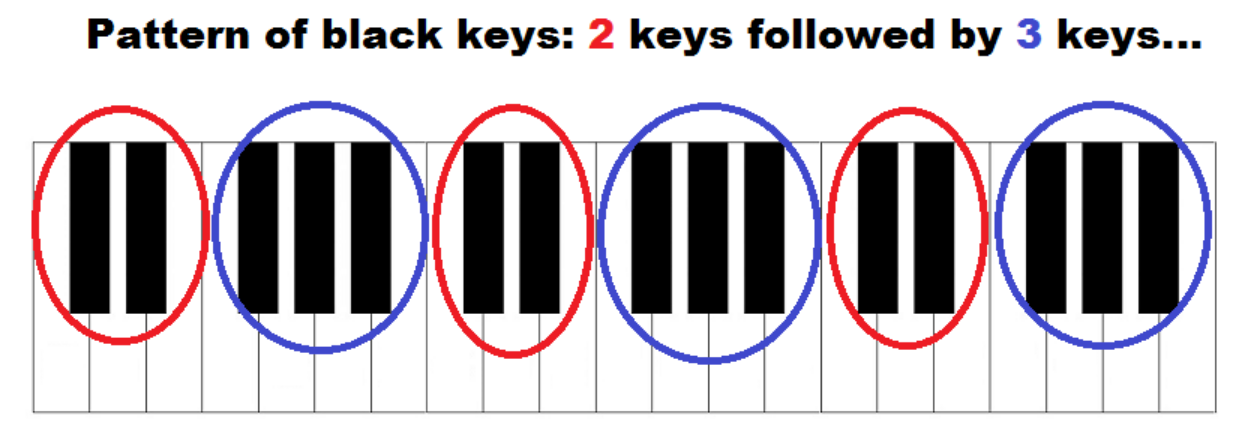
Look at the keyboard. You will see black keys grouped in:
- Groups of 2
- Groups of 3
This pattern repeats across the entire keyboard.
The white key directly to the left of every group of 2 black keys is C.
That means you can find C anywhere on the piano without guessing.
Step 2: Find Middle C
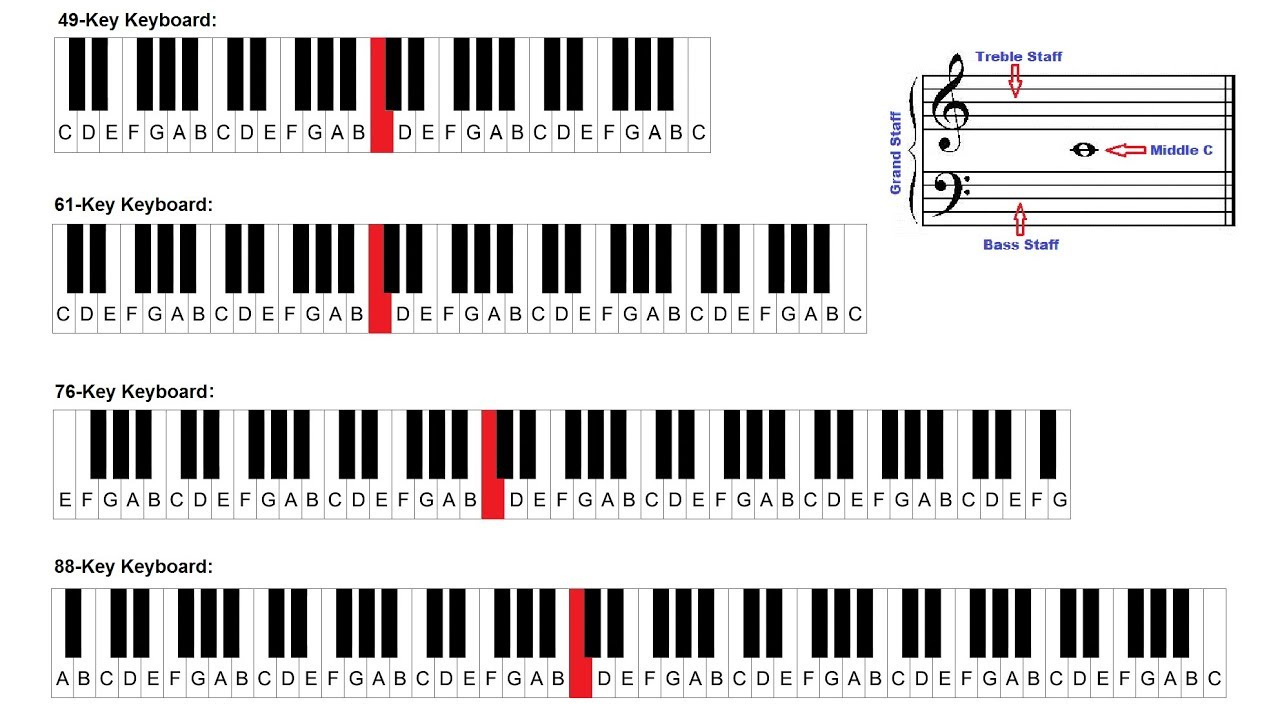
Middle C is the C near the center of the keyboard.
If you have a full-size 88-key piano, it is usually close to the center of the instrument. If you have a smaller keyboard, find the C closest to the middle.
Place your right thumb on Middle C.
Beginner tip: Do not find Middle C by counting from the far left or far right of the keyboard. Find a group of 2 black keys near the center, then locate the white key immediately to the left. That note is C.
Step 3: Play A Five-Note Pattern
Use these finger numbers:
- Thumb = 1
- Index finger = 2
- Middle finger = 3
- Ring finger = 4
- Pinky = 5
Place your right hand on:
- C = 1
- D = 2
- E = 3
- F = 4
- G = 5
Now play:
C – D – E – F – G – F – E – D – C
Play slowly. Keep your wrist relaxed. Do not press hard.
Step 4: Add Rhythm
Count out loud:
1 – 2 – 3 – 4
Play one note per count.
Do not speed up. Do not stop after mistakes. Keep the beat moving.
If you make a mistake, do not restart immediately. Beginners often train themselves to panic-restart. Instead, keep counting and land on the next note. This builds musical recovery, which is an important real-world skill.
Step 5: Turn It Into Music
Now play the same five notes in a simple melody:
C – C – G – G – A – A – G
That is the beginning of “Twinkle, Twinkle Little Star.”
You have now learned three important beginner skills:
- Finding notes
- Using finger numbers
- Playing a simple melody in time
That is enough for your first day.
Your Setup Requirements
You do not need an expensive piano to begin. You need an instrument that makes daily practice easy.
| Situation | Best Setup |
| Shared walls or family at home | Digital piano or keyboard with headphones |
| Very limited space | 61-key keyboard with full-size keys |
| Long-term piano learning | 88-key digital piano with weighted keys |
| Budget-limited beginner | Start with what you have, but avoid mini keys if possible |
| Classical piano goal | Weighted keys become more important |
| Pop, chords, songwriting goal | A 61-key or 76-key touch-sensitive keyboard can work at first |
| Travel or portability | Lightweight keyboard, sustain pedal input, stable stand |
What Features Matter Most?
Prioritize these:
- Full-size keys
- Touch sensitivity
- Stable stand
- Comfortable bench or chair
- Headphones
- Sustain pedal input
Weighted keysare excellent, especially if you want realistic piano feel, but they are not required on day one.
Digital Piano Vs Keyboard Vs Acoustic
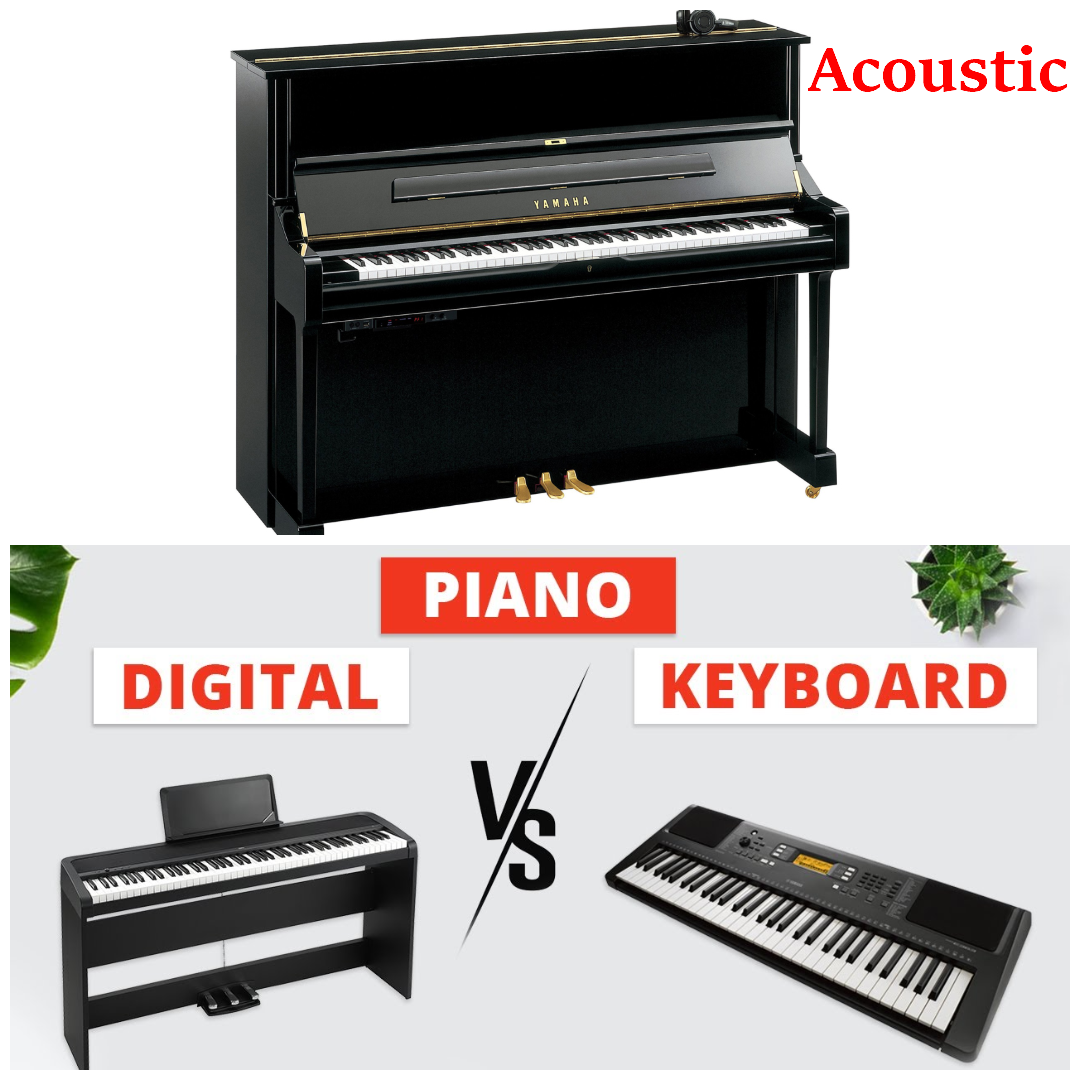
If you want a short, curated shortlist by budget and situation (apartments, beginners, portability), see our guide to best pianos.
Digital Piano
A digital piano is often the best beginner choice because it usually gives you:
- 88 keys
- Weighted or semi-weighted action
- Headphone support
- No tuning costs
- Consistent sound
- Apartment-friendly volume control
Keyboard
A keyboard is usually cheaper and more portable.
It can be a good starting point if you want to learn:
- Basic songs
- Chords
- Pop accompaniment
- Music theory
- Songwriting
The downside is that cheap keyboards may have light, non-weighted keys, which can limit technique later.
Acoustic Piano
An acoustic piano gives the richest feel and sound, but it also requires:
- More space
- Regular tuning
- More maintenance
- Fixed volume
- A larger budget
For many beginners, a digital piano is the most practical balance.
Simple buying rule: choose the instrument you will actually practice on. A perfect acoustic piano that you rarely use is less helpful than a modest digital piano you can play every day with headphones.
Choose Your Learning Path
There are several good ways to learn piano. The best choice depends on your goal, schedule, budget, and learning style.
Teacher Vs App Vs Self-Taught
Choose a teacherif you want faster correction of tension, posture, rhythm, fingering, and hand coordination.
Choose an app or online courseif you need structure, reminders, and bite-sized lessons you will actually follow.
Choose self-taught learningif you enjoy independence, but commit to a feedback habit: record, review, fix one issue, and repeat.
A practical rule: if you repeat the same mistake for a week, you probably do not need more practice. You need better feedback.
If Your Goal Is To Play Songs Fast
Start with:
- Keyboard landmarks.
- Basic rhythm counting.
- 2–4 chord shapes.
- Smooth chord changes.
- Simple accompaniment patterns.
Add later:
- Inversions.
- Lead sheets.
- Ear training.
- Left-hand patterns.
If fast songs are the goal, chords-first is often the shortest path to real music without skipping fundamentals.
If Your Goal Is To Read Written Music
Start with:
- Landmark notes.
- Steps and skips.
- Rhythm discipline.
- Small chunks of 2–4 measures.
- Hands-separate practice.
- Very easy pieces.
If reading is your main goal, you still benefit from learning chords because harmony makes written music more predictable.
Best Path For Most Beginners
Most beginners do best with a hybrid approach:
- Learn enough note reading to understand the keyboard.
- Learn simple chords early so you can play real songs.
- Practice rhythm from the beginning.
- Use one main course, teacher, book, or app.
- Record yourself weekly.
This gives you structure without making piano feel dry or overwhelming.
When Should You Get A Piano Teacher?
You do not need a teacher to start, but feedback can save you weeks of frustration.
Consider getting a teacher, coach, or video feedback if:
- You feel pain or tension.
- You cannot keep rhythm.
- You repeat the same mistake for two weeks.
- You are confused by fingering.
- Your hands feel stiff or awkward.
- You want to prepare for exams or performance.
- You are losing motivation because you do not know what to fix.
- You are practicing consistently but not improving.
Even one lesson every few weeks can help if you are mainly self-taught.
Piano Technique And Posture Beginners Should Learn First
Good technique is not about looking formal. It is about staying relaxed, avoiding pain, and making your hands easier to control.
Basic Piano Posture
Sit so that:
- Your feet are flat on the floor.
- Your back is tall but not stiff.
- Your shoulders are relaxed.
- Your elbows are slightly in front of your body.
- Your forearms are roughly level with the keys.
- Your wrists are neutral, not collapsed.
- Your fingers are naturally curved.
Do not play with force. Piano playing should feel controlled, not tense.
If you feel pain, stop. Pain is not a sign of progress.
Hand Shape And Finger Control
A beginner-friendly hand shape:
- Fingers curved naturally, like holding a small ball.
- Knuckles stable, not collapsing inward.
- Wrists neutral.
- Shoulders relaxed.
- Hands resting on the keys without gripping.
Common beginner mistake: many new players press harder when they want to sound better. Instead, aim for less tension and more control. Loudness should come from controlled movement, not stiff hands.
Quick hand-check drill: let your arm hang loosely by your side. Notice the natural curve of your fingers. Bring that relaxed shape to the keyboard instead of forcing a claw shape or flattening the hand.
Keyboard Landmarks
Many beginners try to memorize the entire keyboard at once. That is not necessary.
Use landmarks instead.
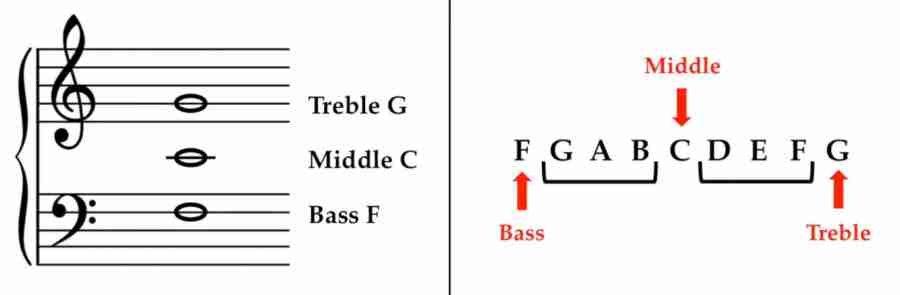
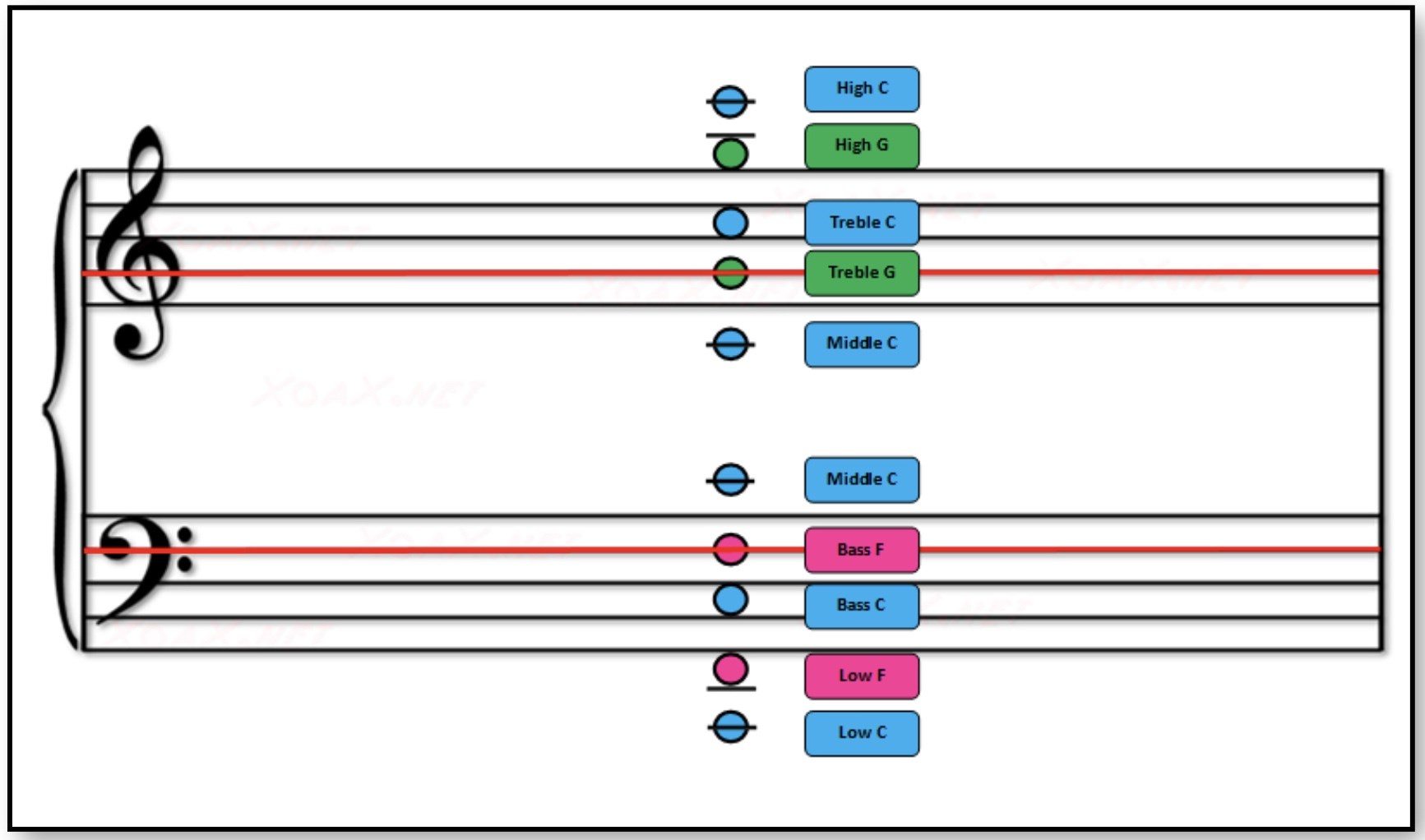
The three key musical landmarks consist of Middle C, Treble G, and Bass F.
If you look at the keyboard, you will notice the black keys are always grouped in twos and threes. This never changes, and it is the secret to finding any note in under a second.
The Most Important Keyboard Landmarks
- Cis to the left of every group of 2 black keys.
- Fis to the left of every group of 3 black keys.
- The musical alphabet is: A B C D E F G
- After G, the pattern starts again at A.
Once you know C and F, the rest of the keyboard becomes much easier.
Quick Drill
Spend 2 minutes finding every C on your keyboard.
Then spend 2 minutes finding every F.
Do this daily for one week. You will stop feeling lost very quickly.
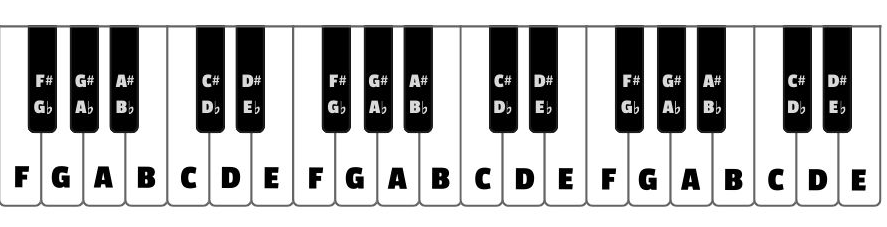
A learner stops hunting for Middle C by “counting from the end.” Instead, they find a 2-black-key group, identify C, and then locate the nearest Middle C region by ear and position.
Rhythm-first: Counting, Note Values, Staying In Time
Rhythm is one of the biggest reasons beginners feel stuck.
Correct notes in bad time still sound wrong.
Start with:
- Counting out loud.
- Tapping the pulse.
- Playing slower than you think you need.
- Practicing rhythm on one note before adding all the notes.
- Using a metronome after you understand the rhythm.
Basic Note Values
| Note Type | Counts In 4/4 |
| Whole note | 4 beats |
| Half note | 2 beats |
| Quarter note | 1 beats |
| Eighth notes | Half beat each, 2 per beat |
Simple Rhythm Drill
Try this:
- Clap and count: 1 – 2 – 3 – 4
- Play C on every count.
- Play C only on beats 1 and 3.
- Play C-D-E-F, one note per beat.
- Repeat without speeding up.
This teaches pulse before note complexity.
Make It Musical Fast
Expression basics beginners should learn early:
- Dynamics:soft, medium, and loud.
- Articulation:legato means connected; staccato means separated.
- Phrasing:music should feel like small musical sentences.
One-minute drill: play C-D-E-F-G softly, then medium, then louder. Next, play it connected, then separated. Same notes, better musical control.
Sheet Music, Chords, Or Ear: Which Comes First?
Beginners often ask whether they should learn notes, chords, or playing by ear first.
The answer: choose one main focus, but do not ignore the others forever.
Learn Sheet Music First If You Want To:
- Play classical music
- Read written pieces
- Follow method books
- Build strong notation skills
- Learn structured repertoire
Learn Chords First If You Want To:
- Play pop songs
- Accompany yourself singing
- Learn worship, jazz, or songwriting basics
- Sound musical quickly
- Understand harmony earlier
Learn By Ear If You Want To:
- Pick out melodies.
- Understand songs by listening.
- Improvise.
- Recognize chord changes.
- Play without always needing written music.
Playing by ear is useful, but it does not replace rhythm, technique, or basic keyboard knowledge. It works best when combined with simple chords and steady counting.
Reading Sheet Music For Beginners
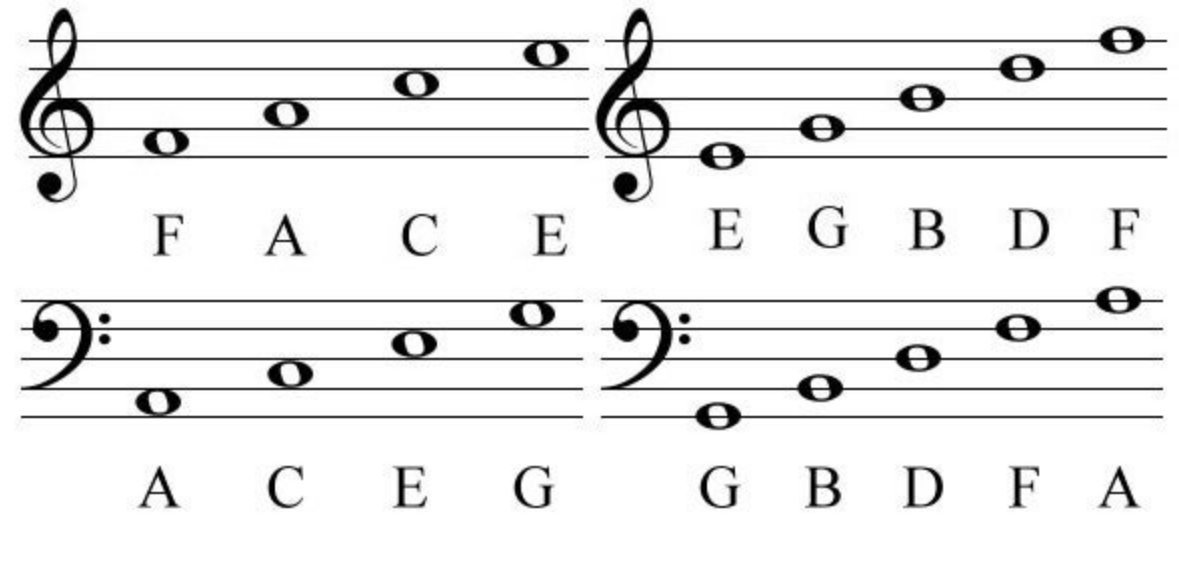
The Grand Staff
Piano musicusually uses two staffs:
- Treble clef:often played by the right hand
- Bass clef:often played by the left hand
Middle C sits between them.
Notes Move By Steps And Skips
Instead of naming every note slowly, watch the movement:
- Step up
- Step down
- Skip up
- Skip down
- Repeat
This turns reading into pattern recognition.
Chords-first (play Real Songs Sooner)
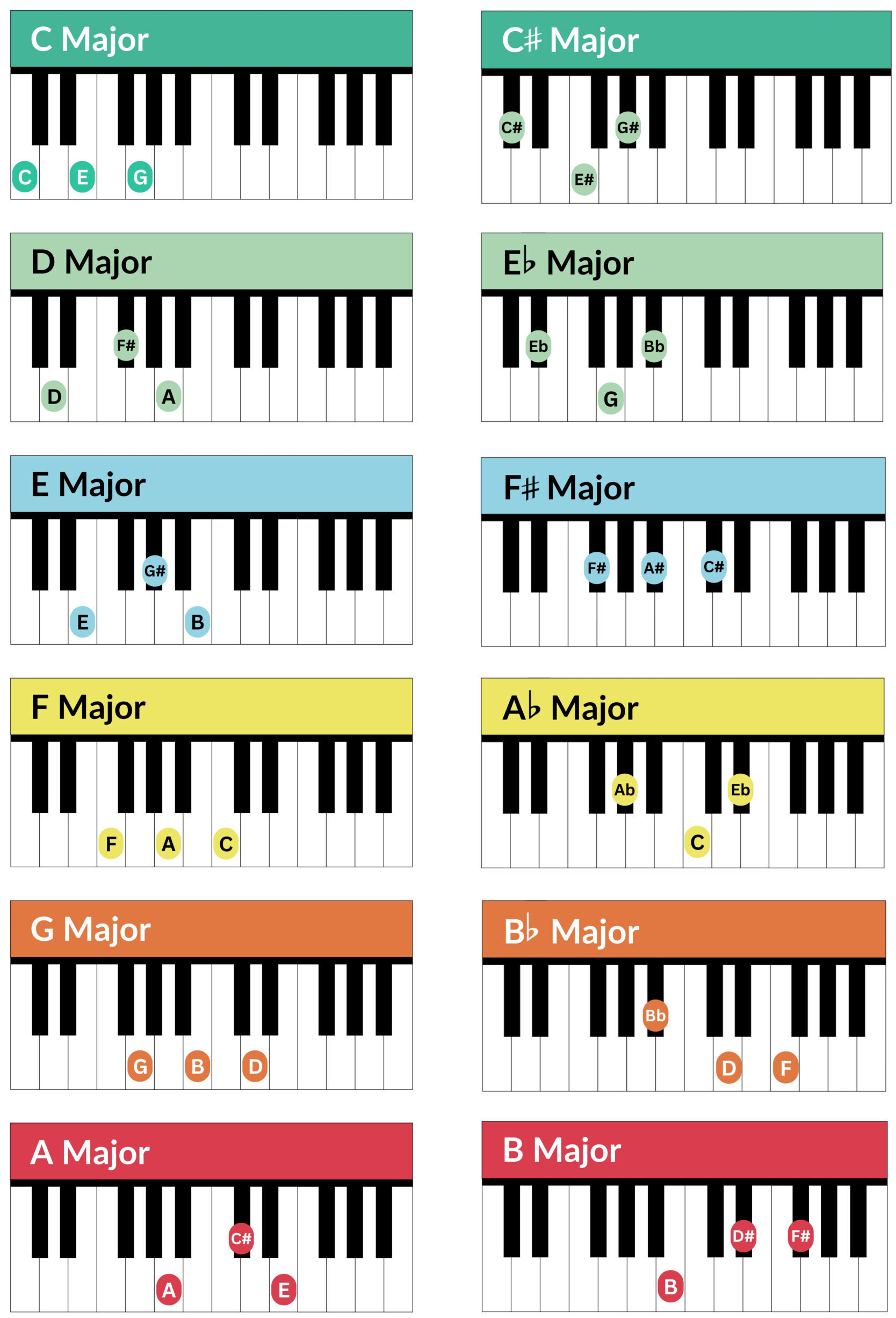
If your goal is to play songs quickly, learn basic chords early.
Start with these four chords in C major:
- C major: C – E – G
- G major: G – B – D
- A minor: A – C – E
- F major: F – A – C
These chords appear in many songs.
How To Read Chord Symbols
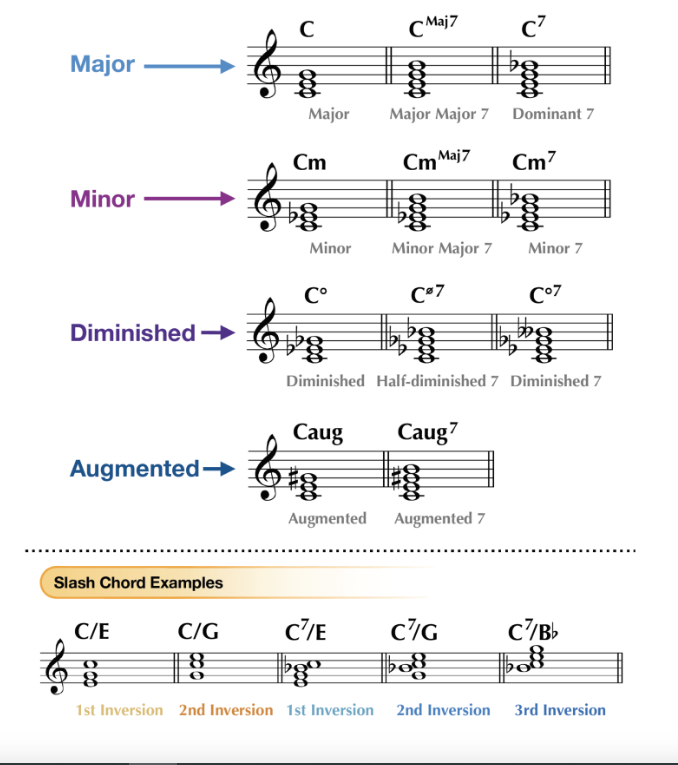
Chord charts are what many people use online. This is how to decode them.
- C = C major chord
- Am = A minor chord
- G7 = G dominant seventh (adds a “pull” back to C)
- Fmaj7 = F major with a softer color
You don’t need to memorize everything-just recognize the letter + whether it’s major/minor, then build the shape you know.
Beginner Chord Practice
Play each chord slowly:
C – G – Am – F
Use one chord per measure.
Count:
1 – 2 – 3 – 4
Then switch to the next chord.
Three Easy Accompaniment Patterns
1. Block Chords
Play all chord notes together.
2. Broken Chords
Play chord notes one at a time.
Example:
C – E – G – E
3. Bass + Chord
Left hand plays the root note.
Right hand plays the chord.
Example:
Left hand: C Right hand: C – E – G
This makes simple chords sound fuller.
How to play from a lead sheet:
Lead sheets are “melody + chords.” This is common in pop, worship, jazz, and accompaniment.
- Right hand:melody (single notes)
- Left hand:chord tones or bass note + chord
- Start simple:left hand plays root note on beat 1, right hand plays melody-then add fuller chords later.
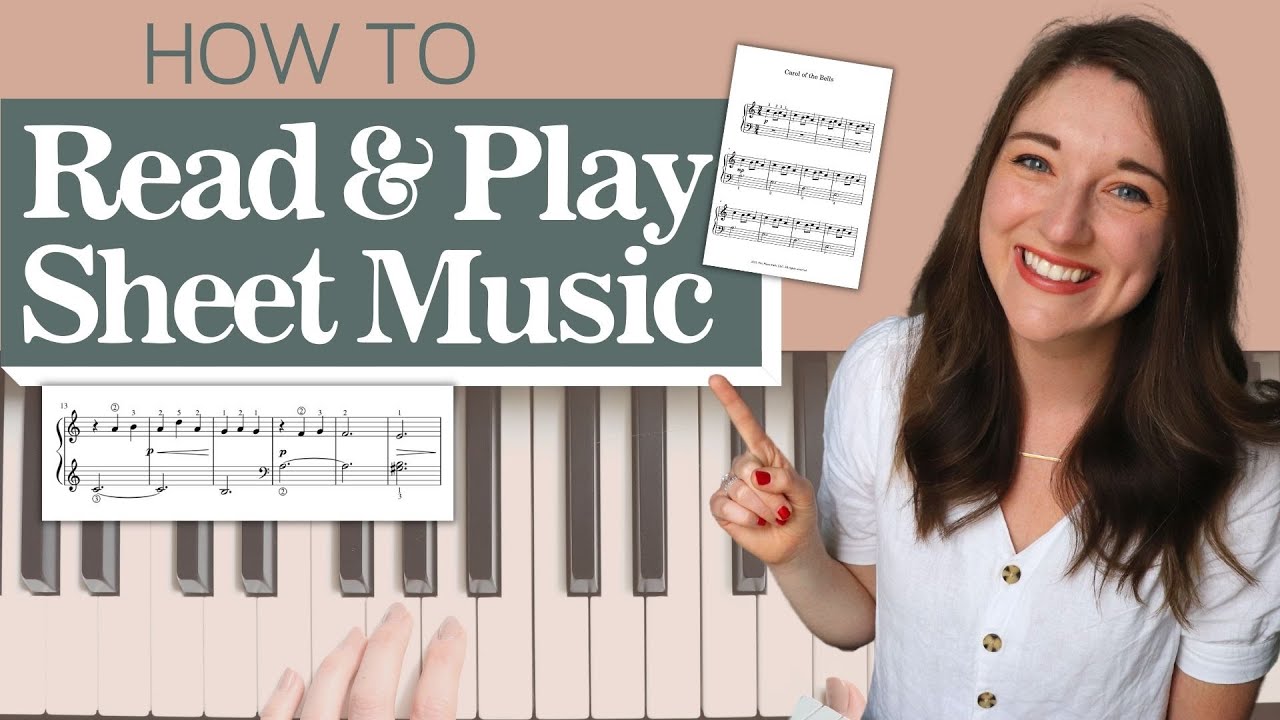
How to Read & Play Piano SHEET Music (STEP-BY-STEP Explanation for Beginners!)
Three Easy Accompaniment Patterns
1. Block Chords
Play all chord notes together once per measure.
2. Broken Chords
Play chord notes one at a time.
Example:
C – E – G – E
3. Bass + Chord
Left hand plays the root note. Right hand plays the chord.
Example:
Left hand: C Right hand: C – E – G
This makes simple chords sound fuller.
Beginner Piano Pedal Guide
Pedals make piano sound beautiful, but they can also hide mistakes.
The main pedal beginners use is the right pedal, also called the sustain pedal.
Beginner Pedal Rule
Play cleanly first. Add pedal later.
Simple Pedal Timing
Use this method:
- Play the chord.
- Press the pedal after the chord.
- Lift the pedal before the next chord.
- Press again after the next chord.
This keeps the sound from becoming muddy.
Here’s a short beginner tutorial on clean sustain-pedal timing.
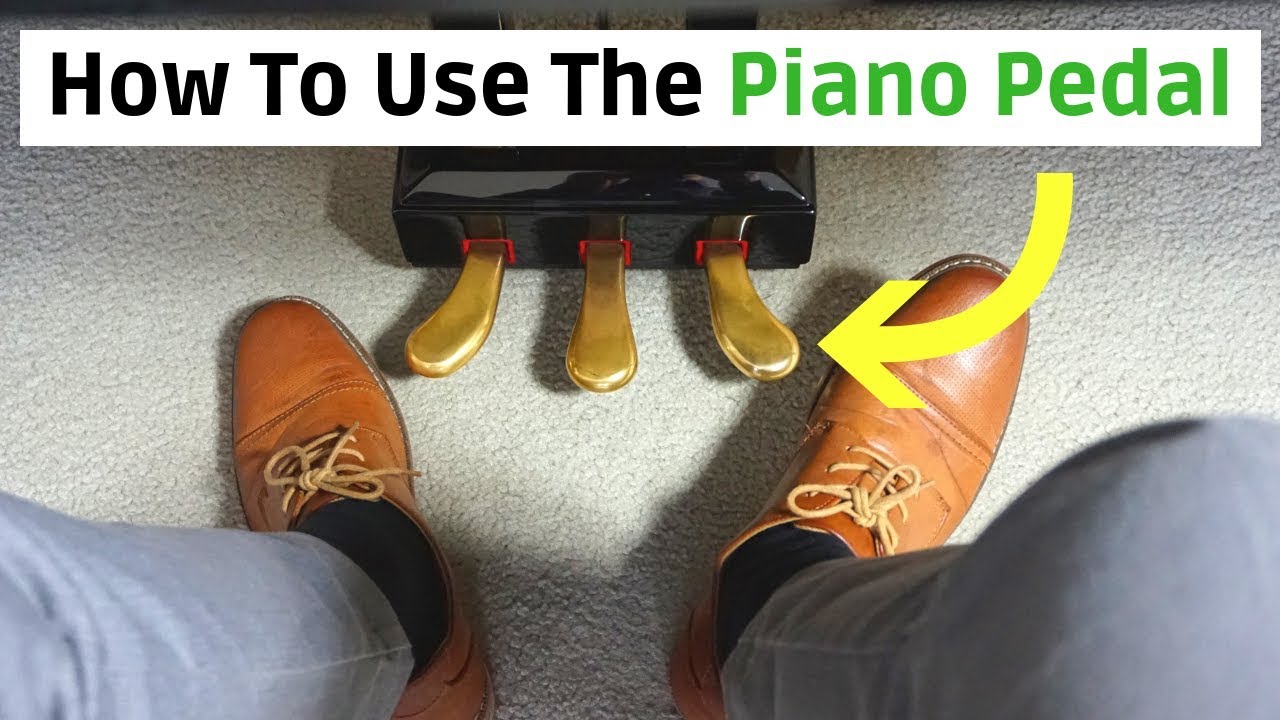
Perfect Your Piano Pedal Control Today
Common Pedal Mistakes
Avoid:
- Holding pedal through every chord
- Pedaling before notes are clean
- Using pedal to cover uneven rhythm
- Ignoring harmony changes
Pedal should improve clarity, not hide problems.
Good First Songs To Learn On Piano
Choose beginner songs that have:
- Small hand movement
- Simple rhythm
- Repeated patterns
- Slow tempo
- Easy melody
- Predictable notes
Reading-First Beginner Songs
Good first choices include:
- “Mary Had a Little Lamb”
- “Twinkle, Twinkle Little Star”
- “Ode to Joy”
- “Jingle Bells”
- “Hot Cross Buns”
- Simple five-finger pieces
If you want a bigger list you can pick from today (sorted by difficulty and style), start with these easy piano songs.
Chords-First Beginner Songs
Start with progressions:
- C – G – Am – F
- C – F – G
- Am – F – C – G
- C – Am – F – G
Your first goal is not complexity. It is steady rhythm.
How To Know If A Song Is Too Hard
A beginner song is probably too hard if:
- You pause every measure.
- Both hands jump around constantly.
- The rhythm has many syncopations you cannot count yet.
- You need the pedal to make it sound acceptable.
- You cannot play it slowly after several days.
- You feel tension every time you attempt it.
- You keep restarting from the beginning instead of fixing small sections.
A good first song should feel slightly challenging, not impossible. If you can play it slowly with focus, it is probably a good level. If every bar feels confusing, choose an easier version.
Beginner Guide To Learning Piano And Guitar
Many beginners compare piano and guitar because both are popular first instruments.
Choose piano firstif you want to understand notes, chords, harmony, and music theory visually. Piano lays notes out in a straight line, so it is easier to see how music works.
Choose guitar firstif your main goal is portable singing accompaniment. Guitar is easier to carry and works well for strumming songs.
Starting From Scratch Beginner Guide To Learning Piano And Guitar
| Skill | Piano / Guitar |
| Finding notes | Easier visually / Harder at first |
| Playing chords | Easier to understand / Easier to strum once shapes are learned |
| Reading music | More direct / More complex due to strings/frets |
| Singing accompaniment | Good / Excellent |
| Music theory | Very clear / Useful but less visual |
| Physical difficulty | Easier on fingertips / Harder on fingertips early |
You can learn both, but start with one main instrument for at least 30–60 days so your practice habit stays focused.
What Should You Practice Each Day To Learn Piano Faster?
The Ingenious Way To Learn Piano
Use this structure:
- Warm-up:2–5 minutes
- One skill:5–10 minutes
- One song chunk:5–12 minutes
- Review:2–3 minutes
If you only have 10 minutes, do one skill and one song chunk.
Why Short, Frequent Practice Beats Cramming
Short, frequent practice usually works better than occasional long practice because it reduces fatigue and gives you more chances to review.
For piano, this means:
- 15 minutes on five days is usually better than 75 minutes once.
- Daily review helps you remember yesterday’s work.
- Short sessions make it easier to notice mistakes.
- Less fatigue means less tension.
How To Avoid Fake Progress
Fake progress happens when you can play something once by luck but cannot repeat it reliably.
Ask:
- Can I play it three times correctly?
- Can I play it slowly?
- Can I start from the middle?
- Can I play it with steady counting?
- Can I still play it tomorrow?
Do not count a section as learned until you can play it correctly three times in a row at a slow tempo.
Beginner Practice Menu
Use this when you know something feels wrong but you are not sure what to practice.
| If You Struggle With | Practice This For 5 Minutes |
| Finding notes | Find every C and F |
| Rhythm | Clap and count 1-2-3-4 |
| Hand tension | Play C-D-E-F-G softly |
| Chord changes | Switch C to G slowly |
| Reading | Read only steps and skips |
| Hands together | Play only the first beat of each measure |
| Pedal blur | Remove pedal and play cleanly |
| Motivation | Play one easy song you like |
| Forgetting | Review yesterday’s hardest measure |
This keeps practice focused instead of random.
How To Improve Your Piano Learning
If you want to know how to improve your piano learning, focus on practice quality instead of practice length.
1. Practice Slowly Enough To Be Correct
If you make the same mistake three times, slow down.
Speed comes after control.
2. Count Out Loud
Many piano problems are rhythm problems.
Count:
- 1 2 3 4
- 1 and 2 and 3 and 4 and
Counting out loud makes timing clearer.
3. Use A Metronome Carefully
Do not start too fast.
Set the metronome slower than your comfort speed and aim for clean playing.
4. Record Yourself
Recording is one of the best self-teaching tools.
Listen for:
- Uneven rhythm
- Wrong notes
- Tension
- Pauses
- Rushing
- Pedal blur
You will hear things you miss while playing.
5. Fix One Problem At A Time
Do not try to fix notes, rhythm, dynamics, fingering, and speed all at once.
Pick one:
- “Today I fix the rhythm.”
- “Today I fix the left hand.”
- “Today I fix the chord change.”
- “Today I fix the pedal.”
Focused practice works faster.
Practice Templates By Goal
If Your Goal Is Pop Songs
Use this 30-minute routine:
- 5 minutes: Review basic chords.
- 5 minutes: Practice chord changes.
- 10 minutes: Work on one song progression.
- 5 minutes: Add rhythm or accompaniment pattern.
- 5 minutes: Sing, hum, or play the melody.
If Your Goal Is Classical Piano
Use this 30-minute routine:
- 5 minutes: Posture and five-finger warm-up.
- 5 minutes: Note reading.
- 10 minutes: Method book piece or beginner repertoire.
- 5 minutes: Rhythm counting.
- 5 minutes: Review yesterday’s hardest measure.
If Your Goal Is Songwriting
Use this 30-minute routine:
- 5 minutes: Chord shapes.
- 5 minutes: Left-hand patterns.
- 10 minutes: Create or repeat a chord progression.
- 5 minutes: Experiment with melody.
- 5 minutes: Record ideas.
If You Are Self-Taught
Use this 30-minute routine:
- 5 minutes: Review yesterday’s lesson.
- 10 minutes: Follow one structured course or book.
- 10 minutes: Practice a song section.
- 5 minutes: Record and write one note about what to fix.
Intermediate Piano Skills: What Comes After The Basics?
Once you can play simple pieces and chords, move into intermediate skills.
1. Scales
Start with:
- C major
- G major
- F major
- A minor
Scales help with:
- Finger control
- Key awareness
- Reading
- Improvisation
- Technique
How To Practice Your First C Major Scale
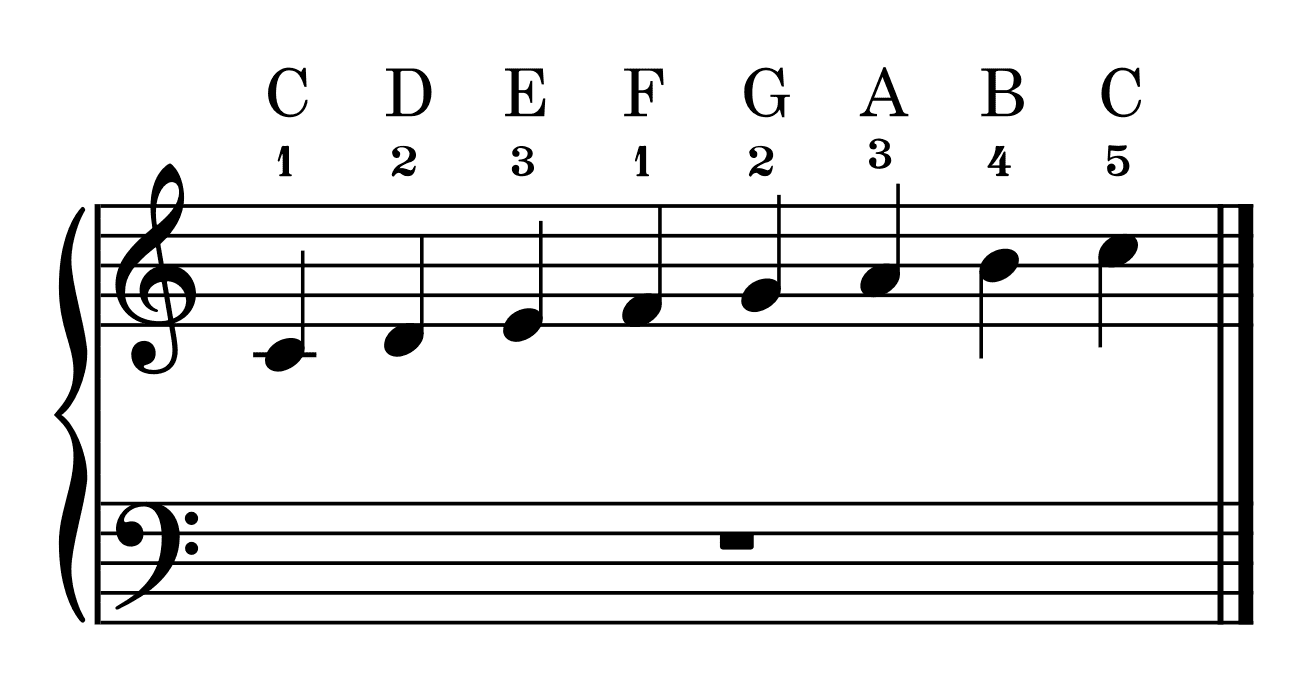
Start with the right hand only. Use this fingering:
C-D-E-F-G-A-B-C
1-2-3-1-2-3-4-5
Practice it this way:
- Play one note per beat.
- Keep your wrist relaxed.
- Tuck the thumb under gently after finger 3.
- Do not twist the whole hand sharply.
- Play slowly enough to stay even.
- Repeat three clean times instead of twenty messy times.
Then try the left hand separately. Do not rush to hands together until each hand feels comfortable.
2. Chord Inversions
Instead of jumping around the keyboard, use inversions.
Example:
C major root position:
C – E – G
First inversion:
E – G – C
Second inversion:
G – C – E
Inversions make chord changes smoother.
Beginner example:Instead of jumping from C major to F major in root position, try keeping common notes close together. Smooth movement sounds more musical than large hand jumps.
3. Sight-Reading
Practice very easy music at first.
Sight-reading should be easier than your main pieces.
The goal is steady reading, not impressive difficulty.
Sight-reading rule: If you cannot keep a steady beat, the music is too hard for sight-reading practice. Choose something easier.
4. Ear Training
Train your ear by listening for:
- Higher vs lower
- Steps vs skips
- Major vs minor
- Chord changes
- Simple melodies
Try picking out simple songs by ear.
5. Hand Independence
Practice patterns where each hand does something different.
Examples:
- Left hand holds whole notes while right hand plays melody.
- Left hand plays broken chords while right hand plays a tune.
- Left hand plays steady rhythm while right hand changes rhythm.
This takes time, so practice slowly.
Advanced Path: Early Steps Toward Mastering The Piano
Mastering the pianodoes not mean learning every song or playing fast all the time. It means developing control, musicality, understanding, and expression.
Advanced piano growth includes:
Technique
- Scales in multiple keys
- Arpeggios
- Chord voicings
- Octaves
- Finger independence
- Even tone
- Relaxed speed
Musicality
- Dynamics
- Phrasing
- Pedaling
- Articulation
- Rubato
- Tone control
- Emotional interpretation
Theory
- Key signatures
- Chord progressions
- Cadences
- Roman numerals
- Modulation
- Harmony
- Form
Repertoire
Study pieces from different styles:
- Baroque
- Classical
- Romantic
- Jazz
- Pop
- Film music
- Contemporary piano
Performance Skills
Practice:
- Starting anywhere in a piece
- Recovering after mistakes
- Playing for friends
- Recording full takes
- Managing nerves
- Memorizing sections
- Interpreting music, not just playing notes
Mastery is built through years of focused, enjoyable, patient work.
Advanced reminder: The best pianists are not just fast. They listen deeply, control tone, shape phrases, understand harmony, and recover gracefully from mistakes.
How Student Pianists Can Balance Practice And Homework
Student pianists do not need more time. They need a simple routine.
Use short practice blocks, such as 10 minutes before homework, 10 minutes after dinner, or 20 minutes on weekends. A small daily session is better than skipping practice all week.
Practice before you feel exhausted. If homework drains your focus, play piano for 10–15 minutes first.
A weekly planner can also help:
| Day | Plan |
| Monday | Practice a song for 15 minutes; do hardest homework first |
| Tuesday | Rhythm drill for 10 minutes; practice after dinner |
| Wednesday | Review lesson for 20 minutes; take a short break first |
| Thursday | Review chords for 10 minutes; keep practice light |
| Friday | Record one section; finish schoolwork early |
| Weekend | Longer review session; practice before social time |
Match practice to your energy. On high-energy days, learn new music or work on hard sections. On low-energy days, review old pieces, clap rhythms, or practice slowly.
Most importantly, avoid all-or-nothing thinking. Missing one day is normal. Try not to miss twice in a row.
How To Stay Motivated When Learning Piano Online
Online learning is convenient, but it can also feel lonely or scattered. Many students jump between random videos without finishing a clear path.
If your main goal is to learn piano online, choose one structured course, teacher, or lesson path first. Then use extra videos only as support, not as your main plan.
1. Choose One Main Course Or Teacher
Do not learn from ten different channels at once.
Pick one main source and follow it for at least 30 days.
You can still use extra videos, but your main path should stay consistent.
2. Set A Weekly Proof Goal
A proof goal is something you can clearly measure.
Examples:
- Play 8 bars without stopping.
- Play C, G, Am, F smoothly.
- Read five notes without guessing.
- Play a melody with steady counting.
- Record one clean 30-second performance.
Motivation grows when you can see proof of progress.
3. Keep A Practice Log
Write down:
- What you practiced
- What improved
- What felt hard
- What to do tomorrow
This prevents the feeling of starting over every day.
4. Record Monthly Progress Videos
Record yourself once a month.
Do not wait until you are “good enough.”
The point is to see improvement over time.
5. Play Music You Actually Like
Method books are useful, but motivation improves when you also play music you enjoy.
Choose beginner-friendly versions of:
- Pop songs
- Film themes
- Worship songs
- Game music
- Classical melodies
- Holiday music
Enjoyment matters.
How Long Does It Take To Learn Piano?
Most beginners can play a simple piece or chord progression within 3–4 weeks. Stronger fluency usually takes 6–12 monthsof steady practice.
Your progress depends on a few key factors:
- Practicing consistently most days
- Getting feedback to avoid bad habits
- Choosing music that is slightly easy
- Keeping rhythm steady
A simple timeline:
- Weeks 1–2:Learn keyboard landmarks, rhythm, and a tiny piece
- Weeks 3–4:Play one beginner piece or progression steadily
- Months 2–3:Improve transitions and hands-together playing
- Months 6–12:Build stronger fluency and learn new music faster
To stay motivated, measure proof, not perfection. Each week, aim for one clean section, one steady chord progression, or one hands-together passage without stopping.
Why Beginners Get Stuck And How To Fix It
Problem: You Keep Playing Wrong Notes
Cause: You are practicing too fast or do not know your landmarks.
Fix:
- Slow down.
- Find C and F first.
- Practice one hand at a time.
- Repeat tiny sections.
Problem: Your Rhythm Is Uneven
Cause: You are focusing only on notes.
Fix:
- Count out loud.
- Clap the rhythm.
- Use a metronome.
- Practice rhythm on one note first.
Problem: Your Hands Will Not Work Together
Cause: The section is too difficult at full speed.
Fix:
- Practice hands separately.
- Combine only one measure.
- Slow down by half.
- Repeat until it feels automatic.
Problem: Your Chords Sound Messy
Cause: Your fingers are not landing together or your pedal is too heavy.
Fix:
- Remove pedal.
- Play chords slowly.
- Check each note.
- Add pedal later.
Problem: You Lose Motivation
Cause: Your goals are too vague.
Fix:
- Set one weekly proof goal.
- Record progress.
- Learn music you like.
- Keep sessions short.
- Celebrate small wins.
What Beginners Should Not Worry About Yet
In your first month, you do not need to master:
- All key signatures.
- Advanced music theory.
- Fast scales.
- Complex classical pieces.
- Jazz voicings.
- Advanced pedal techniques.
- Perfect sight-reading.
- Two-hand independence at full speed.
- Improvising in every key.
Focus first on keyboard landmarks, rhythm, relaxed hands, easy songs, and consistent practice. Those basics make everything else easier later.
Free And Paid Resources
Free Resources Work If You Add Structure
Free lessons can be excellent, but you need a plan.
Use:
- One main YouTube teacher or course
- One beginner method book or app
- One practice routine
- One weekly goal
- One recording habit
Do not collect endless lessons without finishing them.
Paid Resources Are Worth It When You Need Feedback
Consider a teacher, app, or course if:
- You keep repeating the same mistake.
- You feel lost.
- You need accountability.
- You have tension or pain.
- You want faster correction.
- You are preparing for exams or performance.
A teacher is especially helpful for posture, technique, rhythm, and interpretation.
Recommended Learning Resources For Beginners
You do not need every resource. You need the right type of resource for your current problem.
| Need | Helpful Resource |
| Structure | A beginner method book, app, or online course |
| Technique correction | A piano teacher or video feedback |
| Note reading | Beginner sheet music and staff worksheets |
| Chord learning | Chord charts and lead sheets |
| Rhythm | Metronome app and clapping exercises |
| Motivation | Easy songs you actually like |
| Self-feedback | Phone recordings of your hands and sound |
A Simple 30-day Piano Practice Plan You Can Follow
Days 1–7 (daily Micro-tasks)
- Day 1:Find C using black keys; play 5 notes up/down slowly.
- Day 2:Finger numbers; 5-finger pattern with steady counting.
- Day 3:Clap a rhythm; play it on one note with a metronome.
- Day 4:Choose Reading orChords track; do 10 minutes only.
- Day 5:Learn 4 bars of melody orone 2-chord change.
- Day 6:Repeat Day 5 slower; aim for no stops.
- Day 7:Record 30 seconds; fix one timing/tension issue; record again.
Weeks 2–4 (repeat This Weekly Plan)
Each week pick:
- One skill(rhythm, reading pattern, chord changes, inversions)
- One piece/progression(slightly easy)
- One proof goal(8 bars clean, progression steady, or hands-together chunk)
Spacing + mixing practice is supported by learning research (meta-analysis on spacing; music study on interleaving).
For Parents Helping A Child Start Piano
Parents can help a child learn piano by making practice simple, positive, and consistent.
Good beginner goals for children:
- Practice 5–10 minutes at first.
- Keep the keyboard easy to access.
- Use one small assignment per day.
- Praise effort and focus, not only correct notes.
- Let the child repeat easy songs to build confidence.
- Avoid turning every practice session into a correction session.
What parents should avoid:
- Do not demand perfection.
- Do not compare one child with another.
- Do not make every mistake feel serious.
- Do not choose music that is too difficult too early.
- Do not expect young beginners to practice like adults.
Children usually need consistency more than long practice time.
Frequently Asked Questions
Can I Teach Myself Piano?
Yes. You can teach yourself piano if you follow a structured plan, practice consistently, and use recordings to check your mistakes.
A teacher can speed up progress, but self-learning is possible.
What Should I Learn First?
Start with:
- Keyboard landmarks
- Finger numbers
- Rhythm
- Relaxed posture
- Easy melodies
- Basic chords
Do I Need To Read Sheet Music?
Not immediately.
You can begin with chords and simple patterns, especially if your goal is pop music. But learning to read sheet music will make you more independent over time.
Is Piano Hard To Learn?
Piano is easy to start but takes time to master.
The first notes are simple. The challenge is building coordination, rhythm, reading, and expression over time.
How Much Should A Beginner Practice?
Start with 15–30 minutes most days.
If that feels too much, begin with 10 minutes. Consistency matters more than long sessions.
What Is The Best Age To Start Piano?
Any age can start.
Children, teens, and adults can all learn piano. Adults often progress well because they understand goals and can practice deliberately.
Is 25, 40, Or 60 Too Late To Learn Piano?
No. It is not too late. Your progress depends more on consistency, patience, and practice quality than age.
What Is The 80/20 Rule In Piano?
The 80/20 rule means focusing on the small sections that cause most of your mistakes.
Instead of playing the whole song repeatedly, fix the hardest few measures.
How Do I Memorize Piano Notes Faster?
Use landmarks:
- C is left of the 2 black keys.
- F is left of the 3 black keys.
Then learn notes by patterns, steps, and skips.
Can I Learn Piano Online For Free?
Yes. Use free lessons, but keep a clear routine and record yourself regularly. Online learning works best when you avoid random lesson-hopping.
Final Thoughts
If you only remember one thing, make it this: piano progress is a system, not a mood. Choose a track, keep sessions short and frequent, measure one weekly “proof,” and fix problems early instead of practicing around them.
If you want a simple next step: pick one 30-day goal (one piece or one progression), print the starter plan checklist, and commit to showing up for 15 minutes most days. Share this page with someone who wants to start too-practice is easier when you’re not doing it alone.