Understanding Piano Keys: Notes, Layout, And Patterns
The piano is one of the most versatile and widely loved instruments in the world, and everything starts with the keys. Before you can play songs, build chords, or understand music theory, you need to understand how piano keysare laid out and how they work together.
At first glance, the keyboard can look confusing. But beneath the black-and-white pattern is a simple, repeating system. Once you understand that system, the keyboard becomes easy to navigate, and learning music becomes much more enjoyable.
In this guide, you’ll learn how piano keyswork, including note names, keyboard layout, and the patterns that help you find any key quickly, so you can start playing with confidence.
Piano Keys At A Glance
- A standard piano has 88 keys
- 52 white keys and 36 black keys
- White keys are named: A, B, C, D, E, F, G
- Black keys represent sharps (#) and flats (♭)
- The pattern repeats every 12 notes
- Black keys form groups of 2 and 3
- Each repeating unit is called an octave
- Middle C is the main reference point
How Many Keys Are On A Piano?
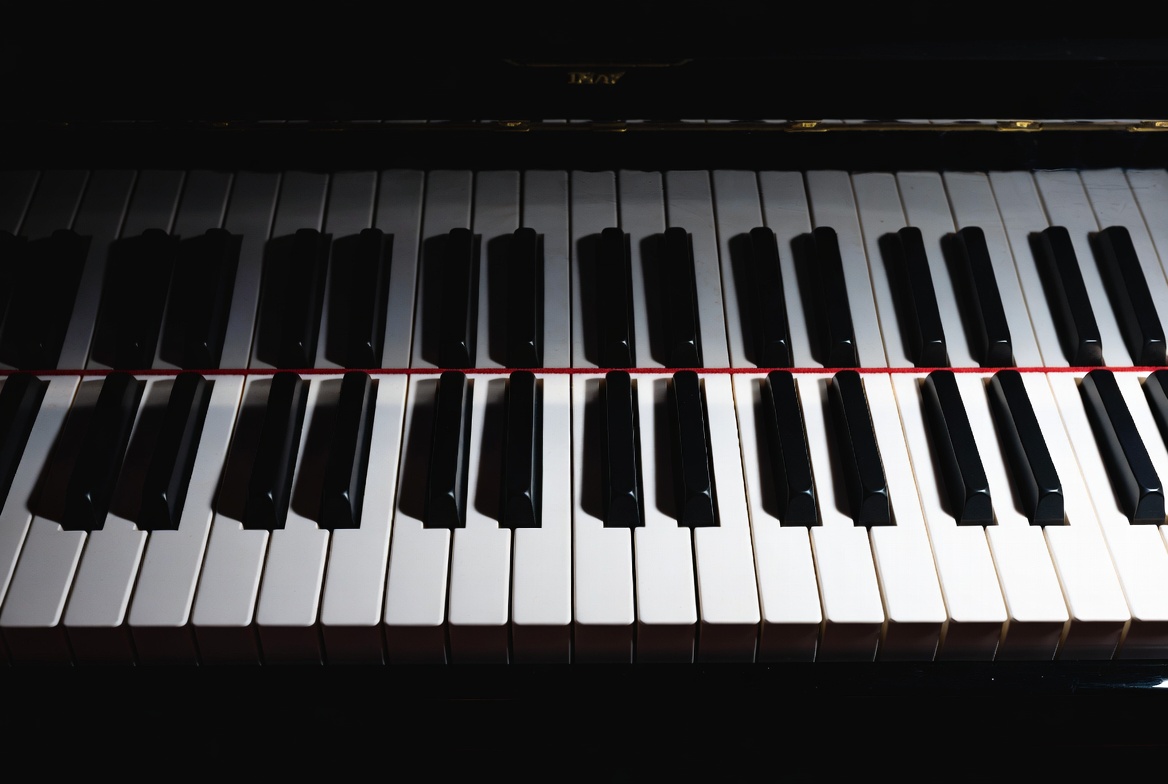
A standard acoustic piano has 88 keys, a layout that has remained unchanged for over a century. This includes 52 white keys and 36 black keys.
While smaller keyboards (like 61 or 76 keys) are common, especially for beginners, the 88-key layout is the industry standard because it provides the full range of musical expression.
Why 88 Keys?
Early pianoshad far fewer keys. Over time, as music became more complex, the keyboard expanded. By the late 1800s, manufacturers like Steinway established 88 keys as the optimal range balancing musical needs with the physical limits of string instruments.
What Are The White Keys?
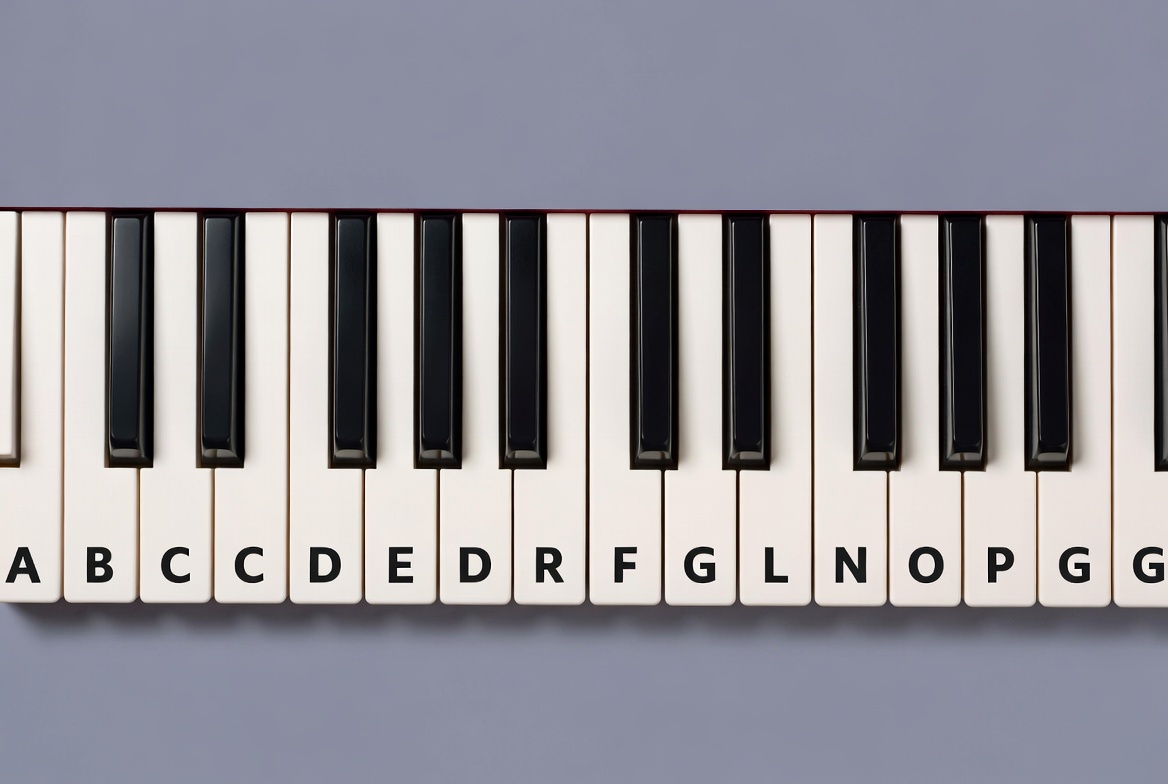
White keys form the foundation of the piano. They carry the main musical alphabet, and getting to know them is the natural first step on any keyboard.
The Musical Alphabet
Every white key on the piano is assigned one of seven letter names: A, B, C, D, E, F, G. These are called natural notes, no modifications, no sharps or flats. They represent the seven foundational pitches of Western music, and the entire naming system is built on them.
After G, the sequence starts again at A and it keeps repeating all the way across the keyboard, higher and higher in pitch each time. A full 88-key piano contains this cycle roughly seven and a half times.
Why Beginners Start With C
Even though the musical alphabet starts at A, beginners usually start at C.
This is because playing from C to C uses only white keys: C → D → E → F → G → A → B → C
This forms the C major scale, which is the simplest and most beginner-friendly scale.
Musical Keys And The White Keys
Here's something interesting to try: play only the white keys, anywhere on the keyboard. You'll notice they all sound fairly harmonious together. That's not an accident.
In music, a key (the musical kind, not the physical kind) is a set of notes that work together as the basis for a piece of music. The white keys outline two specific keys: C major and its relative, A minor. Both use the same set of pitches the white keys, but the note you centre on gives each one a different emotional character.
Play the white keys with C as your home note, and you'll hear the bright, open character of C major. Shift your focus to A and suddenly the same keys take on a more wistful, melancholic quality that's A minor. Same notes, different centre of gravity, completely different feeling.
Keys other than C major and A minor use a mix of white and black keys. That's where scales come in.
Scales: The Pattern Behind The Keys
A scale is a sequence of notes arranged in a specific pattern of distances, which musicians call intervals. The most essential patterns are the major scale and the minor scale.
The smallest distance between any two neighbouring keys on the piano including black keys, is called a semitone. Two semitones equal a whole tone. The major scale is built from this sequence of whole tones (W) and semitones (S).
The key insight is that this W-W-S-W-W-W-S pattern is movable. Apply it starting on D, and you get D major, which includes the black keys F# and C#. Apply it starting on any note, and you get a new major scale and a new key. That's why learning the pattern matters more than memorising any single scale.
The natural notes are your foundation. With them in hand, the black keys are the logical next step.
What Are The Black Keys?

What Are the Black Keys Called? Discover Sharps and Flats Now!
Black keys have a reputation for being intimidating they look like extras, additions, something to deal with once you've mastered the white keys. That's the wrong way to think about them.
Sharps, Flats, And The Logic Of Black Keys
Each black key has two names. It can be called a sharp (#) meaning one semitone higher than the white key to its left or a flat (♭) one semitone lower than the white key to its right. These aren't two different notes. They're two names for the same physical key, and which name you use depends on musical context.
For example: the black key between C and D is called C# (C sharp) when you're in a key that uses sharps, and D♭ (D flat) when you're in a key that uses flats. Same key, same pitch, different label. These pairs are called enharmonic equivalents.
In practical terms, if you're playing a piece in E major (which uses sharps), that black key corresponds to G# not A♭. In D♭ major, the same key becomes G♭. The musical context determines the name, and the name carries information about the key's structure. It's not arbitrary.
The 2-Then-3 Grouping: Your Built-In GPS
Look at the black keys on any section of the keyboard. They don't sit in an even row; they group into clusters of two and three, alternating all the way across. This 2-then-3 pattern repeats exactly in every octave, without exception.
This grouping is the single most useful navigational tool a beginner can learn. It's why experienced pianistsdon't need to count keys from the edge they read the pattern the same way you read words, instantly and without effort.
The Pentatonic Scale: Black Keys On Their Own
Try something: play only the black keys on any piano, in any order, at any speed. Chances are it'll sound surprisingly musical, even beautiful. That's because the five black keys in each octave form a pentatonic scale: a five-note pattern with no dissonant intervals, only smooth, consonant relationships between the notes.
The pentatonic scale is one of the most universal musical structures in human history, appearing in folk music from West Africa, East Asia, Celtic traditions, and blues. The fact that you can access it simply by ignoring the white keys says something profound about how deeply this pattern is embedded in music itself.
Enharmonic Equivalents: One Key, Two Names
It's worth dwelling on this for a moment, because it confuses nearly every beginner. The reason both names for a black key exist C# and D♭, for instance isn't bureaucratic redundancy. It's functional precision.
In a scale, every letter of the musical alphabet must appear exactly once, in sequence. In D major, you need an F and a C. If you used the names G♭ and D♭, you'd have no F and no C in the scale which would break the sequence and the notation. So instead, those notes are named F# and C#. The letter sequence stays intact, the music is notated consistently, and the key relationship is clear at a glance.
For beginners: both names are correct. Which one to use will become intuitive as you learn more about keys and scales.
Octaves: The Repeating Structure
An octave is a group of 12 keys:
- 7 white keys
- 5 black keys
After every 12 keys, the pattern repeats exactly.
Why Do Octaves Sound Similar?
When a note doubles its frequency, it sounds like the same note just higher.
Example:
- A4 = 440 Hz
- A5 = 880 Hz
This relationship is why the keyboard repeats in a structured way.
Practice Exercise
- Play any note
- Now play the same note higher up the keyboard
- Notice how they sound similar
Finding Middle C
Middle C (C4) is the most important reference point on the piano. It's the note directly labelled C4 in scientific pitch notation, and it sits near the centre of the full 88-key layout. Specifically, it's the fourth C from the left on a standard piano.
Middle C is where the two halves of the piano meet the right-hand treble world above and the left-hand bass world below. In sheet music, it sits on a ledger line directly between the treble and bass staves. In practical terms, it's the note you orient everything else around. Learn where Middle C is, and you always have a reference point from which to navigate anywhere on the keyboard.
How To Find It
- Look for the group of two black keys near the center
- The white key to the left is Middle C
Why It Matters
- It divides the keyboard into left and right hand areas
- It’s used as a reference point in sheet music
- Most beginner exercises start here
How to Find Middle C on Any Size Keyboard -Full Size Piano, 36 Key, 49 Key, 61 Key Casio
How To Find Any Note On The Piano Quickly
Knowing note names is one thing. Being able to find any note instantly without counting from the left edge every time is what actually makes the keyboard usable especially when you start playing simple melodies and easy piano songs. Here's the method.
The Landmark Method, Step By Step
- Look for a group of two black keys. The white key directly to the left of the first black key in that group is always C.
- Look for a group of three black keys. The white key directly to the left of the first black key in that group is always F.
- From any C, count right along the white keys: C → D → E. Then the three-black-key group begins, and F comes next.
- From any F, count right: F → G → A → B. Then the pattern resets and the next C follows immediately.
- Use C and F as your two fixed anchors. From either one, you can reach any other note in that octave in seconds.
With a little practice, this stops being a deliberate process and becomes automatic. You see the pattern the same way you see familiar words immediately, without decoding letter by letter.
Piano Keys Chart
A piano key chart helps you understand the layout more clearly.
The white keys follow a repeating sequence of A to G, while the black keys sit between them in groups of two and three.
The most useful shortcut is this:
- The white key before two black keys is always C
- The white key before three black keys is always F
Instead of memorizing every note, you can rely on this pattern to find your way around the keyboard quickly.
Which Keys Go Together? Intervals And Harmony
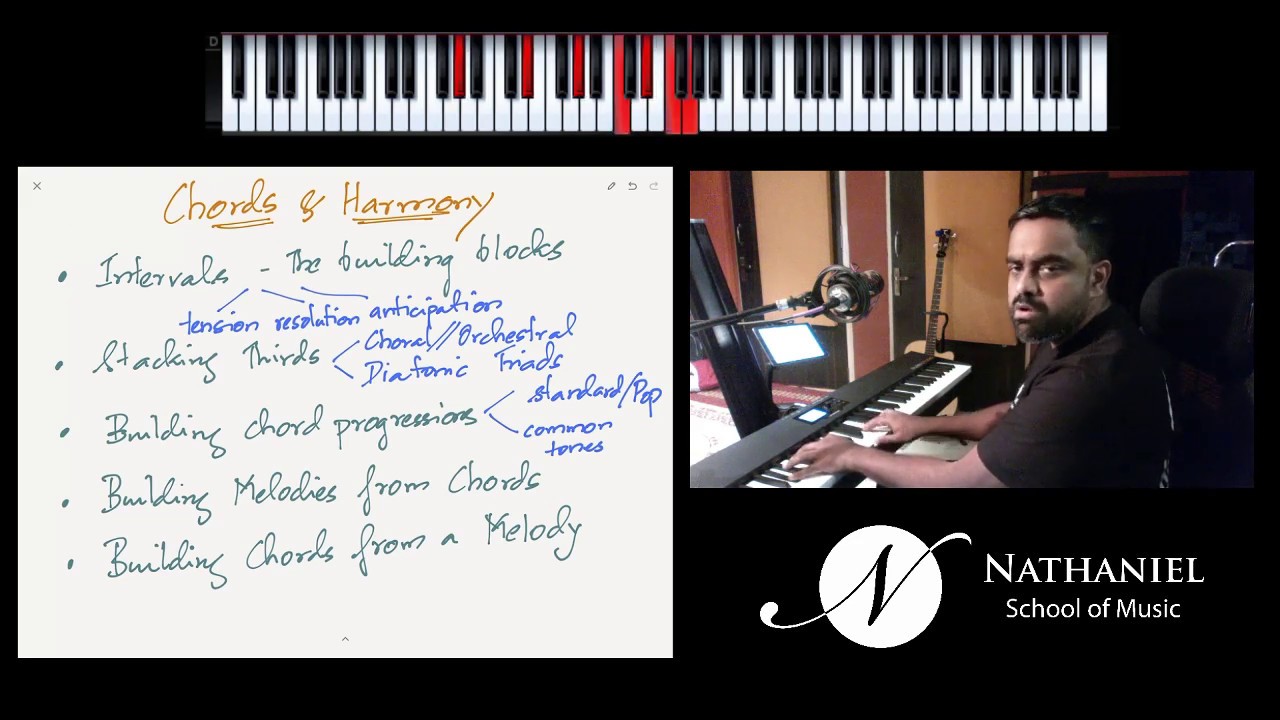
Harmony 101 - Intervals | Triads | Chord Progressions - Jason Zac
Understanding individual keys is the foundation. Understanding how they relate to each other is where music begins.
Intervals
An interval is the distance between two notes, measured in semitones. Every neighbouring key on the piano, white or black, is one semitone apart. That makes the semitone the smallest possible interval.
Some intervals create smooth, pleasing sounds when two notes are played simultaneously. Others create tension. Knowing which is which is the beginning of understanding harmony.
Common Musical Intervals Explained
- Minor Second (1 semitone) Example: C - C# Character: Tense; better suited for melody than harmony
- Major Second (2 semitones)Example: C - D Character: Stepwise movement; essential for building melodies
- Minor Third (3 semitones)Example: D - F Character: Warm and slightly melancholic
- Major Third (4 semitones)Example: D - F# Character: Bright, stable, and foundational in major chords
- Perfect Fourth (5 semitones)Example: C - F Character: Open sound; strong yet slightly ambiguous
- Perfect Fifth (7 semitones)Example: B - F# Character: Very stable; forms the backbone of most chords
- Major Sixth (9 semitones)Example: F - D Character: Sweet, open, and consonant
- Octave (12 semitones)Example: C - C Character: Perfect resonance; same note in a higher or lower register
How These Intervals Function In Music
- Perfect intervals (fourths and fifths)are highly stable and form the structural foundation of most chords.
- Thirds and sixths (major and minor)provide the harmonic richness that gives chords their full, warm sound.
- Small intervals (1-2 semitones)tend to sound dissonant in harmony but are very effective in melody.
- Stepwise motion (moving by semitone or whole tone)creates melodies that are smooth, memorable, and easy to sing.
From Intervals To Chords
When you combine three or more notes from the same key, you create a chord. This is where harmony becomes more complex and expressive, opening up a wide range of musical possibilities.
How Piano Keys Are Structured
Pressing a key feels simple. What happens inside the piano as a result is a beautifully engineered chain reaction.
The Acoustic Piano: Hammers, Strings, And Dampers
Each key is one end of a lever. Press it down, and the other end flies upward, triggering an interlocking mechanism that propels a felt-covered hammer toward metal strings stretched tightly inside the instrument. The hammer strikes the strings and immediately rebounds if it stayed in contact, it would mute the note.
The strings vibrate at a frequency determined by their length and tension, producing a specific pitch. Those vibrations transfer to the piano's soundboard, a large, curved panel of spruce, which amplifies them naturally into the rich, resonant tone you hear.
When you release the key, a damper (a small felt pad resting on the strings) drops back into contact with the strings and stops the vibration, ending the note. The sustain pedal on the right lifts all the dampers simultaneously, letting notes ring freely.
Key Action: Why The Feel Matters
The physical feel of the keys, how much resistance they offer, and how they respond to light versus heavy touch is called the action, and it varies considerably across instruments.
- Weighted hammer action:Simulates the real piano mechanism. Lower keys feel heavier; upper keys feel lighter, exactly as on an acoustic grand. Essential for developing proper technique and touch sensitivity.
- Semi-weighted:Spring-loaded resistance, uniform across all keys. More realistic than synth-action, but doesn't replicate the graded feel of acoustic pianos.
- Synth action (unweighted):Light, fast, springy. Common on entry-level keyboards. Easy to play, but habits formed on synth-action keys often need correcting when moving to a real piano.
If there's any chance you'll eventually play an acoustic piano or if you're taking formal lessons, a weighted hammer-action keyboard is well worth prioritising from the start.
How Piano Keys Work (How Sound Is Produced)
On an acoustic piano:
- Pressing a key causes a hammer to strike strings
- The strings vibrate and produce sound
- A damper stops the sound when you release the key
On a digital piano:
- Sensors detect your touch
- A recorded sound is played
Is 49 Or 61 Keys Enough To Learn Piano?
This is one of the most common practical questions for beginners, and the answer depends on where you want your playing to go.
| YOUR GOAL OR SITUATION | RECOMMENDED KEY COUNT |
| Complete beginner, trying it out | 61 Keys |
| Beginner committed to long-term learning | 88 keys with hammer action |
| Pop, rock, or contemporary music | 61 or 76 keys |
| Classical repertoire, late intermediate level | 76 or 88 keys |
| Serious classical training | 88 keys (non-negotiable) |
| Music production / songwriting | 61 keys (MIDI range adequate) |
| Planning to transition to acoustic piano | 88 keys, weighted hammer action |
The reassuring thing is that all keyboards, regardless of size, are built on the same repeating octave pattern. Playing on a 61-key instrument doesn't teach you a different skill set. The pattern is identical. The only limitation is range: some advanced repertoire uses notes in the extreme low bass or high treble that smaller keyboards simply don't have.
For beginners, a 61-key keyboard is a perfectly sensible place to start. You'll learn the layout, develop your technique, and cover the vast majority of what you'll want to play in the early years. When you outgrow it, you'll know exactly why you need more keys and by then, you'll have a much clearer sense of what instrument to invest in.
Things To Consider When Buying A Piano (Beginner Guide)
Tips On Buying Your First Keyboard! - What Do You Need To Know?
While buying a piano, a beginner should consider some common points to choose the right instrument for their level. Looking at some of the best pianosavailable can also help you understand what features and quality to expect. Focus on these key factors:
1. Key Action (Feel Of The Keys)
- Weighted (hammer action):Closest to an acoustic piano; best for serious learning
- Semi-weighted:A middle ground; decent feel for beginners
- Unweighted (synth action):Light and fast, but not ideal for developing technique
Recommendation:If possible, choose weighted keys.
2. Number Of Keys
- 61 keys: good for beginners
- 76 keys: more flexibility
- 88 keys: full range
If budget allows, go for 88 keys to avoid upgrading too soon.
3. Sound Quality
- Listen for clear, realistic piano tones
- Check for dynamic response (louder when you press harder)
4. Polyphony (Important!)
- This determines how many notes can sound at once
- Minimum recommended: 64-note polyphony
- Better: 128 or higher
5. Connectivity
- USB/MIDI for apps and lessons
- Headphone jack for silent practice
6. Size And Portability
- Compact keyboards are easier to move
- Full digital pianos are more stable but heavier
7. Budget
- Entry-level keyboards: affordable and great for learning
- Mid-range digital pianos: better sound and feel
Don’t overbuy, start with something comfortable and upgrade later. If you’re serious about learning, combining the right instrument with structured piano lessonscan significantly improve your progress.
Types Of Pianos
Understanding the main types of pianohelps you choose what fits your needs.
1. Acoustic Pianos
These are traditional pianos with strings and hammers.
- Grand Piano:Best sound quality, used in concerts
- Upright Piano:More compact; common in homes and schools
Pros:Rich sound, natural feel
Cons:Expensive, heavy, needs tuning
2. Digital Pianos
Electronic instruments designed to replicate acoustic pianos.
- Weighted keys
- Built-in sounds
- Headphone support
Pros:Affordable, no tuning, great for practice
Cons:Slightly less authentic sound
3. Keyboards (Portable)
Lightweight and versatile.
- Often 61 keys
- Many sound options
Pros:Cheap, portable, fun
Cons:Less realistic feel
4. MIDI Controllers
Used with computers and music software. Best for music production, not ideal as a first piano
Start Learning To Play Piano
7 Days To Learning Piano (Beginner Lesson)
Starting doesn’t need to be complicated. Follow this simple path:
Step 1: Learn The Layout
- Identify C, F, and Middle C
- Understand black key patterns (2 and 3 groups)
Step 2: Practice Simple Scales
- Start with C major (white keys only)
- Play slowly and evenly
Step 3: Learn Basic Chords
Start with:
- C major (C-E-G)
- G major (G-B-D)
- F major (F-A-C)
These form the foundation of many songs.
Step 4: Play Simple Songs
- Begin with one-hand melodies
- Then add basic chords
Step 5: Build Consistency
- Practice 5-10 minutes daily
- Focus on accuracy, not speed
Optional Tools
- Piano learning apps
- YouTube tutorials
- Beginner sheet music
The key is consistency, not perfection. You can also speed up your progress by using some of the top apps for learning piano, which provide guided lessons, feedback, and interactive practice tools.
Practical Beginner Exercises
- Find All Cs:Scan the keyboard and locate every C using black key patterns.
- Play Only Black Keys:You’ll hear a pleasant, musical sound; this is the pentatonic scale.
- Practice C Major Scale:Play white keys from C to C slowly.
- Jump Between Octaves:Play the same note in different octaves to train your ear.
Tips For Faster Learning
- Focus on patterns, not memorization
- Practice a little every day (5-10 minutes helps)
- Use Middle C as your anchor
- Learn to recognize black key groups instantly
- Start simple, don’t rush into complex songs
People Also Ask
How Many Keys Does A Piano Have?
A standard acoustic piano has 88 keys 52 white and 36 black. This spans just over seven octaves, from A0 to C8. Smaller keyboards (61 or 76 keys) are common and suitable for beginners and intermediate players, but 88 remains the universal acoustic standard.
What Are The Names Of All The Piano Keys?
White keys cycle through the letters A, B, C, D, E, F, G and then repeat. Black keys are named as sharps (#) or flats (♭) of the white keys beside them for example, the black key between C and D is either C# or D♭, depending on musical context.
Where Is Middle C On The Piano?
Middle C (C4) is the C nearest the physical centre of the keyboard specifically the fourth C from the left on a standard 88-key piano. It sits to the left of the two black keys closest to the middle of the instrument, and is the universal reference point in music notation.
What Is The Pattern Of Black Keys On The Piano?
Black keys repeat in groups of two, then three, across every octave. The two-key group surrounds C, D, and E. The three-key group surrounds F, G, A, and B. This pattern is your most useful navigational tool on the entire keyboard.
How Do Piano Keys Produce Sound?
On an acoustic piano, pressing a key triggers a felt hammer to strike metal strings; the strings vibrate and a soundboard amplifies the result. On a digital piano, velocity sensors detect how fast the key moves and trigger a pre-recorded audio sample at the matching dynamic level.
Final Thoughts
The piano keys may look complex, but it’s built on a simple repeating pattern of 12 notes. Once you understand that pattern, everything becomes easier, from finding notes to playing songs.
Start by locating Middle C, learn the black key patterns, and explore the keyboard step by step. With a little practice, the keys will stop feeling random and start making perfect sense.