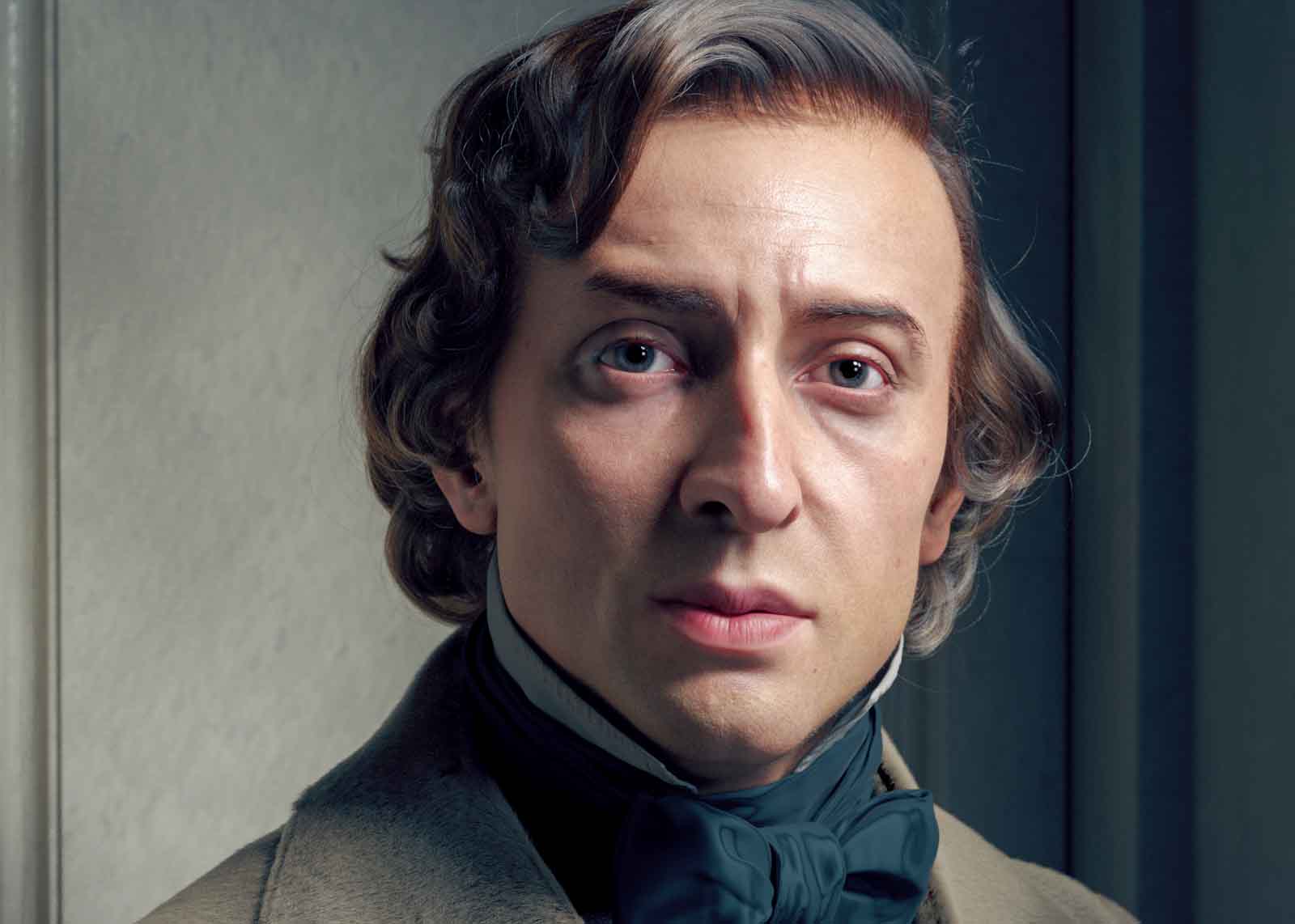
Frédéric Chopinwas born in the Duchy of Warsaw on 1 March 1810 (22 February 1810 in the Julian calendar) in the village of Żelazowa Wola, near Warsaw. His parents were Tekla Justyna Krzyżanowska, a Polish noblewoman from the Skarbek estate, and Nicolas (Mikołaj) Chopin, a Polish‐speaking Frenchman born in Lorraine. Frédéric was the second of four children (his siblings were Ludwika, Izabela, and Emilia).
Within months of his birth the family moved to Warsaw, where Nicolas Chopin secured a post teaching French at the Warsaw Lyceum and opened a boarding school for gentry children. Chopin’s early years were thus spent in Warsaw in a cultured, bilingual home; his father’s household was noted for frequent gatherings of professors and artists.
From childhood, music was a constant presence in the Chopin home. Frédéric’s mother played piano and his father played violin and flute, and the young boy “demonstrated a musical talent very early on”. His first piano teacher was family friend Wojciech Żywny, who began giving him lessons around 1816 (when Chopin was six) and continued until about 1822.
During these years Chopin was introduced to keyboard music at home by his mother and developed a fondness for the folk tunes of rural Poland. On summer holidays in the Kujawy countryside, he collected peasant songs and dances, playing local instruments and noting the distinct rhythms of Polish folk music. These early experiences with folk melodies later became a lasting influence on his musical style.
Chopin’s formal schooling took place in Warsaw. He attended the Warsaw Lyceum from 1823 until 1826, where his father was on the faculty. In the Lyceum the young Chopin received a broad education (and often spent holidays at country estates with classmates), but he continued intensive musical study outside school hours.
In the autumn of 1826 (at age 16) he entered the newly established Warsaw Conservatory of Music (then part of the Warsaw School of Music) to study music theory, harmony, and composition under the composer Józef Elsner.
Elsner, recognizing the strength of Chopin’s natural gifts, allowed him to focus on piano musicand original composition, while ensuring he acquired a solid grounding in counterpoint and theory. This blend of a musical family background, early piano instruction, and exposure to Polish folk culture formed the foundation of Chopin’s development as a musician.
| Aspect | Verified Information |
| Birth | Born on 1 March 1810 in Żelazowa Wola, near Warsaw. |
| Parents | Son of Tekla Justyna Krzyżanowska and Nicolas Chopin. |
| Childhood Home | Raised in a cultured, bilingual household in Warsaw. |
| Early Music Exposure | Introduced to music at home by his parents. |
| First Piano Teacher | Studied piano with Wojciech Żywny from about 1816. |
| Folk Influence | Exposed to Polish folk music during rural holidays. |
| Formal Schooling | Attended the Warsaw Lyceum from 1823 to 1826. |
| Music Education | Entered the Warsaw Conservatory in 1826. |
| Long-Term Health | Chopin suffered from chronic illness for many years. |
| Date of Death | He died on 17 October 1849 in Paris. |
| Age at Death | Chopin was 39 years old at the time of his death. |
| Cause of Death | The most widely accepted cause is complications related to tuberculosis. |
Career Beginnings
Frédéric Chopin first gained notice as a child prodigy in Warsaw. By his mid-teens he was already composing and publishing piano music, for example, his early polonaises and waltzes, and by age eight he was playing regular salon concerts for Warsaw’s elite.
He sold his pieces to publishers and made a name for himself within Poland’s musical circles. During these years Chopin built the foundation of his professional career: he was sought after as a piano teacher and by 1829 had completed works in most of the genres he would later master, mazurkas, nocturnes, études, etc.
His first major published piece was the Rondo in C minor, Op. 1 (1825), and he gave several important concerts in Warsaw in 1830, where he performed his own compositions and piano concertos. These early successes in Poland set the stage for his later international career.
International Breakthrough
| Event | Details |
| Warsaw Concerts (1830) | He premiered the Piano Concerto in F minor in March and the Piano Concerto in E minor in October. |
| Vienna Performances (1829) | Chopin performed successfully in Vienna, gaining international attention. |
| Paris Debut (1832) | He gave his first Paris concert at a Pleyel salon, gradually establishing his reputation. |
| Private Salon Performances | He preferred intimate aristocratic salons over large public concert halls. |
| Britain Tour (1848) | He performed in London and Scotland, including a concert before Queen Victoria. |
| Final Public Concert | His last public performance took place in London in 1848 during a charity event. |
Chopin’s first major breakthrough on the international stage came in 1829 when he traveled to Vienna. There, at age 19, he gave a series of concerts that impressed Viennese audiences and critics.
On August 11, 1829, he premiered his set of Variations on “Là ci darem la mano” for piano and orchestra in Vienna’s Kärntnertortheater, with himself at the piano. Contemporary accounts report that each variation was greeted with thunderous applause, marking a triumphant debut abroad.
His success in Vienna earned him praise from composers such as Robert Schumann, who later lauded him as a “genius.”
In late 1830 Chopin left Poland amid the November Uprising and moved to Paris (arriving in 1831). Settling in the French capital, the musical heart of Europe at the time, he gradually established himself in Parisian artistic circles.
He became known as a brilliant soloist and teacher, forging friendships with figures like Franz Lisztand Vincenzo Bellini. Chopin gave his first Paris concert in early 1832 (at the salon of piano-maker Camille Pleyel) and, after a slow start, achieved his first real acclaim later that year.
A landmark event was a private benefit concert on December 30, 1832 at the Hôtel de Monaco, where Chopin performed before Parisian nobility. This appearance is now considered the true start of his prominence in France, as it led to a steady rise in commissions, patrons, and public recognition.
Major Performances & Concert Highlights
Chopin gave relatively few public recitals in his career (approximately thirty after settling in Paris), preferring intimate salon performances. Still, several of his concerts stand out.
In Warsaw during 1830 he gave at least three major concerts of his own works: in March he introduced the Piano Concerto in F minor, Op. 21 (with himself at the keyboard), and in October he premiered the Piano Concerto in E minor, Op. 11, both accompanied by the National Theatre’s orchestra.
These Warsaw concerts showcased his most ambitious compositions and were among his final appearances in Poland.
In France, Chopin frequently performed in private concerts for aristocratic audiences rather than large public halls. He appeared often at the Pleyel salons and in gatherings hosted by the Rothschilds and other patrons.
In 1838–39 he gave the only complete concert tour outside France, spending a winter in Majorca with George Sand, although he was ill for much of that trip, he completed significant works during it.
The most notable tour of Chopin’s later career was his 1848 trip to Britain. On May 15, 1848 he performed at Stafford House (the London residence of the Duchess of Sutherland) before Queen Victoria and Prince Albert, playing solo piano amid a program of chamber music.
Contemporary reports praised his performance before royalty. Two months later, on July 7 and 15, he gave semi-public concerts in London at fashionable venues; one was held at Lord Falmouth’s London home.
Finally, on February 16, 1848 (some sources say November 16, 1848), Chopin played what proved to be his last public concert at London’s Guildhall during a charity ball for Polish refugees.
Despite frail health, he performed on a Broadwood grand piano and reportedly earned enthusiastic applause. This London recital, marking the end of his performance career, was hailed by one observer as “brilliant” even as Chopin collapsed soon after returning home.
Recordings & Discography
Chopin died long before the era of sound recording, but his music has since become one of the most-recorded repertoires in classical music. Virtually every major pianist of the 20th and 21st centuries has made landmark Chopin albums.
For example, Alfred Cortot’s 1930s recordings of the Nocturnes and Etudes remain classic interpretations, and later artists like Arthur Rubinstein, Maurizio Pollini, and Krystian Zimermaneach produced celebrated complete sets of Chopin’s solo piano works.
Major labels (such as Deutsche Grammophon, EMI, Sony, and Philips) have issued multi-disc editions of Chopin’s piano music, often spanning dozens of CDs.
In addition to studio recordings, many historic live performances of Chopin’s music have been preserved on record. These include early 20th-century piano-rolls and shellac records by Polish virtuosos, as well as later television and radio recordings of competitions and concerts.
The Fryderyk Chopin Institute in Warsaw has also supervised scholarly editions of his works and published archival recordings of famous Chopin pianistson its label.
Today new Chopin recordings continue to appear every year, featuring both established stars and young competition winners, which helps keep his catalogue fresh in the public ear.
Awards & Professional Recognition
During his lifetime Chopin did not accumulate formal awards or titles in the way modern concert artists might; composers of the Romantic era rarely held civil honors. Instead, his recognition came through public and critical acclaim.
Leading music critics of the day frequently praised his originality and skill. For example, after hearing Chopin’s Piano Concerto in E minor in Paris (1831), the influential critic François-Joseph Fétis wrote that the work was full of “spirit” and “original” themes.
Chopin also earned the respect of fellow musicians; he was invited to teach and examine at the Paris Conservatory and counted many virtuoso pianists among his admirers.
Posthumously, Chopin’s professional legacy has been celebrated by institutions worldwide. In 1926–27 the Polish government established the Fryderyk Chopin Institute and opened a museum in Warsaw to preserve his manuscripts and history.
The International Fryderyk Chopin Piano Competition, inaugurated in 1927 and held every five years in Warsaw, has since become one of the world’s most prestigious music contests, with top prizes and medals named in Chopin’s honor.
Chopin’s image and name have appeared on national currencies, postage stamps and awards, reflecting his status as a cultural icon. Thus, while he won few formal honors in life, the enduring esteem of his career is evident in the numerous memorials, competitions and academic chairs that bear his name.
Collaborations With Orchestras & Conductors
Chopin’s output was overwhelmingly for solo piano, but he did compose several works involving orchestra. His two piano concertos (in F minor, Op. 21, and in E minor, Op. 11) were both written in 1830 and premiered in Warsaw with Chopin as soloist.
The F minor Concerto debuted on 17 March 1830 at the Warsaw National Theatre, and the E minor Concerto on 11 October 1830 at the same venue. For the premiere of the E minor Concerto, the orchestra was conducted by Carlo Evasio Soliva.
Contemporary press reported that these premieres were successful, with applause for the composer’s piano playing. Chopin rarely performed with orchestras otherwise, and he never fully orchestrated most of his own pieces (he considered the orchestra a subordinate partner in these works).
In modern times, Chopin’s concertos and his small-scale concertante pieces (such as the Grande Polonaise Brillante, Op. 22, and the Allegro de Concert, Op. 46) have become staples of the symphonic repertoire.
Today, virtually every major orchestra includes Chopin’s concertos in its library, and leading conductors routinely program them with star soloists. For example, international artists like Maurizio Pollini(soloist) have performed Chopin concertos with orchestras such as the London Philharmonic or the Concertgebouw Orchestra, under conductors ranging from Claudio Abbadoto François-Xavier Roth.
The collaboration of Chopin’s piano music with orchestras continues in recordings as well:https://fxroth.com/biography/ notable examples include Krystian Zimermanplaying with the Los Angeles Philharmonic under Carlo Maria Giulini, and Alexis Weissenberg with the Warsaw Philharmonic.
In this way, Chopin’s original compositions for piano and orchestra have sustained a living performance tradition.
Recent Career Activity
Although Chopin’s personal career ended in the mid-19th century, his musical influence remains very active today. In recent years the world has marked major anniversaries of his life with concerts and scholarship.
For instance, the bicentenary of his birth in 2010 was celebrated by special festivals and new editions of his scores. More recently, 2024–2025 marked 175 years since his death, and concert halls around the world organized tributes (the Chopin Institute streamed an anniversary concert on October 17, 2024).
Chopin’s music continues to thrive in education and competition: the Chopin Institute in Warsaw offers scholarships and masterclasses in his style, and its summer academies draw young pianists from many countries.
Scholarly activity on Chopin has also seen newsworthy developments. In 2023, for example, researchers announced the discovery of a previously unknown Chopin waltz manuscript at the Morgan Library in New York, the first new Chopin composition identified in decades.
Record labels and streaming services regularly release new Chopin recordings, from historical live performances to cutting-edge interpretations. Every edition of the International Chopin Piano Competition (the 19th edition was scheduled for 2025) brings Chopin’s name into current music discourse by spotlighting young artists who specialize in his works.
In short, Chopin’s “career” after death is carried on through ongoing concerts, competitions, research, and recordings, ensuring that his musical legacy remains a living and evolving part of the classical music world.
Performance
- International concert activity (1829–1848):Performed publicly in Warsaw, Vienna, Paris, London, and Scotland, establishing an early transnational reputation as a virtuoso pianist-composer.
- Vienna concerts (1829–1830):Gave well-received public performances that introduced his original piano style to major Central European audiences.
- Paris debut and core career base (from 1832):Made a decisive impact with concerts at Salle Pleyel, one of Paris’s most prestigious venues, where he appeared multiple times during his career.
- Elite salon performances:Regularly performed in influential Parisian salons for leading cultural figures, shaping performance standards for Romantic piano music in intimate settings.
- London and Scotland tour (1848):Undertook a late-career concert tour, performing for aristocratic and public audiences, demonstrating sustained professional demand despite declining health.
- Collaborations and shared programs:Appeared in concerts associated with prominent musicians of the era, including circles connected to Franz Lisztand other leading Romantic artists.
- Performance impact:Renowned for redefining piano performance through refined touch, nuanced dynamics, and expressive rubato, influencing contemporary performers and concert expectations.
Technical Approach And Piano Control
Frédéric Chopin’s piano technique was distinguished by economy of motion, refined finger independence, and a non-percussive approach to key attack. Contemporary expert accounts consistently describe his playing as avoiding physical force, instead relying on precise finger action supported by a relaxed arm and flexible wrist.
His technical control favored suppleness over volume, allowing rapid passagework, intricate ornamentation, and wide-spanning figurations to remain clear without aggressive articulation. Chopin’s own pedagogical principles emphasized evenness of touch, controlled finger legato, and the avoidance of unnecessary muscular tension, which directly informed his technical execution at the keyboard.
Tone, Touch, And Sound Color
Chopin’s tone production was widely noted for its variety and subtle gradation rather than sheer power. Expert descriptions repeatedly emphasize his capacity to produce a singing tone that closely imitated the expressive qualities of the human voice.
His touch was characterized by sensitivity to key depth and pressure, enabling finely differentiated sound colors within a narrow dynamic range. This approach allowed inner voices, melodic lines, and harmonic shading to emerge with clarity, even in dense textures.
His sound palette relied on nuanced tonal layering rather than dramatic contrasts, reinforcing an intimate and refined sonic character.
Rhythm, Phrasing, And Structural Clarity
Chopin’s rhythmic approach combined strict structural grounding with controlled flexibility. Credible expert commentary consistently confirms that his use of tempo modification was highly disciplined, with the underlying pulse remaining stable even when surface rhythms were freely shaped.
His phrasing reflected careful attention to musical syntax, with melodic lines shaped according to harmonic direction rather than surface embellishment. Structural clarity was maintained through balanced phrase lengths and proportional timing, ensuring that expressive freedom did not disrupt formal coherence.
Interpretative Approach To Repertoire
In interpreting his own repertoire, Chopin prioritized fidelity to musical line and harmonic intent over overt dramatization. His interpretative approach avoided exaggeration, instead favoring restraint, balance, and precision.
Ornamentation was executed as an integral expressive component rather than decorative display, and melodic emphasis was carefully calibrated to preserve clarity of form. Expert analysis indicates that Chopin viewed interpretation as an extension of compositional logic, requiring disciplined control rather than subjective indulgence.
Balance Between Precision And Expression
Chopin’s playing exemplified a measured balance between technical precision and expressive nuance. His control of voicing, articulation, and timing allowed expressive elements to emerge naturally from the musical material rather than being imposed externally.
Expression was achieved through micro-level adjustments of touch, timing, and dynamics, all executed within a framework of technical exactitude. This balance ensured that expressive intent never compromised clarity, accuracy, or proportionality.
Critical Observations And Musical Identity
Critical consensus identifies Chopin’s musical identity as one grounded in refinement, restraint, and structural intelligence. His pianism was neither theatrical nor extroverted, but inwardly focused and meticulously controlled.
The defining characteristics of his style—subtle tone gradation, disciplined rhythmic flexibility, and precision of articulation—formed a cohesive interpretative philosophy centered on musical integrity. Rather than redefining pianistic power, Chopin reshaped expectations of expressive depth, demonstrating that intensity could be achieved through control, clarity, and nuanced sound rather than physical force.
Frédéric Chopin Net Worth
At the time of death, Frédéric Chopin’s net worth is estimated to have been between $1 million and $10 million. He supported himself by selling his piano compositions and by teaching piano to wealthy students (charging a high fee of one guinea per hour).
In Paris he gave few public concerts, preferring to perform in private salons for aristocratic patrons. Notably, a wealthy patron (Jane Stirling) helped support him in his final years. Major business outlets have not published any official figure, so these estimates remain unofficial.
FAQs
1. Who Was Frédéric Chopin?
Frédéric Chopin was a Polish composer and virtuoso pianist of the Romantic era, born in 1810 and active mainly in Paris. He is best known for his solo piano works, which reshaped piano technique and expression.
2. What Is Frédéric Chopin Most Famous For?
Frédéric Chopin is most famous for his piano compositions, including nocturnes, mazurkas, études, polonaises, and two piano concertos. His music is admired for its lyrical style, technical refinement, and expressive depth.
3. Where Was Frédéric Chopin Born?
Frédéric Chopin was born in Żelazowa Wola, in the Duchy of Warsaw (present-day Poland), on 1 March 1810. He spent most of his childhood and education in Warsaw before leaving Poland as a young adult.
4. Did Frédéric Chopin Mainly Perform In Public Concerts?
No, Frédéric Chopin gave relatively few public concerts during his career. He preferred performing in private salons for small, elite audiences, especially after settling in Paris.
5. How Did Frédéric Chopin Earn His Income?
Frédéric Chopin earned most of his income through teaching piano to wealthy students and publishing his compositions. Public performances were a smaller part of his professional earnings.
6. When Did Frédéric Chopin Die, And What Was The Cause Of His Death?
Frédéric Chopin died on 17 October 1849 in Paris at the age of 39. He suffered from chronic ill health for many years, and the most widely accepted cause of death is complications related to tuberculosis, though this has been discussed by medical historians.